
303 vs 304 Stainless Steel: Key Differences for Investment Casting & Industrial Applications
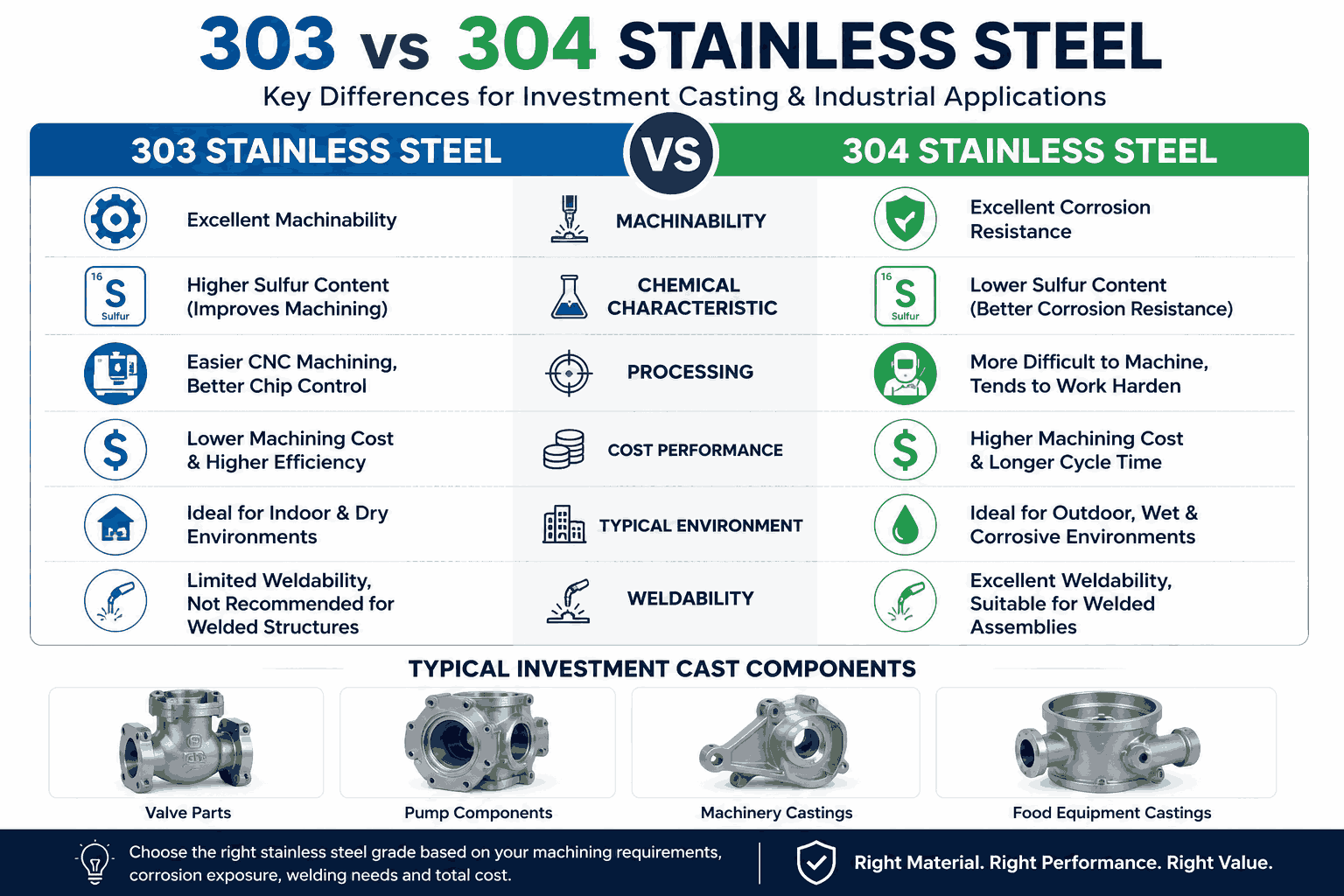
Picking the proper stainless steel directly affects how well your parts work, how smoothly production runs, and your total expenses.
303 stainless steel and 304 stainless steel are two of the most popular austenitic stainless steels.. Though their basic chemical makeup is alike, they perform quite differently during production and in actual use.
For engineers, buyers, and casting manufacturers, the challenge is straightforward:
Should you choose 303 or 304 stainless steel for your next industrial component?
The answer depends on several factors, including:
- Machining requirements
- Corrosion exposure
- Welding needs
- Mechanical performance
- Investment casting suitability
- Long-term operating costs
In this guide, we compare 303 vs 304 stainless steel from both engineering and investment casting perspectives, helping you select the most suitable material for industrial applications.
Understanding 303 and 304 Stainless Steel
Before comparing performance, it is helpful to understand what these materials have in common.
Both 303 and 304 belong to the 300-series austenitic stainless steel family. They contain high chromium and nickel content, providing excellent corrosion resistance and non-magnetic properties in the annealed condition.
Common characteristics include:
- Austenitic microstructure
- Good toughness
- Excellent formability
- High ductility
- Good oxidation resistance
- Suitable for many industrial environments
The primary difference lies in one important alloying element:
Sulfur.
303 stainless steel contains additional sulfur to improve machining performance. This modification makes machining easier but also affects corrosion resistance, weldability, and casting behavior.
Chemical Composition Comparison
The following table highlights the key composition differences.
| Element | 303 Stainless Steel (%) | 304 Stainless Steel (%) |
| Chromium (Cr) | 17.0–19.0 | 18.0–20.0 |
| Nickel (Ni) | 8.0–10.0 | 8.0–10.5 |
| Carbon (C) | ≤0.15 | ≤0.08 |
| Manganese (Mn) | ≤2.0 | ≤2.0 |
| Silicon (Si) | ≤1.0 | ≤1.0 |
| Sulfur (S) | 0.15 min | ≤0.03 |
| Phosphorus (P) | ≤0.20 | ≤0.045 |
Why Sulfur Matters
The increased sulfur content in 303 forms manganese sulfide inclusions throughout the material.
These inclusions:
Improve
- Chip breaking
- Machining speed
- Tool life
Reduce
- Corrosion resistance
- Weldability
- Surface finish quality in corrosive environments
This single composition change explains most performance differences between the two grades.
303 vs 304 Stainless Steel: Key Property Comparison
Machinability
For many manufacturers, machinability is the biggest reason to select 303 stainless steel.
303 Stainless Steel Advantages
303 is often considered one of the easiest stainless steels to machine.
Benefits include:
- Faster cutting speeds
- Better chip control
- Reduced tool wear
- Lower machining costs
- Higher production efficiency
Many machine shops use 303 when producing:
- Shafts
- Bushings
- Fasteners
- Fittings
- Precision-machined components
304 Stainless Steel Challenges
304 is significantly more difficult to machine.
During machining, it tends to:
- Work harden quickly
- Generate more heat
- Produce stringy chips
- Increase tool wear
As a result, machining operations often require:
- Lower cutting speeds
- More rigid tooling
- Increased machining time
Machinability Comparison
| Property | 303 | 304 |
| Relative Machinability | 78% | 45% |
| Tool Life | Better | Lower |
| Chip Formation | Excellent | Moderate |
| Machining Cost | Lower | Higher |
Investment Casting Perspective
When a casting requires extensive secondary machining, 303 may reduce total manufacturing cost.
However, machinability should never be the only selection criterion.
Corrosion Resistance
Corrosion resistance is where 304 stainless steel clearly outperforms 303.
Why 304 Performs Better
The low sulfur content of 304 allows for a more uniform passive chromium oxide layer on the surface.
This protective film provides excellent resistance against:
- Moisture
- Industrial atmospheres
- Cleaning chemicals
- Food processing environments
- Mild chemical exposure
Typical 304 Applications
- Food equipment
- Kitchen hardware
- Pharmaceutical machinery
- Water treatment equipment
- Architectural components
The sulfur inclusions that improve machining also create localized weak points.
Limitations of 303
As a result, 303 is more susceptible to:
- Pitting corrosion
- Crevice corrosion
- Surface staining
- Chemical attack
Avoid 303 In
- Marine environments
- Coastal installations
- Chloride exposure
- Chemical processing systems
- Aggressive cleaning applications
Corrosion Resistance Comparison
| Environment | 303 | 304 |
| Indoor Dry Conditions | Excellent | Excellent |
| Humid Environment | Good | Excellent |
| Food Processing | Fair | Excellent |
| Marine Atmosphere | Poor | Better |
| Chemical Exposure | Moderate | Good |
For most corrosion-sensitive applications, 304 is the preferred choice.
Weldability Comparison
Welding performance is another major differentiator.
304 Stainless Steel
304 offers excellent weldability using standard welding processes:
- TIG welding
- MIG welding
- Resistance welding
- Laser welding
Advantages include:
- Stable weld quality
- Good joint strength
- Lower cracking risk
- Reliable long-term performance
This makes 304 a common material for fabricated equipment and welded assemblies.
303 Stainless Steel
303 is generally not recommended for welded structures.
The sulfur content can cause:
- Hot cracking
- Porosity
- Reduced weld integrity
- Lower corrosion resistance near weld zones
When welding cannot be avoided, special procedures may be required.
Weldability Comparison
| Property | 303 | 304 |
| Weldability | Fair to Poor | Excellent |
| Crack Resistance | Lower | Higher |
| Structural Welding | Not Preferred | Recommended |
| Fabrication Flexibility | Limited | High |
Mechanical Properties Comparison
Despite their compositional differences, the mechanical properties of 303 and 304 are relatively similar.
| Property | 303 Stainless Steel | 304 Stainless Steel |
| Tensile Strength | ~620 MPa | ~515–620 MPa |
| Yield Strength | ~240 MPa | ~205–215 MPa |
| Elongation | ~50% | ~40–60% |
| Hardness (HB) | ~190 | ~201 |
| Density | 8.0 g/cm³ | 8.0 g/cm³ |
What This Means
Both materials provide:
- Good toughness
- High ductility
- Reliable structural performance
Material selection is usually driven more by:
- Corrosion requirements
- Machining requirements
- Welding requirements
rather than strength differences.
Cost Comparison
Many buyers focus only on raw material price, but total manufacturing cost tells a more complete story.
Raw Material Cost
In most markets:
- 303 and 304 have similar base alloy costs.
- 304 may occasionally cost slightly less due to wider availability.
Manufacturing Cost
Machining costs often create the biggest difference.
303 Benefits
- Faster production
- Lower tooling consumption
- Reduced machine time
304 Challenges
- Longer cycle times
- Higher tooling expenses
- Increased labor cost
Total Cost Consideration
| Cost Factor | 303 | 304 |
| Material Cost | Similar | Similar |
| Machining Cost | Lower | Higher |
| Welding Cost | Higher | Lower |
| Corrosion Maintenance | Higher | Lower |
The lowest-cost solution depends on the specific application rather than material price alone.
303 vs 304 for Investment Casting
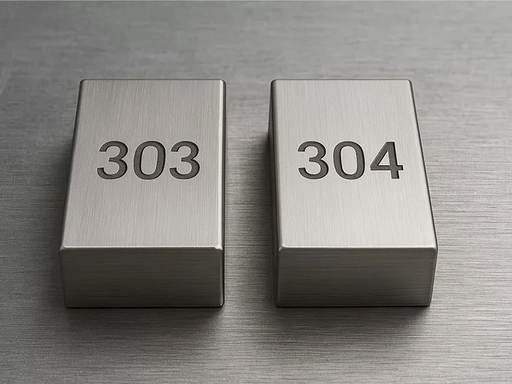
Material behavior during casting is an important consideration for foundries and OEM buyers.
When 303 Stainless Steel Is Suitable
303 investment castings are commonly selected when:
- Extensive machining is required
- Corrosion exposure is limited
- High-volume production is needed
- Precision-machined features dominate the design
Typical examples include:
- Machine components
- Valve accessories
- Instrument fittings
- Fasteners
- Mechanical hardware
When 304 Stainless Steel Is Better
304 investment castings are preferred when:
- Corrosion resistance is critical
- Welded assemblies are required
- Products operate outdoors
- Components contact water or chemicals
Typical examples include:
- Pump castings
- Food machinery parts
- Marine hardware
- Industrial valves
- Process equipment components
Typical Industrial Applications
Common Applications for 303 Stainless Steel
Automotive Components
- Precision shafts
- Sensor housings
- Fasteners
Industrial Equipment
- Bushings
- Couplings
- Threaded fittings
Machined Hardware
- Screws
- Nuts
- Instrument parts
303 is often selected where machining efficiency is the highest priority.
Common Applications for 304 Stainless Steel
Food Processing Equipment
- Mixers
- Conveyors
- Processing machinery
Chemical Equipment
- Tanks
- Valves
- Piping components
Marine and Outdoor Equipment
- Hardware
- Structural fittings
- Water-contact components
Medical Equipment
- Non-implant components
- Equipment housings
304 is generally preferred when corrosion resistance determines service life.
How to Choose Between 303 and 304 Stainless Steel
The following guidelines can simplify material selection.
Choose 303 Stainless Steel If:
✓ Machining efficiency is critical
✓ Production volume is high
✓ Corrosion exposure is minimal
✓ Welded construction is not required
✓ Reducing machining cost is a priority
Choose 304 Stainless Steel If:
✓ Corrosion resistance is important
✓ Components operate outdoors
✓ Water or chemicals are present
✓ Welding is required
✓ Long-term durability matters
Why Choose JC CASTING for Stainless Steel Investment Castings?
The debate between 303 vs 304 stainless steel is not about identifying a universally superior material. It is about matching material characteristics to application requirements.
At JC CASTING, we regularly manufacture precision investment castings for customers across:
- Industrial machinery
- Valve and pump industries
- Food processing equipment
- Marine systems
- Petrochemical applications
- Automotive manufacturing
Our engineering experience shows that neither 303 nor 304 is universally better.
The correct material depends on:
- Service environment
- Corrosion requirements
- Machining volume
- Structural design
- Total lifecycle cost
JC CASTING’s engineering team helps customers evaluate material performance, casting manufacturability, machining requirements, and overall project economics before production begins.
Over the years, JC CASTING has supported customers across multiple industries by providing precision-cast stainless steel components tailored to demanding operating environments.
Case Study : 303 Stainless Steel Valve Actuator Components
A North American industrial equipment manufacturer required a large volume of precision-machined actuator components.
Challenge
- Tight dimensional tolerances
- Significant post-casting machining
- Cost reduction target
- Indoor operating environment
Solution
Our engineering team recommended 303 stainless steel investment castings due to the component’s heavy machining requirements and limited corrosion exposure.
Results
- Improved machining efficiency
- Reduced tooling wear
- Lower overall manufacturing costs
- Consistent dimensional accuracy across production batches
The customer achieved a measurable reduction in machining time while maintaining required performance standards.
Contact JC CASTING today to discuss your project and receive a professional quotation.
303 vs 304 Stainless Steel: Key Differences for Investment Casting & Industrial Applications
303 vs 304 Stainless Steel: Key Differences for Investment Casting & Industrial Applications
Selecting the right stainless steel grade can significantly impact product performance, manufacturing efficiency, and total project cost.
Among the most commonly specified austenitic stainless steels, 303 stainless steel and 304 stainless steel are often compared because they share similar chemical foundations but deliver very different manufacturing and service characteristics.
For engineers, buyers, and casting manufacturers, the challenge is straightforward:
Should you choose 303 or 304 stainless steel for your next industrial component?
The answer depends on several factors, including:
- Machining requirements
- Corrosion exposure
- Welding needs
- Mechanical performance
- Investment casting suitability
- Long-term operating costs
In this guide, we compare 303 vs 304 stainless steel from both engineering and investment casting perspectives, helping you select the most suitable material for industrial applications.
Understanding 303 and 304 Stainless Steel
Before comparing performance, it is helpful to understand what these materials have in common.
Both 303 and 304 belong to the 300-series austenitic stainless steel family. They contain high chromium and nickel content, providing excellent corrosion resistance and non-magnetic properties in the annealed condition.
Common characteristics include:
- Austenitic microstructure
- Good toughness
- Excellent formability
- High ductility
- Good oxidation resistance
- Suitable for many industrial environments
The primary difference lies in one important alloying element:
Sulfur.
303 stainless steel contains additional sulfur to improve machining performance. This modification makes machining easier but also affects corrosion resistance, weldability, and casting behavior.
Chemical Composition Comparison
The following table highlights the key composition differences.
| Element | 303 Stainless Steel (%) | 304 Stainless Steel (%) |
| Chromium (Cr) | 17.0–19.0 | 18.0–20.0 |
| Nickel (Ni) | 8.0–10.0 | 8.0–10.5 |
| Carbon (C) | ≤0.15 | ≤0.08 |
| Manganese (Mn) | ≤2.0 | ≤2.0 |
| Silicon (Si) | ≤1.0 | ≤1.0 |
| Sulfur (S) | 0.15 min | ≤0.03 |
| Phosphorus (P) | ≤0.20 | ≤0.045 |
Why Sulfur Matters
The increased sulfur content in 303 forms manganese sulfide inclusions throughout the material.
These inclusions:
Improve
- Chip breaking
- Machining speed
- Tool life
Reduce
- Corrosion resistance
- Weldability
- Surface finish quality in corrosive environments
This single composition change explains most performance differences between the two grades.
303 vs 304 Stainless Steel: Key Property Comparison
Machinability
For many manufacturers, machinability is the biggest reason to select 303 stainless steel.
303 Stainless Steel Advantages
303 is often considered one of the easiest stainless steels to machine.
Benefits include:
- Faster cutting speeds
- Better chip control
- Reduced tool wear
- Lower machining costs
- Higher production efficiency
Many machine shops use 303 when producing:
- Shafts
- Bushings
- Fasteners
- Fittings
- Precision-machined components
304 Stainless Steel Challenges
304 is significantly more difficult to machine.
During machining, it tends to:
- Work harden quickly
- Generate more heat
- Produce stringy chips
- Increase tool wear
As a result, machining operations often require:
- Lower cutting speeds
- More rigid tooling
- Increased machining time
Machinability Comparison
| Property | 303 | 304 |
| Relative Machinability | 78% | 45% |
| Tool Life | Better | Lower |
| Chip Formation | Excellent | Moderate |
| Machining Cost | Lower | Higher |
Investment Casting Perspective
When a casting requires extensive secondary machining, 303 may reduce total manufacturing cost.
However, machinability should never be the only selection criterion.
Corrosion Resistance
Corrosion resistance is where 304 stainless steel clearly outperforms 303.
Why 304 Performs Better
The low sulfur content of 304 allows for a more uniform passive chromium oxide layer on the surface.
This protective film provides excellent resistance against:
- Moisture
- Industrial atmospheres
- Cleaning chemicals
- Food processing environments
- Mild chemical exposure
Typical 304 Applications
- Food equipment
- Kitchen hardware
- Pharmaceutical machinery
- Water treatment equipment
- Architectural components
Limitations of 303
The sulfur inclusions that improve machining also create localized weak points.
As a result, 303 is more susceptible to:
- Pitting corrosion
- Crevice corrosion
- Surface staining
- Chemical attack
Avoid 303 In
- Marine environments
- Coastal installations
- Chloride exposure
- Chemical processing systems
- Aggressive cleaning applications
Corrosion Resistance Comparison
| Environment | 303 | 304 |
| Indoor Dry Conditions | Excellent | Excellent |
| Humid Environment | Good | Excellent |
| Food Processing | Fair | Excellent |
| Marine Atmosphere | Poor | Better |
| Chemical Exposure | Moderate | Good |
For most corrosion-sensitive applications, 304 is the preferred choice.
Weldability Comparison
Welding performance is another major differentiator.
304 Stainless Steel
304 offers excellent weldability using standard welding processes:
- TIG welding
- MIG welding
- Resistance welding
- Laser welding
Advantages include:
- Stable weld quality
- Good joint strength
- Lower cracking risk
- Reliable long-term performance
This makes 304 a common material for fabricated equipment and welded assemblies.
303 Stainless Steel
303 is generally not recommended for welded structures.
The sulfur content can cause:
- Hot cracking
- Porosity
- Reduced weld integrity
- Lower corrosion resistance near weld zones
When welding cannot be avoided, special procedures may be required.
Weldability Comparison
| Property | 303 | 304 |
| Weldability | Fair to Poor | Excellent |
| Crack Resistance | Lower | Higher |
| Structural Welding | Not Preferred | Recommended |
| Fabrication Flexibility | Limited | High |
Mechanical Properties Comparison
Despite their compositional differences, the mechanical properties of 303 and 304 are relatively similar.
| Property | 303 Stainless Steel | 304 Stainless Steel |
| Tensile Strength | ~620 MPa | ~515–620 MPa |
| Yield Strength | ~240 MPa | ~205–215 MPa |
| Elongation | ~50% | ~40–60% |
| Hardness (HB) | ~190 | ~201 |
| Density | 8.0 g/cm³ | 8.0 g/cm³ |
What This Means
Both materials provide:
- Good toughness
- High ductility
- Reliable structural performance
Material selection is usually driven more by:
- Corrosion requirements
- Machining requirements
- Welding requirements
rather than strength differences.
Cost Comparison
Many buyers focus only on raw material price, but total manufacturing cost tells a more complete story.
Raw Material Cost
In most markets:
- 303 and 304 have similar base alloy costs.
- 304 may occasionally cost slightly less due to wider availability.
Manufacturing Cost
Machining costs often create the biggest difference.
303 Benefits
- Faster production
- Lower tooling consumption
- Reduced machine time
304 Challenges
- Longer cycle times
- Higher tooling expenses
- Increased labor cost
Total Cost Consideration
| Cost Factor | 303 | 304 |
| Material Cost | Similar | Similar |
| Machining Cost | Lower | Higher |
| Welding Cost | Higher | Lower |
| Corrosion Maintenance | Higher | Lower |
The lowest-cost solution depends on the specific application rather than material price alone.
303 vs 304 for Investment Casting
Material behavior during casting is an important consideration for foundries and OEM buyers.
When 303 Stainless Steel Is Suitable
303 investment castings are commonly selected when:
- Extensive machining is required
- Corrosion exposure is limited
- High-volume production is needed
- Precision-machined features dominate the design
Typical examples include:
- Machine components
- Valve accessories
- Instrument fittings
- Fasteners
- Mechanical hardware
When 304 Stainless Steel Is Better
304 investment castings are preferred when:
- Corrosion resistance is critical
- Welded assemblies are required
- Products operate outdoors
- Components contact water or chemicals
Typical examples include:
- Pump castings
- Food machinery parts
- Marine hardware
- Industrial valves
- Process equipment components
Typical Industrial Applications
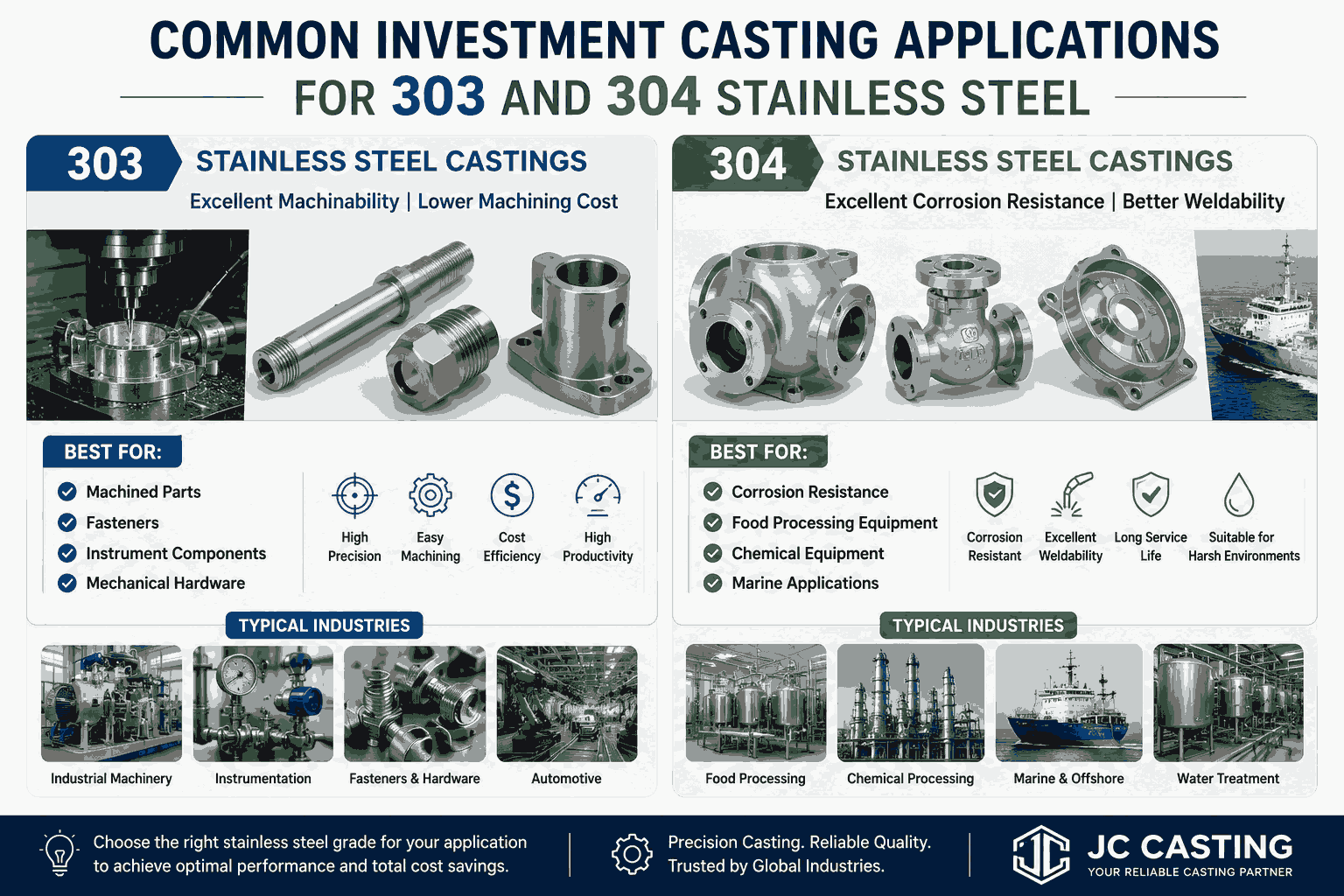
Common Applications for 303 Stainless Steel
Automotive Components
- Precision shafts
- Sensor housings
- Fasteners
Industrial Equipment
- Bushings
- Couplings
- Threaded fittings
Machined Hardware
- Screws
- Nuts
- Instrument parts
303 is often selected where machining efficiency is the highest priority.
Common Applications for 304 Stainless Steel
Food Processing Equipment
- Mixers
- Conveyors
- Processing machinery
Chemical Equipment
- Tanks
- Valves
- Piping components
Marine and Outdoor Equipment
- Hardware
- Structural fittings
- Water-contact components
Medical Equipment
- Non-implant components
- Equipment housings
304 is generally preferred when corrosion resistance determines service life.
How to Choose Between 303 and 304 Stainless Steel
The following guidelines can simplify material selection.
Choose 303 Stainless Steel If:
✓ Machining efficiency is critical
✓ Production volume is high
✓ Corrosion exposure is minimal
✓ Welded construction is not required
✓ Reducing machining cost is a priority
Choose 304 Stainless Steel If:
✓ Corrosion resistance is important
✓ Components operate outdoors
✓ Water or chemicals are present
✓ Welding is required
✓ Long-term durability matters
Why Choose JC CASTING for Stainless Steel Investment Castings?
The debate between 303 vs 304 stainless steel is not about identifying a universally superior material. It is about matching material characteristics to application requirements.
At JC CASTING, we regularly manufacture precision investment castings for customers across:
- Industrial machinery
- Valve and pump industries
- Food processing equipment
- Marine systems
- Petrochemical applications
- Automotive manufacturing
Our engineering experience shows that neither 303 nor 304 is universally better.
The correct material depends on:
- Service environment
- Corrosion requirements
- Machining volume
- Structural design
- Total lifecycle cost
JC CASTING’s engineering team helps customers evaluate material performance, casting manufacturability, machining requirements, and overall project economics before production begins.
Over the years, JC CASTING has supported customers across multiple industries by providing precision-cast stainless steel components tailored to demanding operating environments.
Case Study : 303 Stainless Steel Valve Actuator Components
A North American industrial equipment manufacturer required a large volume of precision-machined actuator components.
Challenge
- Tight dimensional tolerances
- Significant post-casting machining
- Cost reduction target
- Indoor operating environment
Solution
Our engineering team recommended 303 stainless steel investment castings due to the component’s heavy machining requirements and limited corrosion exposure.
Results
- Improved machining efficiency
- Reduced tooling wear
- Lower overall manufacturing costs
- Consistent dimensional accuracy across production batches
The client was able to reduce machining time noticeably, all while keeping performance right where it needed to be.
For free to contact JC CASTING today to discuss your project and receive a professional quotation.