When comparing die casting vs investment casting, engineers and buyers are not just searching for definitions — they are looking for real manufacturing capabilities, real products, and reliable foundries.That is exactly where JC Casting comes in.
In this article, we will break down the key differences, advantages, limitations, costs, materials, and applications of die casting and investment casting—so you can confidently select the right process for your project.
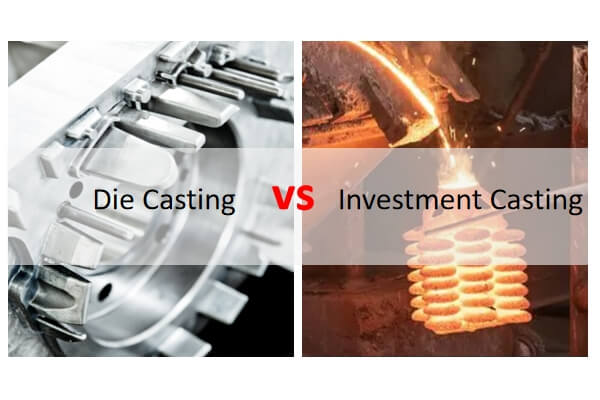
What Is Die Casting?
Die casting is a manufacturing process in which molten metal is injected into a reusable steel mold (die) under high pressure. The metal solidifies quickly, producing parts with excellent dimensional accuracy and surface finish.
Key Characteristics of Die Casting
- High-pressure injection (up to 25,000 psi)
- Steel molds (dies) designed for high-volume production
- Fast cycle times
- Excellent repeatability
Common Die Casting Materials
Die casting is primarily used for non-ferrous metals, including:
- Aluminum alloys
- Zinc alloys
- Magnesium alloys
Steel and stainless steel cannot be die cast due to their high melting temperatures.
What Is Investment Casting?
Investment casting, also known as lost wax casting, is a precision casting process where a wax pattern is coated with ceramic material to form a shell. Once hardened, the wax is melted away, and molten metal is poured into the cavity.
Key Characteristics of Investment Casting
- Extremely high dimensional accuracy
- Excellent surface finish
- Ability to cast complex geometries
- Suitable for a wide range of metals
Common Investment Casting Materials
Investment casting supports both ferrous and non-ferrous metals, including:
- Stainless steel
- Carbon steel
- Alloy steel
- Heat-resistant alloys
- Aluminum and bronze
This makes investment casting ideal for high-performance and corrosive environments.
Die Casting vs Investment Casting: Key Differences
1. Materials Compatibility
One of the biggest differences between die casting and investment casting is material selection.
- Die casting: Limited to low-melting-point non-ferrous metals
- Investment casting: Supports stainless steel, alloy steel, and high-temperature materials
If your application requires strength, corrosion resistance, or high-temperature performance, investment casting is the clear winner.
2. Design Complexity
Investment casting allows for:
- Thin walls
- Internal passages
- Complex shapes
- Sharp corners and fine details
Die casting also offers good accuracy, but complex internal geometries often require secondary machining.
For complex valve bodies, pump components, or precision mechanical parts, investment casting offers greater design freedom.
3. Surface Finish and Accuracy
| Feature | Die Casting | Investment Casting |
|---|---|---|
| Surface Finish | Excellent | Excellent |
| Tolerances | Tight | Extremely tight |
| Post Machining | Minimal | Often minimal |
Investment casting often achieves near-net-shape parts, reducing machining costs—especially for stainless steel components.
4. Production Volume and Cost
- Die casting requires expensive steel molds, making it cost-effective only for high-volume production
- Investment casting uses lower-cost tooling, making it ideal for:
- Low to medium volumes
- Custom parts
- Prototyping and small batches
If you are producing tens of thousands of parts, die casting may be cheaper per unit. For lower volumes or frequent design changes, investment casting is more economical.
5. Mechanical Properties
Investment cast parts typically offer:
- Higher tensile strength
- Better fatigue resistance
- Superior corrosion resistance (especially stainless steel)
Die casting parts may contain internal porosity due to trapped gases, which can limit pressure resistance and welding capability.
This is a critical factor for valves, pumps, and pressure-containing components.
Applications: When to Choose Each Process
Choose Die Casting If:
- You need high-volume production
- The part is made from aluminum or zinc
- Cost per unit is the top priority
- The design is relatively simple
Typical industries:
- Automotive
- Consumer electronics
- Lighting housings
Choose Investment Casting If:
- You need stainless steel or alloy steel parts
- The application involves corrosion, pressure, or heat
- Complex geometry is required
- High mechanical performance is critical
Typical industries:
- Valve and pump manufacturing
- Oil & gas
- Chemical processing
- Food and pharmaceutical equipment
- Aerospace and industrial machinery
Die Casting vs Investment Casting: Which Is Better?
There is no “one-size-fits-all” answer.
- Die casting is better for speed and volume
- Investment casting is better for performance, materials, and precision
The right choice depends on:
- Material requirements
- Operating environment
- Annual production volume
- Cost vs performance priorities
Why Investment Casting Is Preferred for Valves and Stainless Steel Parts
For valve components, investment casting offers clear advantages:
- Uniform wall thickness
- Excellent pressure integrity
- Superior corrosion resistance
- Reliable performance in harsh environments
This is why most industrial valves, pump bodies, and flow control components are produced using stainless steel investment casting rather than die casting.
FAQ: Die Casting vs Investment Casting
Can JC Casting supply both die casting and investment casting parts?
What casting process is best for valve bodies?
Which process offers better corrosion resistance?
Is investment casting more expensive than die casting?
Can stainless steel be die cast?
Which casting process is stronger?
Final Thoughts
When comparing die casting vs investment casting, the real question is not which process is cheaper — but which process is right for your product. With JC Casting, you don’t have to compromise.
As a trusted investment casting foundry and die casting foundry, we can help you choose the optimal process, reduce failures, and improve product performance.