
Investment Casting vs Sand Casting: Key Differences, Costs, and Applications
When manufacturers compare investment casting vs sand casting, they are not just looking for definitions — they are evaluating which casting process and foundry can truly meet their technical and commercial requirements. That is why choosing the right foundry matters as much as choosing the right process.
JC Casting is both an investment casting foundry and a sand casting foundry, offering customers flexible solutions based on part size, material, precision level, and production volume.
This article explains the real differences between investment casting and sand casting, with practical guidance on when each process should be used.
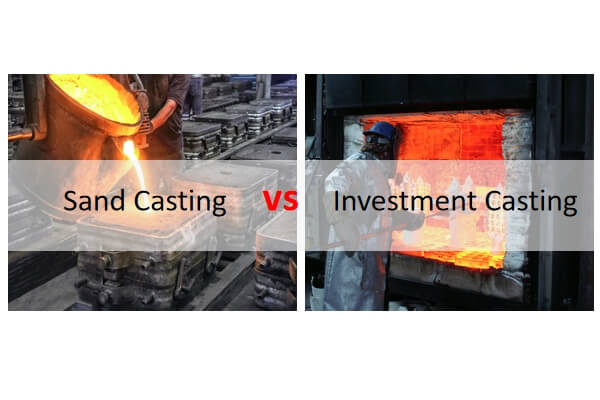
What Is Investment Casting?
Investment casting, also known as lost wax casting, is a precision casting process that uses wax patterns and ceramic shells to achieve near-net-shape components with excellent accuracy and surface finish.
Key Characteristics of Investment Casting
- High dimensional accuracy
- Smooth surface finish
- Ability to cast complex geometries
- Reduced machining requirements
Investment Casting at JC Casting
As a professional investment casting foundry, JC Casting specializes in stainless steel and alloy steel precision components, especially for demanding industrial environments.
Typical investment casting products include:
- Stainless steel valve bodies
- Pump casings and impellers
- Pipe fittings
- Flow control components
Investment casting is the preferred solution when precision, corrosion resistance, and pressure performance are critical.
What Is Sand Casting?
Sand casting is one of the most traditional and widely used metal casting processes. It uses sand molds to form the cavity, into which molten metal is poured. After solidification, the mold is broken to remove the casting.
Key Characteristics of Sand Casting
- Low tooling cost
- Suitable for large and heavy components
- Broad material compatibility
- Flexible for low-volume production
Sand Casting at JC Casting
As an experienced sand casting foundry, JC Casting produces carbon steel, stainless steel, and alloy steel sand castings for applications where part size and structural strength matter more than surface finish.
Typical sand casting products from JC Casting include:
- Large pump housings
- Machine bases
- Structural brackets
- Heavy industrial components
Sand casting is often the most economical choice for large, simple, and thick-walled parts.
Investment Casting vs Sand Casting: Key Differences
1. Dimensional Accuracy and Tolerances
Accuracy is one of the most important differences between the two processes.
- Investment casting:
Tight tolerances and near-net-shape results. - Sand casting:
Looser tolerances, extensive machining often required.
At JC Casting, customers often start with sand casting for prototypes or large parts, then transition to investment casting when tighter tolerances are required.
2. Surface Finish
- Investment casting produces a smooth, refined surface suitable for sealing and fluid flow.
- Sand casting produces a relatively rough surface due to the sand mold texture.
This is why valves, pumps, and pressure-containing components are rarely sand cast when investment casting is available.
3. Design Complexity
Investment casting supports:
- Thin walls
- Internal channels
- Complex flow paths
- Integrated features
Sand casting is better suited for:
- Simple geometry
- Thick walls
- Large dimensions
JC Casting helps customers evaluate designs early to determine whether investment casting or sand casting will deliver the best cost-performance balance.
4. Materials and Mechanical Properties
Both investment casting and sand casting support steel and stainless steel, but results differ:
- Investment casting:
Dense microstructure, better mechanical consistency, and superior corrosion resistance. - Sand casting:
Coarser grain structure and higher variability.
For applications involving pressure, chemicals, or temperature cycling, JC Casting recommends investment casting.
5. Cost Structure and Production Volume
| Factor | Investment Casting | Sand Casting |
|---|---|---|
| Tooling Cost | Medium | Low |
| Machining Cost | Low | High |
| Ideal Volume | Low to medium | Low |
| Precision Level | High | Medium |
As both an investment casting foundry and sand casting foundry, JC Casting can recommend the most economical process without bias.
Typical Applications by Process
Investment Casting Applications
- Stainless steel valve bodies
- Pump casings and impellers
- Chemical processing components
- Food and pharmaceutical equipment parts
Sand Casting Applications
- Large pump housings
- Industrial machine frames
- Structural steel components
- Heavy equipment parts
Investment Casting vs Sand Casting: Which Is Right for You?
Choose investment casting if:
- Precision and surface quality matter
- Complex geometry is required
- Corrosion or pressure resistance is critical
Choose sand casting if:
- The part is large and simple
- Precision is not critical
- Initial tooling cost must be minimal
JC Casting supports both processes, allowing customers to scale, optimize, and upgrade without changing suppliers.
Why Many Customers Choose JC Casting
- One foundry for investment casting and sand casting
- Strong experience with stainless steel components
- Engineering support from design to production
- Stable quality and consistent delivery
Whether you need high-precision investment cast parts or large sand cast components, JC Casting provides the right process for your application.
When evaluating investment casting vs sand casting, the correct choice depends on design complexity, performance requirements, and total cost — not just unit price.
By working with a foundry like JC Casting, which offers both investment casting and sand casting, manufacturers can reduce risk, control costs, and achieve better long-term performance.