
Water Glass Casting VS Silica Sol Casting: Key Differences, Costs, and Applications
In modern precision casting, manufacturers often face a choice between Water Glass Casting and Silica Sol Casting. Choosing the right method is critical for product performance, cost-efficiency, and durability. JC Casting, a professional casting foundry, offers both Water Glass Casting and Silica Sol Casting solutions, providing flexible options for part size, material, and precision requirements.
This article explains the core differences, advantages, and typical applications of these two processes to help manufacturers make the right decision.
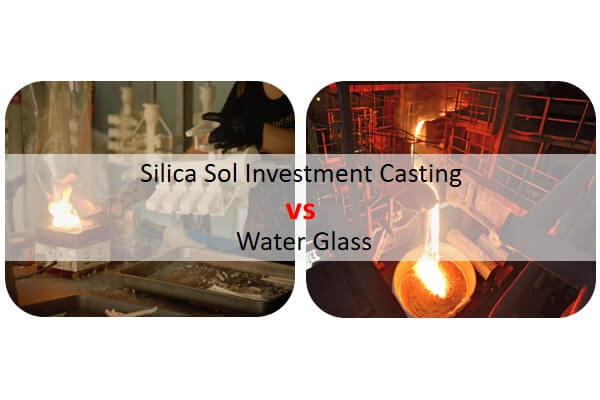
1. What Is Water Glass Casting?
Water glass casting involves water glass quartz sand as the molding substance. It can endure temperatures up to 1800 degrees Fahrenheit. It is more costly than wet clay sand and uses a different technique called “water glass method.” Water glass de-waxes in the high-temperature water, and the ceramic mold is formed of water glass quartz sand.The process is fast, cost-effective, and suitable for medium to large-sized castings.
The density of Water glass is the highest and has the greatest viscosity. The coating powder-liquid ratio is lower, there are more flaws, and it has greater viscosity.
Key Advantages
- Lower cost compared to silica sol casting
- Fast mold preparation
- Suitable for medium and large-sized castings
- Easy to modify mold geometry
Typical Products
- Pump housings
- Valve bodies
- Large structural components
JC Casting uses Water Glass Casting for applications where cost-effectiveness and quick turnaround are critical without compromising overall structural integrity.
2. What Is Silica Sol Casting?
Silica Sol Casting, also known as colloidal silica or chemical bonded casting, is a precision casting process that produces highly accurate, smooth, and intricate castings. The silica sol casting process uses zircon sand as the molding material. This can tolerate temperatures up to 2000 degrees Fahrenheit. This molding material is quite costly.
Silica sol is a milky colloid. Because the colloid grains are tiny (10-20 micrometer) and have a large surface area, they do not interfere with the materials’ natural color.
Silica sol is soluble in water and not in organic solvent. It may be mixed with any proportion of alcohol or water to dissolve. The unique feature is that, because of its low viscosity, it can soak the regions where water soaks. This results in excellent dispersion and permeability when combined with other substances. When the moisture evaporated from silica sol, colloid grains adhere firmly to the material’s surface. After that, a combination of silicon and oxygen is formed between grains as a result of this evaporation. It has good adhesive properties.
Key Advantages
- High dimensional accuracy
- Excellent surface finish
- Can cast thin walls and complex geometries
- Minimal post-machining required
Typical Products
- Precision valve components
- Pump impellers
- Flow control devices
- Chemical processing parts
JC Casting specializes in Silica Sol Casting for applications requiring high precision, fine surface finish, and complex internal flow channels.
3. Water Glass Casting VS Silica Sol Casting: Key Differences
The most popular investment casting processes today are water glass and silica sol investment casting. The major differences between the two are in the surface roughness and cost of production. The water glass technique de-waxes into a high-temperature bath, while the ceramic mold is made of water glass quartz sand. Silica sol method de-waxes into a flash fire, while silica sol zircon sand is used to make the ceramic mold.
Investment casting is a method of casting. It can be used to create everything from tiny castings weighing less than a few ounces to large castings weighing hundreds of pounds. It’s more expensive than die or sand casting. However, its per-unit costs decrease as production volumes rise. Investment casting allows you to make complicated forms. It also enables the creation of products with exceptional surface features and tight tolerances. It only needs little surface finishing or machining needed.
In terms of shell dry process, the two differ significantly. The drying process in silica sol shell is natural and takes place at constant temperature and humidity levels. which necessitates more time and money. Water glass shell is dried using a chemical hardener.
Here’s a table showing a summary of the differences between Silica-Sol Casting and Water Glass Casting
| WATER GLASS INVESTMENT CASTING | SILICA SOL INVESTMENT CASTING | |
| Unit Weight | 0.1 – 100kg | 0.1 – 100kg |
| Size Limitation | 0.01 – 0.5 meter | 0.01 – 0.5 meter |
| Complexity | Complex | Very complex |
| Wall Thickness | >3mm | >1mm |
| Cost | High | Low |
| Machining | Needs less machining | Needs more machining |
| Material | Stainless Steel | Carbon and Alloy Steel |
| Typical Applications | Pump housings, valve bodies, large structural components | Precision valves, impellers, chemical equipment |
4. Which Casting Method Should You Choose?
Choose Water Glass Casting if:
- Cost-efficiency is the priority
- Parts are medium to large and simple
- Fast mold preparation is required
Choose Silica Sol Casting if:
- Precision and surface quality are critical
- Thin walls or complex internal geometries are required
- Corrosion resistance or fine details are essential
In a word.
Water Glass Casting is ideal for medium-to-large, simple parts with faster turnaround.
Silica Sol Casting excels in precision, surface finish, and complex geometries.
JC Casting, offering both methods, helps manufacturers select the optimal casting process based on performance, material, and cost considerations.
5. Why Choose JC Casting?
- Expertise in both Water Glass Casting and Silica Sol Casting
- High-quality stainless steel and alloy castings
- Engineering support from design to production
- Reliable quality, consistency, and on-time delivery
Whether you need medium-to-large structural components via Water Glass Casting or precision, high-finish parts via Silica Sol Casting. By working with a foundry like JC Casting, which offers both processes, manufacturers can reduce risk, optimize costs, and achieve long-term reliability in their casting operations.