When it comes to manufacturing processes, die casting and CNC machining are two of the most popular methods. Both have distinct advantages, and the best choice depends on your project’s needs. In this article, we will compare these two techniques, highlighting their differences, benefits, and ideal applications. We will also discuss which one is best for specific use cases, helping you decide the right process for your project.
At JC Casting, we specialize in both die casting and CNC machining. Whether you need fast, large-scale production with die casting or precise, high-quality parts with CNC machining, we can provide the best solution for your needs. Contact us for a quote today!
What is Die Casting?
Die casting is a manufacturing process where molten metal is forced into a steel mold under high pressure. The mold is made from durable materials like steel or aluminum and is designed to create parts with fine details. The process is highly efficient for producing metal parts in large quantities.
Key Benefits of Die Casting:
- Fast Production: Die casting is fast, making it ideal for large production runs.
- Low Cost per Part: It is cost-effective for large quantities because the molds can be reused many times.
- High Strength: Parts made from die casting are durable and strong.
- Good Surface Finish: Die-cast parts generally have a smooth surface, reducing the need for post-processing.
What is CNC Machining?
CNC machining (Computer Numerical Control) is a subtractive manufacturing process. It involves using a computer-controlled machine to remove material from a solid block to create the desired shape. CNC machines can be used to create highly precise and intricate parts from a wide variety of materials, including metals, plastics, and composites.
Key Benefits of CNC Machining:
- Precision Cutting: CNC machines offer high precision, making them ideal for parts that require tight tolerances.
- Material Flexibility: CNC machining works with almost any material, from metals to plastics and composites.
- Prototyping: CNC is perfect for prototyping, as it allows for quick adjustments and changes.
- Customization: CNC machining is ideal for creating custom or complex designs that are not possible with die casting.
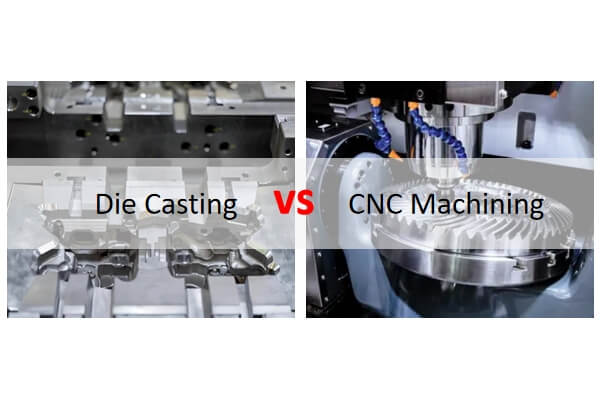
Die Casting vs CNC Machining: A Detailed Comparison
Below, we compare die casting and CNC machining in terms of several important factors such as production speed, cost, material options, and part complexity.
| Feature | Die Casting | CNC Machining |
|---|---|---|
| Production Speed | Fast (ideal for large quantities) | Slower (takes more time per part) |
| Cost per Part | Lower for large volumes | Higher for each part |
| Material Options | Limited to specific metals (aluminum, zinc) | Any material (metal, plastic, composite) |
| Part Complexity | Best for simple shapes | Best for complex shapes and details |
| Setup Cost | High (due to mold creation) | Low (no need for molds) |
| Surface Finish | Smooth (minimal post-processing) | Varies (often requires additional finishing) |
Which Process is Best for Your Project?
When to Choose Die Casting
Die casting is the best option when you need high-volume production of parts with simple geometries. It is ideal for projects that require fast production and cost-effective solutions for large quantities.
Common applications for die casting include:
- Automotive: Engine parts, brackets, and housings.
- Aerospace: Lightweight components for aircraft and spacecraft.
- Consumer Electronics: Casings for phones, tablets, and other devices.
- Industrial Equipment: Gears, housings, and structural parts.
When to Choose CNC Machining
CNC machining is the best option when you need precision, flexibility, and the ability to work with a variety of materials. It is ideal for low-volume production or custom parts that require intricate designs and tight tolerances. CNC machining is also excellent for prototyping and making parts that require frequent design adjustments.
Common applications for CNC machining include:
- Medical Devices: Surgical instruments, implants, and diagnostic tools.
- Aerospace: Complex parts like turbine blades or engine components.
- Automotive: Custom engine components, brackets, and prototypes.
- Electronics: Heat sinks, connectors, and enclosures.
FAQs: Die Casting vs CNC Machining
Here are some frequently asked questions to help you decide between die casting and CNC machining:
Q1: Which process is cheaper for large quantities?
A: Die casting is cheaper for large quantities because it uses reusable molds, which lowers the cost per part in high-volume production runs.
Q2: Can CNC machining work with any material?
A: Yes, CNC machining is highly versatile and can work with a wide variety of materials, including metals, plastics, and composites.
Q3: Is CNC machining suitable for prototypes?
A: Yes, CNC machining is ideal for prototyping because it allows for quick adjustments and fine-tuning of designs.
Q4: Which method is faster for large production runs?
A: Die casting is faster for large production runs, as it can produce parts quickly using reusable molds.
Q5: Do parts made from die casting require post-processing?
A: Die-cast parts generally have a good surface finish, but some may require additional finishing for intricate details or to remove any small imperfections.
Why Choose JC Casting?
At JC Casting, we specialize in both die casting and CNC machining. We offer fast, reliable, and high-quality services to meet your manufacturing needs. Whether you need die-cast parts for large-scale production or CNC-machined parts for complex designs and prototypes, we have the expertise and equipment to deliver the best solution for your project.
Contact JC Casting today for a free quote! Let us help you find the best manufacturing process for your needs, ensuring high quality and cost-efficiency.
Conclusion
In summary, both die casting and CNC machining are essential manufacturing techniques. Each method has its own strengths and is suited for different applications. If you need high-volume production with simple shapes, die casting is the ideal choice. If you need precision, material flexibility, or custom parts, CNC machining is the better option.
At JC Casting, we offer both die casting and CNC machining services to meet all your manufacturing needs. Get in touch today and let us assist you with your project!
Keywords: die casting, CNC machining, precision manufacturing, high-volume production, prototyping, JC Casting, CNC machining company, die casting foundry