
1. Overview & Core Value
This article provides a comprehensive breakdown of the SS316 investment casting process, its unique technical advantages, best-use applications, and important production considerations. We also compare SS316 investment casting with other manufacturing methods to help engineers and buyers make faster, more accurate decisions on materials and processes.”.
Article Structure
- Industry challenges for corrosion-resistant precision metal parts
- Complete SS316 lost wax casting workflow
- Core benefits and data comparison with other casting processes
- Typical application scenarios in marine, chemical, food and medical industries
- Process limitations and professional selection tips
Modern industrial equipment faces strict working conditions. Marine salt spray, chemical acid-base liquids, and long-term high-pressure operation easily damage ordinary metal parts. Traditional sand casting and pure machining cannot balance precision, surface quality and corrosion resistance. SS316 lost wax casting solves these pain points perfectly. It delivers high-precision, smooth, durable and corrosion-resistant stainless steel parts for harsh industrial environments.
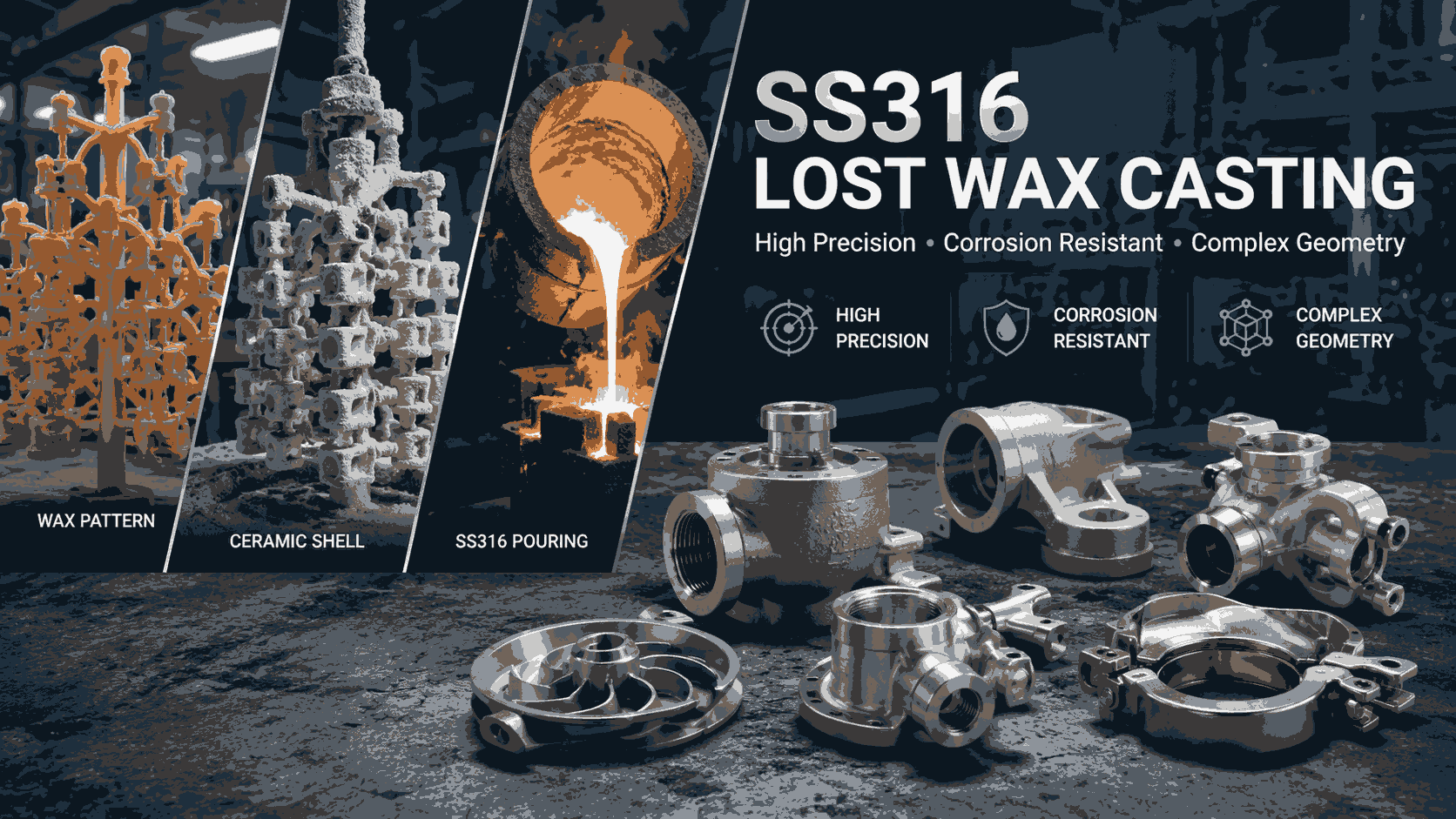
2. What Is SS316 Lost Wax Casting?
Lost wax casting, also called investment casting, is a popular precision metal forming process. It uses wax patterns and ceramic shells to create complex metal components with tiny tolerances and smooth surfaces.
SS316 stainless steel is a molybdenum-alloyed steel grade. It provides stronger chloride and chemical corrosion resistance than regular SS304 steel. It also maintains stable mechanical strength under high temperature and high pressure.
Combining SS316 material with lost wax casting creates high-performance parts that standard casting methods cannot produce. This combination becomes the top choice for industrial precision components that require long service life and low failure rates.
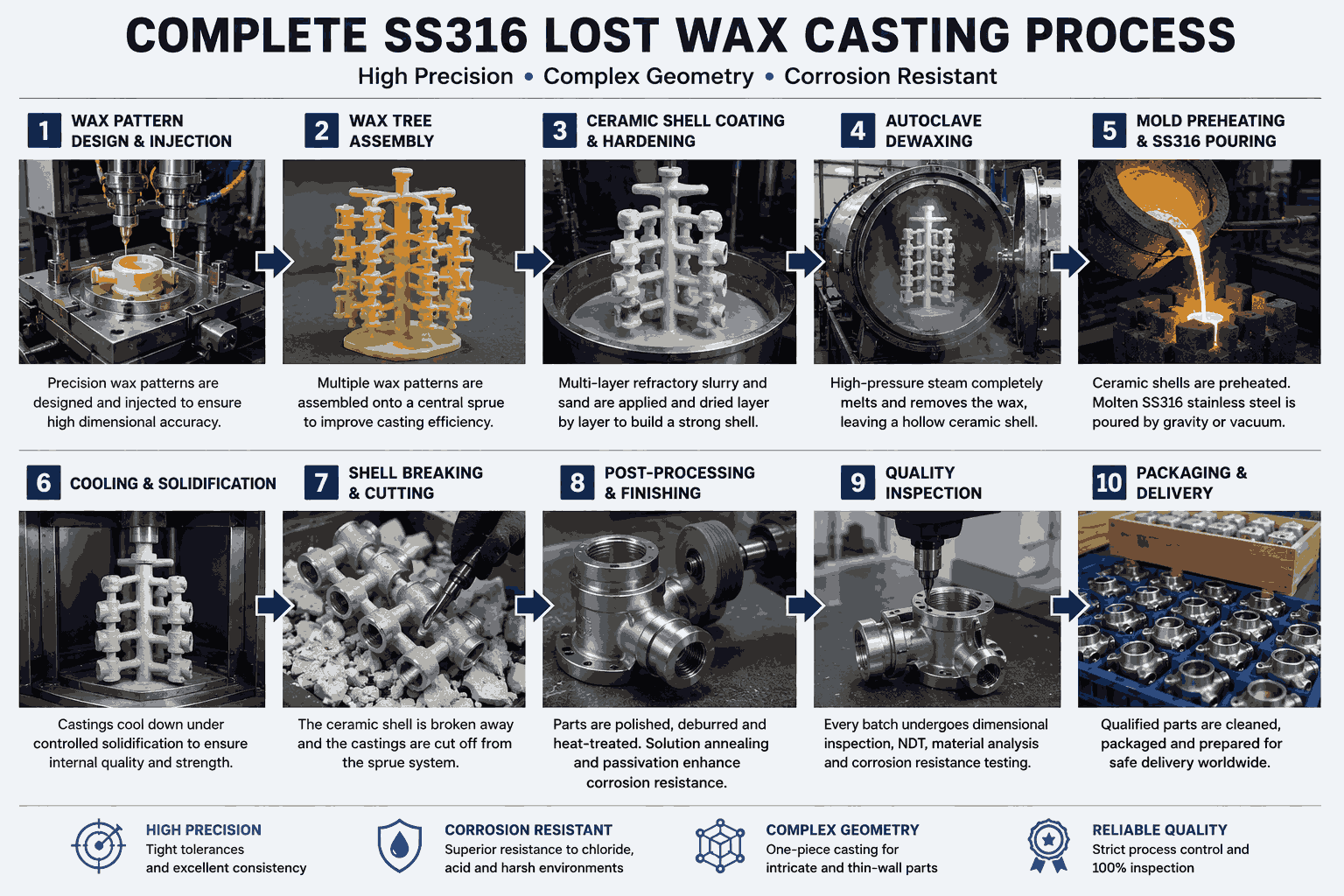
3. Complete SS316 Lost Wax Casting Process
SS316 lost wax casting follows a standardized, repeatable production flow. Every step strictly controls dimensional accuracy and material performance.
3.1 Wax Pattern Design and Injection
Workers design custom wax molds according to part drawings. Precision injection equipment produces high-consistency wax patterns. Teams check and calibrate every wax dimension to match final product requirements.
3.2 Wax Tree Assembly
Workers assemble multiple qualified wax patterns onto a central sprue. This tree structure improves casting efficiency and keeps batch products consistent.
3.3 Ceramic Shell Coating and Hardening
Technicians apply multi-layer refractory slurry and sand coating on the wax tree. Each layer fully air-dries and hardens. The customized shell structure adapts to high-temperature SS316 molten steel and avoids casting defects.
3.4 Autoclave Dewaxing
High-pressure steam equipment completely melts and removes all wax inside the shell. This step forms a clean, hollow ceramic cavity for pouring.
3.5 Mold Preheating and SS316 Pouring
Workers preheat ceramic shells to prevent thermal cracking. The factory melts SS316 stainless steel at a fixed high temperature and pours molten steel through gravity or vacuum pouring systems.
3.6 Cooling, Shell Breaking and Cutting
Casting parts cool down under controlled solidification rules. Workers break ceramic shells and cut off redundant sprue systems to obtain initial casting blanks.
3.7 Post-Processing and Finishing
Professional teams polish, deburr and heat-treat SS316 castings. Special solution annealing and surface passivation enhance the material’s corrosion resistance and surface finish.
3.8 Strict Quality Inspection
Every batch undergoes dimensional testing, surface defect detection, material composition analysis and corrosion resistance verification. Only qualified parts enter final packaging and delivery.
4. Core Advantages of SS316 Lost Wax Casting (With Data Comparison)
SS316 lost wax casting outperforms traditional sand casting and ordinary machining in precision, surface quality and service life. The table below shows clear differences for industrial reference.
| Performance Item | SS316 Lost Wax Casting | Traditional Sand Casting | Pure Machining |
| Dimensional Tolerance | ±0.005 in/in (high precision) | ±0.03 in/in (low precision) | ±0.002 in/in (ultra-precision but high cost) |
| Surface Roughness | Ra ≤ 3.2 μm (smooth) | Ra ≥ 12.5 μm (rough, with pores) | Ra ≤ 1.6 μm (super smooth) |
| Complex Structure Adaptability | Excellent (one-piece forming) | Poor (simple shapes only) | Limited (high waste for complex parts) |
| Corrosion Resistance | Excellent (full SS316 performance) | Average (easy surface oxidation) | Excellent (same material property) |
| Production Cost | Medium (cost-effective for mass production) | Low (low precision value) | High (serious material waste) |
From the comparison above, SS316 lost wax casting provides the best comprehensive performance for most industrial precision corrosion-resistant parts. It balances precision, quality and manufacturing cost perfectly.
Key strengths include:
- Smooth surface without sand holes and burrs, which improves fluid transmission performance for valve and pipeline parts
- Strong resistance to seawater, chloride and acid-base corrosion, suitable for long-term harsh environment operation
- One-time forming for hollow, thin-wall and irregular complex structures
- Uniform internal metal structure with stable tensile strength and high-temperature durability
5. Main Industrial Applications
Manufacturers widely use SS316 lost wax casting parts in industries that require high sanitation and strong corrosion resistance.
5.1 Marine and Offshore Industry
SS316 cast components resist seawater corrosion effectively. Factories apply them in ship pipe fittings, marine valve parts, offshore platform accessories and seawater desalination equipment.
5.2 Chemical and Petrochemical Industry
Chemical production involves frequent acid and alkali medium contact. SS316 lost wax casting produces pump impellers, reactor accessories and fluid control valves that maintain stable performance for years.
5.3 Food and Beverage Industry
Food-grade SS316 materials meet hygienic standards. Precision cast sanitary valves, connectors and brewing equipment parts avoid rust and contamination during food processing.
5.4 Automotive and Industrial Equipment
Manufacturers use SS316 casting parts for high-temperature exhaust components, turbocharger accessories, hydraulic system parts and precision instrument components.
5.5 Medical and Pharmaceutical Industry
High-purity SS316 lost wax castings support medical device structures and pharmaceutical fluid delivery systems with safe and stable performance.
6. Process Limitations and Selection Tips
SS316 lost wax casting has obvious advantages, but it also has minor limitations. It costs more than traditional sand casting. The high melting point of SS316 steel requires strict temperature control during production.
You should choose SS316 lost wax casting if your project needs complex shapes, tight tolerances, smooth surface and long-term corrosion resistance. You can select sand casting for low-precision ordinary structural parts or pure machining for ultra-precision simple parts.
7. Final Thoughts: Why SS316 Lost Wax Casting Dominates Industrial Precision Parts
SS316 lost wax casting is a mature, high-value precision manufacturing technology. It combines the excellent corrosion resistance of SS316 stainless steel and the high precision of investment casting. It solves many manufacturing difficulties for complex, durable and anti-corrosion industrial components.
If you need custom high-quality SS316 precision casting parts for marine, chemical, food or industrial equipment projects,JC Casting is your trusted professional partner. We specialize in SS316 lost wax casting production,offering full support for custom drawings and mass production. Contact our team today to get professional solutions and competitive quotes.