
How to Choose a Reliable High Chrome Casting Manufacturer
High chrome castings (high chromium white iron) serve harsh wear-intensive industries including mining, cement, power, metallurgy and slurry pumping. Their service life directly depends on the foundry’s alloy formula, casting craft, heat treatment and quality control. Below is a complete step-by-step guide to screen trustworthy High Chrome Casting Manufacturer.
1. Verify Professional Industry Experience & Matching Application Cases
High chrome casting performance varies drastically by working conditions (light abrasion vs heavy impact, dry grinding vs corrosive slurry). Prioritize factories with targeted industry experience:
- Years of specialization: Choose manufacturers with ≥10 years focusing solely on high-chrome wear castings, not general low-alloy castings. General foundries lack mature high-chrome heat treatment know-how.
- Matching reference projects: Request real client cases identical to your parts: mill liners, crusher hammers, slurry pump impellers, pulverizer roller sleeves, grinding balls, etc. Ask for field service life data from end users to validate wear resistance.
- Target client portfolio: Reliable suppliers cooperate with large cement plants, mining groups and power enterprises; avoid small workshops with only scattered small orders.
2. Audit Full-Set Production Equipment & Process Capacity
High chrome iron requires strict control over melting, molding and heat treatment. Check core hardware on-site or via video inspection:
(1) Melting System
- Equipped with medium-frequency induction furnaces for precise alloy proportioning (Cr 10%–30%, C, Mn, Si, Mo, Cu microalloy adjustment). Arc furnaces deliver unstable chemical consistency for high chrome grades.
- Real-time spectrometric sampling before pouring every furnace batch to lock chemical tolerance within ±0.5%.
(2) Molding Technology
Confirm they master crafts matching your product structure:
- Resin sand casting: complex thick wear parts, high dimensional accuracy
- V-process vacuum casting: smooth surface, fewer internal defects
- Centrifugal casting: pump sleeves, roller rings for uniform hardness
- Lost foam casting: large batch simple wear components Small foundries relying on manual clay sand produce excessive porosity, shrinkage and crack defects.
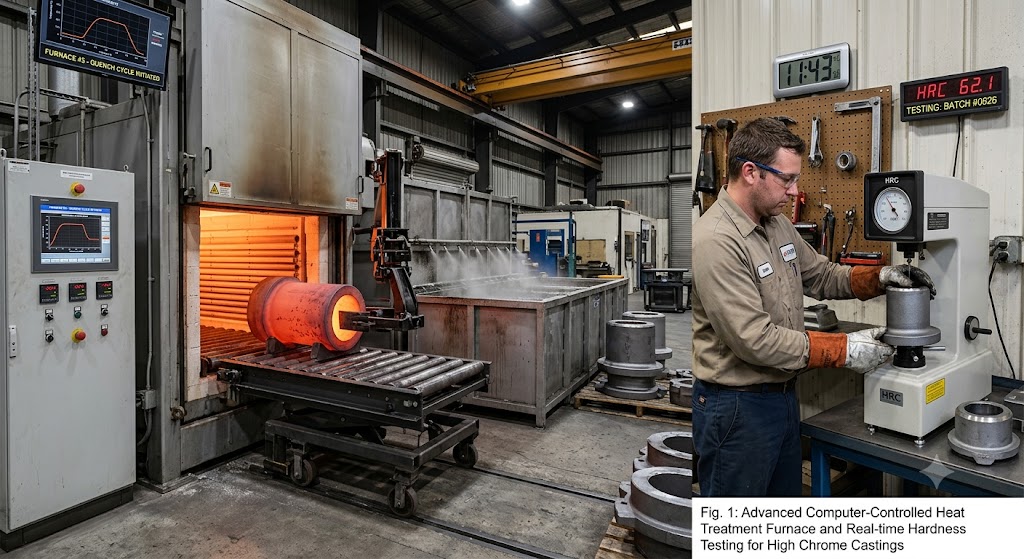
(3) Independent Heat Treatment Workshop (Non-negotiable)
Hardness and toughness of high chrome castings are determined by quenching + tempering:
- Computer-controlled high-temperature furnaces with automatic temperature curve recording
- Complete quenching tanks (air/oil/water cooling) to reach standard hardness: HRC 58–65 for standard high chrome series
- Manufacturers outsourcing heat treatment cannot guarantee batch consistency and often suffer inconsistent wear life.
(4) Supporting Precision Machining
Select suppliers with in-house CNC lathes, milling machines and drilling equipment to finish mounting surfaces, holes and assembly dimensions; outsourced machining introduces tolerance errors and delivery delays.
3. Inspect High Chrome Casting Manufacturer Complete Quality Control Lab & Testing Capabilities
A trustworthy factory owns full in-house testing equipment and provides official test reports per batch:
Mandatory Testing Equipment
- Optical emission spectrometer: full chemical composition analysis of Cr, C, Mo, Ni
- Rockwell hardness tester (HRC) + Brinell hardness tester
- Metallographic microscope: inspect carbide distribution (key to wear resistance)
- Impact testing machine: measure impact toughness to prevent fracture under shock load
- NDT devices: magnetic particle inspection (MPI), ultrasonic flaw detection to check internal cracks, shrinkage cavities
- CMM coordinate measuring machine for dimensional tolerance verification
Standard Test Documents They Must Provide
- Material chemical report for each melt
- Hardness & impact test record
- Metallographic photos
- Dimensional inspection sheet
- NDT non-destructive flaw report Reliable manufacturers accept third-party independent testing by SGS, BV or local authorized labs; factories refusing external inspection usually cut corners on alloy ratios.
4. Confirm Authorized Quality System Certifications
Valid certifications prove standardized, traceable production management:
- ISO 9001 Quality Management System (basic threshold)
- ISO 14001 environmental & ISO 45001 occupational safety certificates
- Compliance with international high chrome standards: ASTM A532 (US), GB/T 17445, BS 4844, DIN wear cast iron standards
- For export orders: provide factory audit reports, PPAP production approval documents for mass production tracking
5. Evaluate Batch Consistency, Production Capacity & Delivery Stability
- Annual output scale: Check daily furnace melting tonnage and monthly delivery volume. Small factories cannot fulfill bulk orders and frequently delay shipments.
- Batch repeatability: Ask for hardness fluctuation data of consecutive batches; qualified suppliers control HRC variation within ±2 across the same grade.
- Lead time transparency: Clarify standard production cycle for samples and mass orders, spare parts stocking capacity for emergency rush orders.
- Supply chain risk: Avoid manufacturers fully dependent on outsourced ferrochrome raw materials; stable raw material inventory prevents production suspension due to price or supply shortages.
6. Assess Customization Capability & Technical Engineering Support
Different working conditions demand customized high chrome formulas (12%Cr, 15%Cr, 20%Cr, 27%Cr, or Mo-alloyed anti-corrosion grades):
- Reliable foundries deploy material engineers to adjust Cr, molybdenum and copper content based on your working environment (high impact, fine abrasion, acidic slurry, high temperature).
- Provide design optimization: modify casting wall thickness, add feeding risers to reduce defects, optimize casting structure to extend component service life.
- Support drawing-based customization, reverse engineering for broken worn spare parts, and small-batch trial production before mass order release.
7. Compare After-Sales Service & Quality Liability Terms
Clear after-sales policies distinguish responsible manufacturers from low-cost counterfeit suppliers:
- Quality warranty: Confirm compensation standards for defective castings (porosity, low hardness, early fracture) caused by production flaws—free reproduction or full refund.
- Failure analysis service: Professional teams analyze premature wear/breakage issues and adjust alloy formula for improved performance.
- Fast spare part replenishment: Emergency shipment channel for broken critical wear parts to reduce equipment downtime.
- Formal written contracts: Specify material standards, hardness index, inspection standards, delivery schedule and quality liability clauses to avoid verbal disputes.
8. Avoid Common Red Flags of Unreliable Manufacturers
Eliminate suppliers showing these risky signals during screening:
- Cannot provide full chemical & hardness test reports, or only offer vague data without batch records
- No independent heat treatment workshop, outsources quenching/tempering externally
- Refuse third-party inspection or on-site factory audit
- Extremely low quotes far below market average (usually reduces chromium content to cut cost, leading to short service life)
- Lack matching industry client cases, only produce generic low-grade castings
- No professional engineering team, cannot customize alloy grades per working conditions
- Ambiguous after-sales liability, deny compensation for defective products
Final Practical Selection Workflow
- Collect 3–5 candidate manufacturers via industry platforms or peer recommendations
- Request material test samples and field case data for preliminary screening
- Conduct on-site factory audit or live video inspection of production & lab equipment
- Place small trial orders first to verify casting quality, dimensional accuracy and wear performance
- Formalize long-term cooperation after trial batch passes all inspection standards
Would you like me to turn this guide into a concise factory audit checklist (English version) you can use for supplier site visits?