
If you’re sourcing brass parts or designing mechanical components, you need a process that gives you fine details, tight tolerances, and great corrosion resistance. When standard sand casting just can’t cut it for high-precision parts, brass lost wax casting is definitely the way to go.
As a professional brass lost wax casting foundry with over 10 years of production experience, we break down everything engineers and buyers need to know in this easy-to-read guide.
What Is Brass Lost Wax Casting? Essential Basics
Brass lost wax casting (also called brass investment casting) is a precision process where a wax pattern is used to form a ceramic mold. Molten brass is then poured into the mold to create high-accuracy metal components.
This method is ideal for producing complex geometries that are difficult or expensive to machine directly.
Can brass be used in lost wax casting?
Yes. Brass is highly suitable for lost wax casting due to its:
- Excellent fluidity in molten state
- Good filling ability for thin and complex structures
- Stable mechanical properties after solidification
- Relatively low melting range compared to steel alloys
However, engineers must control:
- Zinc evaporation during melting
- Oxidation at high temperature
- Composition stability during repeated melting cycles
These factors directly affect casting quality and consistency.
Typical Properties of Brass Used in Lost Wax Casting
| Property | Typical Value | Why It Matters |
| Melting Range | 900–940°C | Lower melting temperature than stainless steel, reducing energy consumption |
| Density | 8.4–8.7 g/cm³ | Suitable for durable industrial components |
| Casting Fluidity | Excellent | Easily fills thin-wall and complex molds |
| Corrosion Resistance | Good | Performs well in marine and plumbing environments |
| Machinability | Excellent | Reduces machining time after casting |
| Surface Finish | Ra 3.2–6.3 μm (typical) | Produces attractive, near-net-shape parts |
Advantages compared to other casting methods
Compared with sand casting or die casting, brass lost wax casting offers:
- Higher dimensional accuracy
- Better surface finish (often near-machined quality)
- More complex internal structures
- Reduced machining requirements
It is especially suitable for precision parts where performance and consistency matter more than lowest cost.
Brass Lost Wax Casting: Step-by-Step Process
Brass Lost Wax Casting: Step-by-Step Process
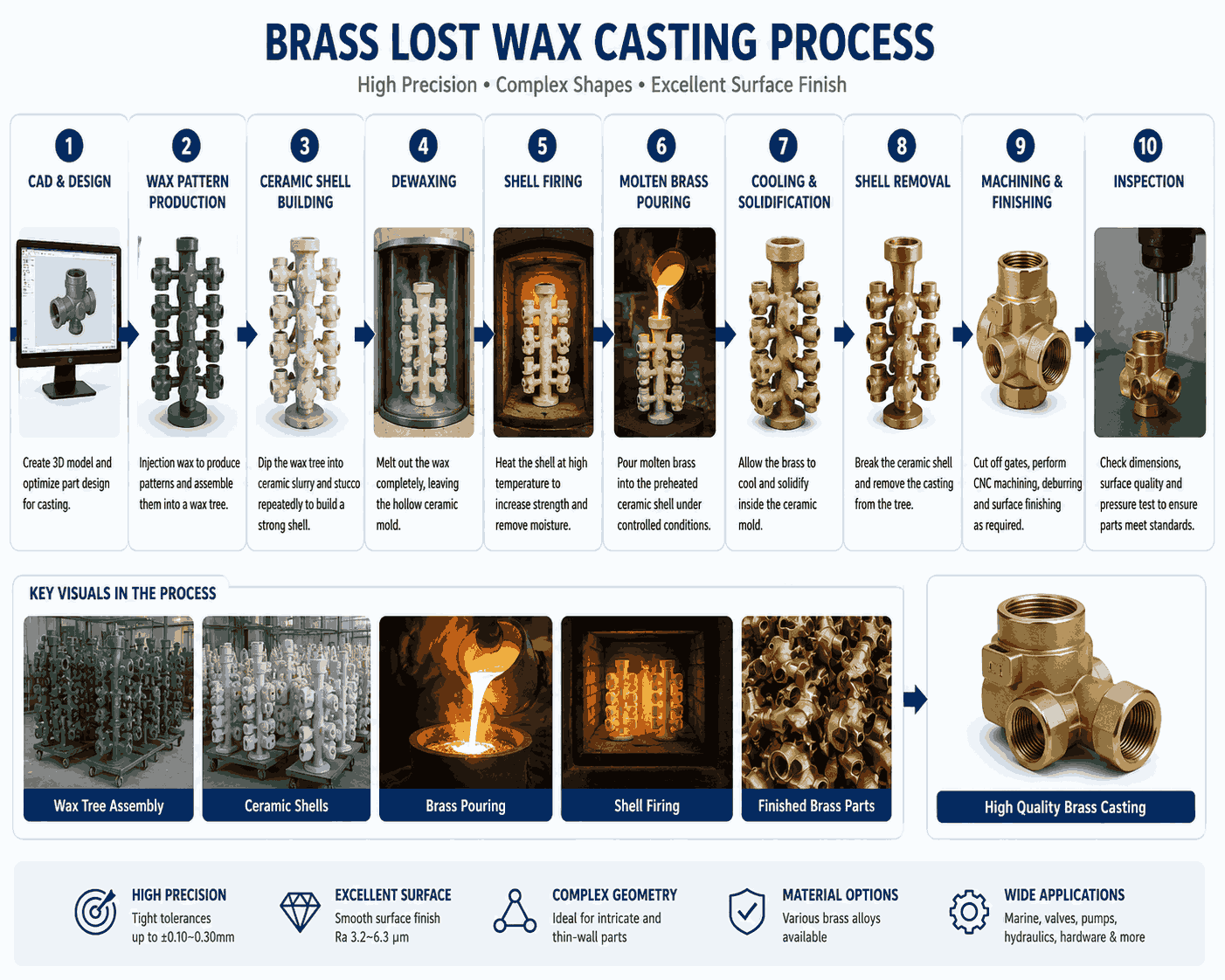
Step 1: Wax pattern production
The whole brass lost wax casting process starts with wax patterns. Workers inject special industrial wax into aluminum molds to create exact copies of the final brass parts. These wax patterns include all fine features, threads, and small grooves. We assemble multiple wax patterns into a cluster to improve production efficiency for bulk orders.
Step 2: Ceramic shell formation (USG plaster-based materials)
Mold quality decides the final casting precision. Our team uses the best USG plaster for lost wax brass casting to build rigid, heat-resistant molds. We mix the plaster with water, pour it over the wax cluster, and let it fully cure. USG plaster provides stable permeability and high-temperature strength, which prevents mold cracking during brass pouring. This is a critical supply for qualified lost wax brass casting production.
Step 3: Dewaxing, mold preheating, and brass pouring
After the plaster hardens, we put the mold into a high-temperature oven to melt out all internal wax. This dewax step leaves a hollow cavity identical to the wax pattern. We then preheat the empty plaster mold to control cooling speed. Finally, workers pour molten brass into the cavity under gravity or vacuum pressure. The liquid brass fills every detail of the pre-made mold cavity completely.
Step 4: Post-processing and inspection
Once the brass cools and solidifies, we break the plaster mold to take out raw castings. Our team cuts off the casting sprue, polishes surfaces, and removes minor burrs. We then conduct dimensional checks, surface testing, and material composition verification. Every finished part meets ISO standards before delivery for all brass lost wax casting service orders.
Key Technical Factors in Brass Lost Wax Casting
Temperature control and alloy stability
Brass alloys are sensitive to temperature fluctuations. If overheating occurs:
- Zinc loss increases
- Porosity risk rises
- Mechanical properties become unstable
Stable furnace control is essential for repeatability.
Shrinkage and dimensional tolerance
All metals shrink during cooling. In brass casting:
- Shrinkage must be compensated in mold design
- Wax pattern accuracy directly affects final tolerance
Precision foundries typically achieve tighter tolerances than sand casting processes.
Surface finish and precision performance
Brass lost wax casting can achieve:
- Smooth surfaces close to Ra 3.2–6.3 μm
- Minimal machining requirements
- Consistent detail reproduction
This makes it ideal for visible or functional precision components.
Brass Casting vs Brass Lost Wax Casting: Key Differences
Brass Lost Wax Casting vs Sand Casting
| Feature | Brass Lost Wax Casting | Traditional Sand Casting |
| Dimensional Accuracy | ±0.10–0.30 mm | ±0.50–1.50 mm |
| Surface Finish | Excellent | Moderate |
| Complex Geometry | Excellent | Limited |
| Thin Wall Capability | Excellent | Moderate |
| Machining Required | Minimal | Often Extensive |
| Tooling Cost | Medium | Low |
| Best Production Volume | Low to Medium | Medium to High |
| Typical Applications | Precision valves, marine parts, hydraulic fittings | Large housings, simple industrial parts |
Brass Casting vs Brass Lost Wax Casting: Key Differences
Dimensional accuracy comparison
- Sand casting: lower accuracy, requires machining
- Lost wax casting: high precision, near-net-shape
Surface quality and material performance
- Sand casting: rough surface, visible grain structure
- Lost wax casting: smooth surface, fine structural consistency
Cost and lead time
- Sand casting: lower tooling cost, faster for simple parts
- Lost wax casting: higher initial cost, better for complex or high-value parts
Industrial Applications of Brass Lost Wax Casting
| Industry | Typical Components | Key Benefits |
| Marine | Hose fittings, valve bodies, couplings | Excellent corrosion resistance |
| Petrochemical | Instrument fittings, pump parts | Chemical resistance and precision |
| Hydraulic Systems | Connectors, manifolds | Leak-free sealing surfaces |
| Plumbing | Water valves, pipe connectors | Long service life |
| Architectural Hardware | Handles, decorative fittings | Excellent surface appearance |
| Industrial Machinery | Precision mechanical components | High dimensional accuracy |
Brass Lost Wax Casting Foundry Selection Guide
Key Traits of Reliable Suppliers & Exporters
A qualified brass lost wax casting exporter must own independent wax injection, plaster molding, and heat treatment workshops. You should check their export experience, material certification reports, and past project cases. Trusted brass lost wax casting exporters always provide transparent technical communication before quoting a brass lost wax casting pricelist.
Quality Control System (ISO and Testing Standards)
Choose foundries with ISO 9001 certified quality systems. Our factory conducts spectrum analysis for alloy composition, dimensional CMM inspection, and salt spray corrosion tests for marine parts. Standardized testing ensures every shipment meets international industrial norms.
Delivery Stability and Production Capacity
Capacity and on-time delivery matter most for long-term procurement. Our workshop supports monthly output of 50 tons of brass castings. We arrange production schedules in advance to avoid delays for seasonal or urgent orders, keeping stable supply for global importers.
Brass Lost Wax Casting Applications & Case Reference
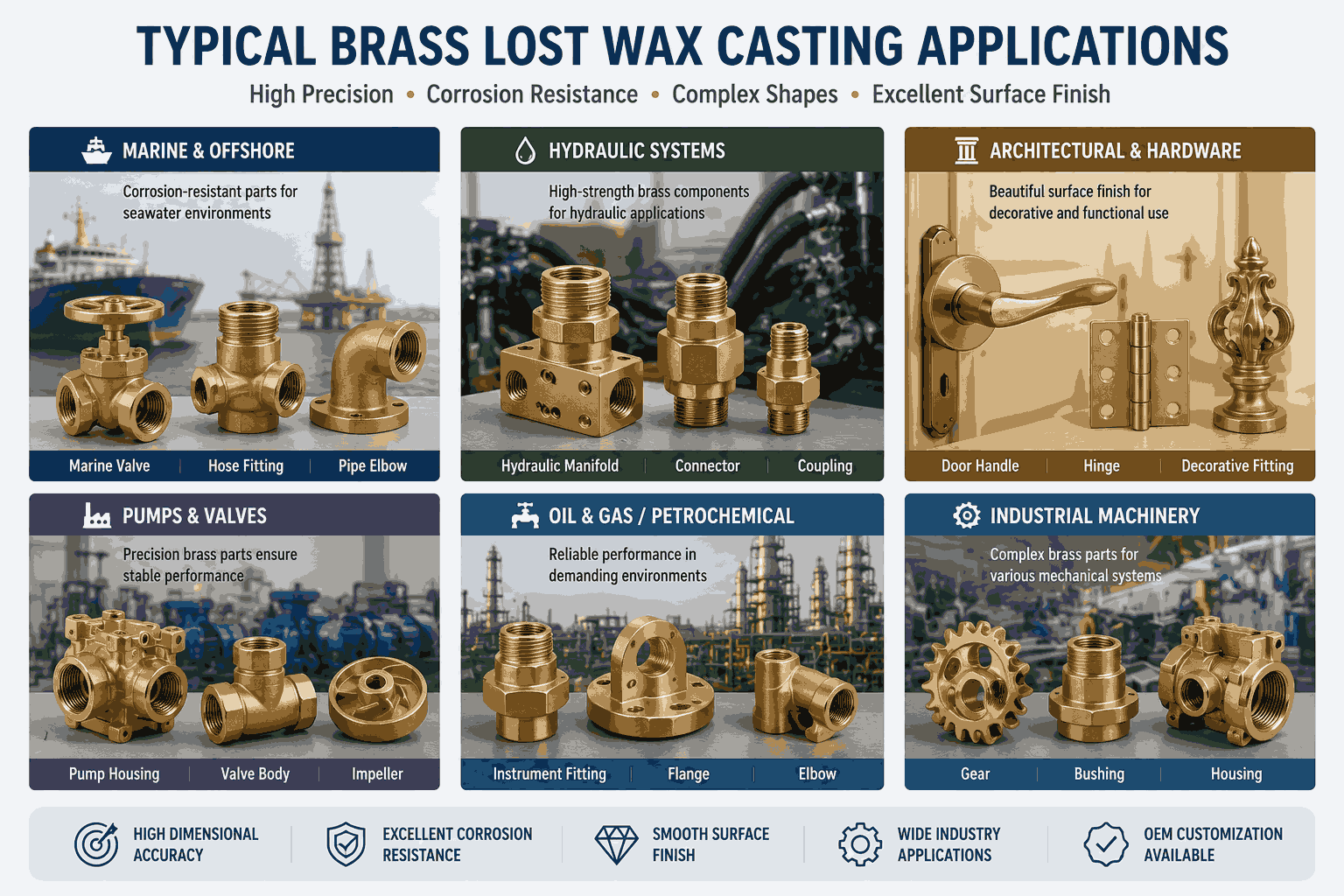
Typical part structures
Common geometries include:
- Thin-walled valve components
- Complex internal flow channels
- Threaded precision connectors
Surface quality comparison
Compared with sand casting:
- Fewer surface defects
- Lower porosity risk
- Better consistency across batches
Industrial application scenarios
Brass lost wax casting is widely used in:
- Offshore engineering systems
- Petrochemical pipelines
- Industrial pump and valve assemblies
- Precision mechanical equipment
Final Thoughts & Custom Brass Lost Wax Casting Inquiry
Brass lost wax casting remains the most reliable manufacturing solution for high-precision, corrosion-resistant brass components. It delivers better accuracy, smoother surfaces, and more design freedom than regular cast brass.
Whether you need standard parts or full OEM customization, JC Casting as a professional brass lost wax casting foundry provides stable quality, transparent pricing, and on-time export delivery. Contact us today to get your customized brass lost wax casting price list and project consultation.