
Bronze and brass are the two most common copper alloys for industrial precision casting. But honestly, a lot of engineers, buyers, and foundry partners still struggle to pick the right one for mechanical, marine, or petrochemical projects.The wrong choice leads to poor part durability, frequent equipment failure, and unnecessary cost waste.Even though they’re both copper-based, they perform completely differently when it comes to strength, corrosion resistance, and how easy they are to cast
This guide breaks down bronze vs brass casting in simple, clear language. We cover core material differences, standard casting processes, practical industrial applications, and professional selection tips. By the end of this article, you will know exactly when to use bronze and when to choose brass for your next custom casting project.
What Is Bronze Casting?
Bronze casting refers to the manufacturing of components using bronze alloys, which are primarily made of copper combined with tin and, in some grades, aluminum, nickel, manganese, or silicon. Bronze has been widely used for thousands of years because of its excellent strength, wear resistance, and corrosion performance.
Modern precision foundries commonly produce bronze brass casting parts through investment casting, sand casting, centrifugal casting, and permanent mold casting, depending on the component size and required dimensional accuracy.
Compared with brass, bronze generally offers:
- Higher wear resistance
- Better fatigue strength
- Superior corrosion resistance, especially in seawater
- Longer service life under heavy loads
Typical bronze casting applications include:
- Pump impellers
- Valve bodies
- Marine propellers
- Bearings and bushings
- Worm gears
- Industrial wear plates
- Petrochemical equipment components
Because bronze maintains its mechanical properties under harsh operating conditions, it is often the preferred material for demanding industrial environments.
What Is Brass Casting?
Brass is another copper alloy, but its primary alloying element is zinc instead of tin. The zinc content can vary depending on the required strength, machinability, and corrosion resistance.
Compared with bronze, casting brass bronze components generally costs less and offers excellent machinability. Brass also has attractive golden color, making it popular in architectural and decorative applications.
Advantages of brass include:
- Excellent machinability
- Lower material cost
- High thermal conductivity
- Good electrical conductivity
- Smooth casting surface
- Attractive appearance
Common brass castings include:
- Pipe fittings
- Plumbing valves
- Electrical connectors
- Decorative hardware
- Instrument components
- Furniture accessories
- Low-pressure industrial fittings
While brass performs well in many environments, it is generally less resistant to seawater corrosion and abrasive wear than bronze.
Bronze vs Brass: Key Material Differences
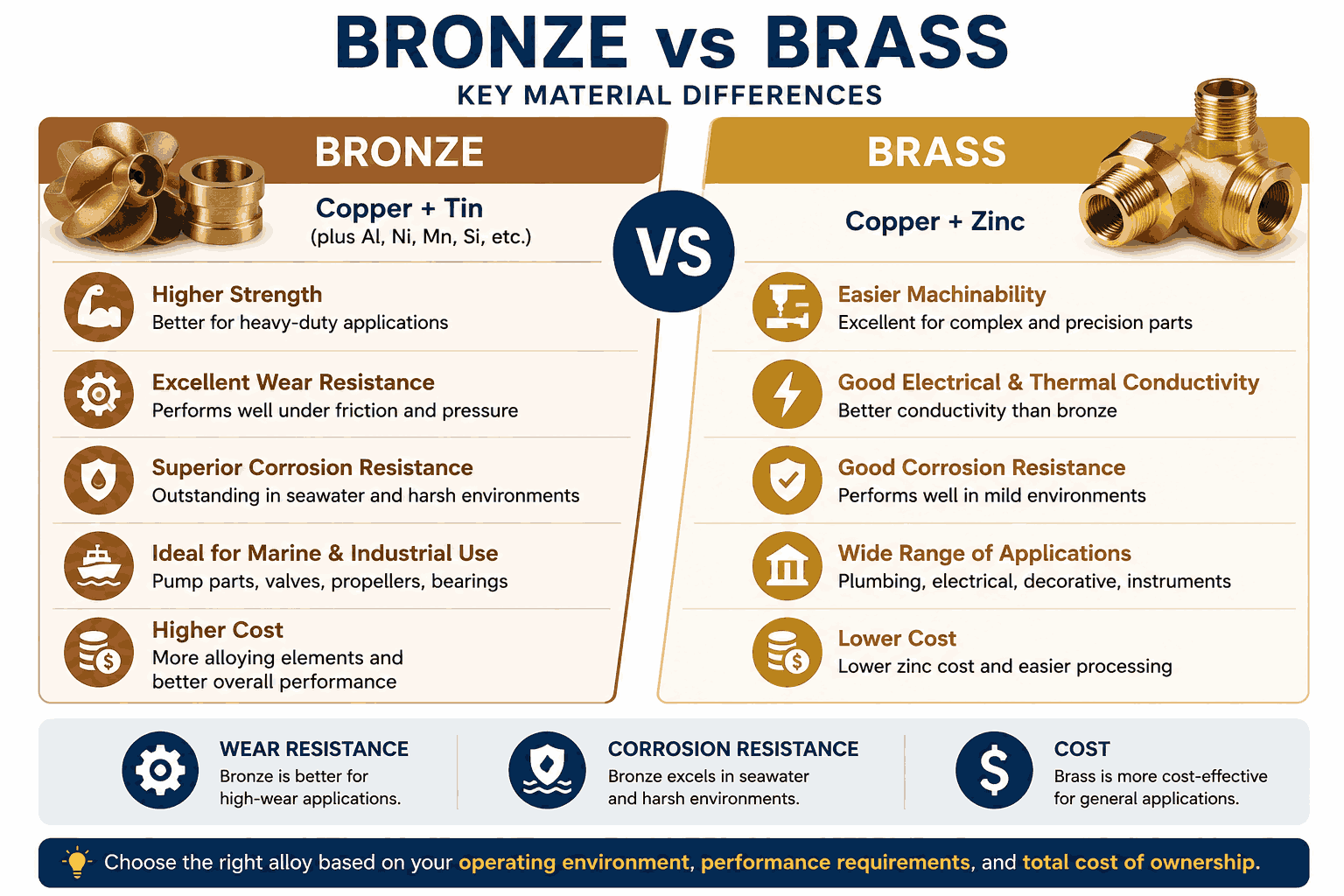
The table below covers all critical industrial indicators to help you quickly distinguish bronze and brass. Every comparison targets real casting production and field application demands.
| Comparison Item | Bronze | Brass |
| Composition | Copper + Tin (with optional aluminum, silicon) | Copper + Zinc (variable zinc ratio) |
| Strength | High tensile strength, strong load-bearing capacity | Moderate strength, suitable for light to medium load |
| Hardness | High hardness, resistant to deformation | Medium hardness, easy to deform under heavy pressure |
| Wear Resistance | Excellent, ideal for friction and moving parts | Average, wears fast under long-term friction |
| Machinability | Good but requires more cutting power | Excellent, easy to machine and polish |
| Corrosion Resistance | Superior, anti-rust and anti-chemical erosion | Good in dry air, poor in saltwater and humidity |
| Thermal Conductivity | High, stable heat transfer performance | Very high, faster heat dissipation |
| Electrical Conductivity | Good conductivity | Better conductivity than bronze |
| Casting Performance | Stable molding for thick-wall, heavy-duty parts | High fluidity, perfect for thin-wall & complex parts |
| Cost | Higher raw material and production cost | Cost-effective for mass production |
| Color | Dark reddish-brown | Bright golden yellow |
| Weight | Denser and heavier | Lighter than bronze |
Bronze vs Brass Casting Process
Both bronze and brass can be manufactured using several casting methods. The best process depends on component geometry, production volume, dimensional tolerance, and mechanical requirements.
Investment Casting
Investment casting produces highly accurate components with excellent surface finish. It is widely used for precision bronze and brass casting parts such as valve components, pump parts, marine fittings, and machinery accessories.
Advantages include:
- Tight dimensional tolerance
- Complex geometry
- Reduced machining
- Excellent surface quality
Sand Casting
Sand casting is suitable for medium and large castings where cost efficiency is important.
Typical products include:
- Large pump housings
- Valve bodies
- Industrial flanges
- Marine equipment
Centrifugal Casting
Centrifugal casting is commonly used for cylindrical bronze products such as bushings and bearing sleeves because it produces dense, high-strength material.
Permanent Mold Casting
Permanent mold casting offers faster production cycles and consistent quality for medium-volume manufacturing.
When casting with brass or bronze, manufacturers evaluate several factors before selecting a process:
- Part size
- Required tolerance
- Mechanical properties
- Surface finish
- Production quantity
- Budget
A qualified foundry can recommend the most suitable casting process based on the application.
Industrial Applications: When Should You Choose Bronze or Brass?
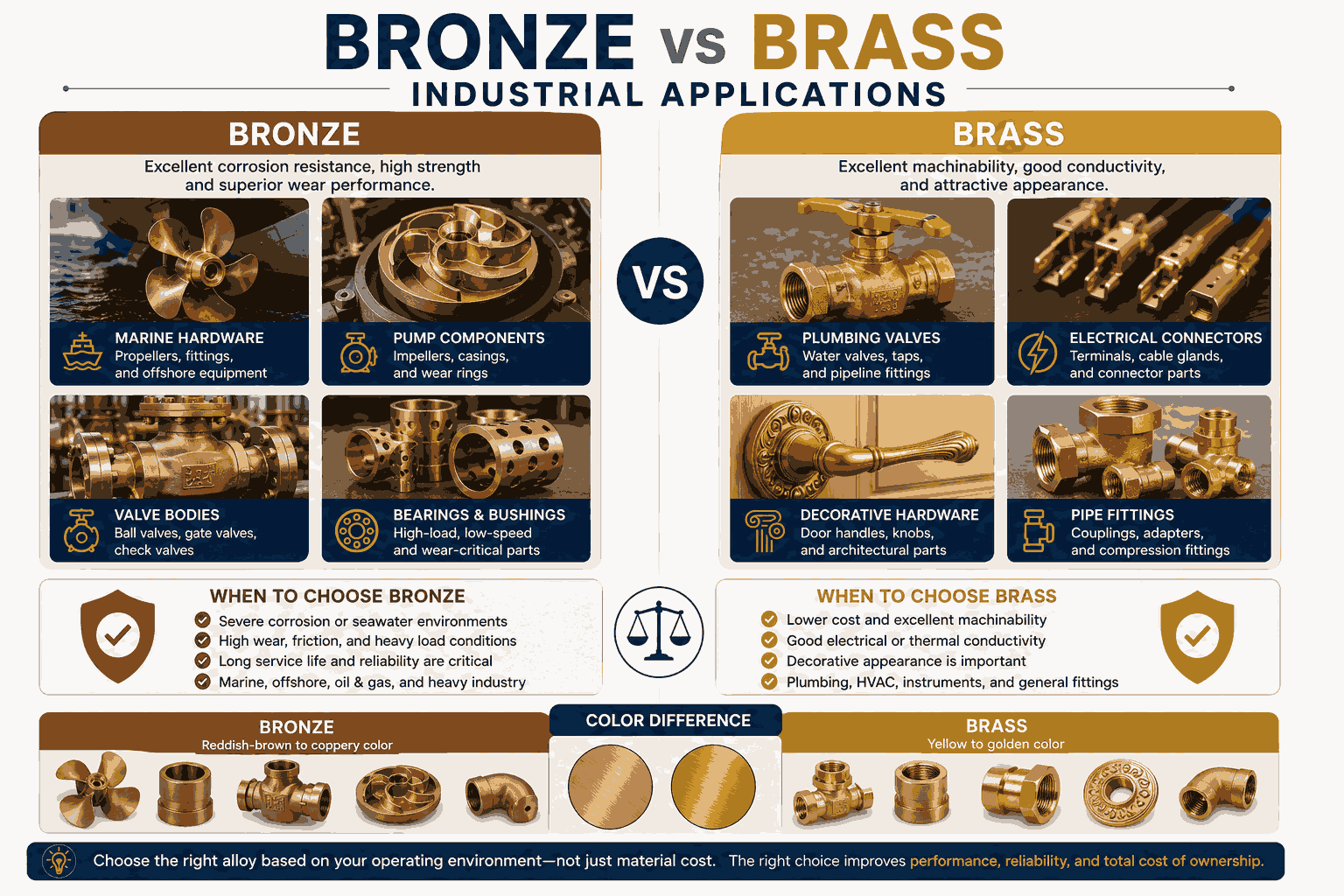
1.Core Advantages of Brass Casting
Brass provides outstanding machinability and high casting fluidity. It lowers processing time and reduces production costs for mass orders. Brass also offers bright and uniform surface quality that requires minimal polishing. Its excellent thermal and electrical conductivity makes it ideal for conductive and heat-dissipating components. Brass performs stably in dry, indoor, and common mechanical environments.
2.Core Advantages of Bronze Casting
Bronze owns superior hardness, wear resistance, and corrosion resistance. It resists saltwater, salt fog, acid, and alkaline medium erosion effectively. Bronze maintains stable mechanical performance under heavy load, high friction, and continuous working conditions. It hardly deforms or rusts in outdoor, marine, and petrochemical environments. Bronze also shows strong fatigue resistance for long-term cyclic operation.
3.When to Choose Brass Casting
Select brass for general mechanical parts, standard pipeline valves, plumbing components, instrument accessories, and indoor mechanical equipment. Choose brass if you prioritize cost control, fast production, and easy post-processing. Brass perfectly matches light-load, low-corrosion, and conventional industrial working conditions.
4.When to Choose Bronze Casting
Select bronze for marine equipment, offshore platform parts, petrochemical anti-corrosion valves, high-wear bearings, heavy-load hydraulic components, and outdoor heavy machinery. Choose bronze if your projects require long service life, high pressure resistance, and strong anti-corrosion performance. Bronze becomes the most cost-effective option for harsh and high-demand working scenarios.
Common Alloy Selection Mistakes & Quality Purchasing Tips
a.Common Bronze and Brass Casting Selection Mistakes
Many buyers and engineers make two typical mistakes in alloy selection. First, they choose low-cost brass for marine and chemical environments to save budget. This mistake causes rapid oxidation, serious corrosion, and frequent part replacement. Second, they over-specify bronze for ordinary standard parts, which creates unnecessary cost waste without extra performance improvement. Blind experience-based selection always affects equipment stability and project profit.
b.How to Source High-Quality Bronze and Brass Castings
High-quality castings depend on both correct alloy selection and standardized production. First, confirm clear working condition parameters including load, temperature, and medium environment before placing orders. Second, cooperate with foundries that adopt anti-oxidation flux treatment and precise temperature control. Third, require complete quality inspection reports for hardness, size accuracy, and corrosion resistance. Fourth, prioritize factory direct supply to avoid middleman markup and unstable quality.
Partner with an Experienced Bronze and Brass Casting Foundry
Material selection and process control decide the final performance of your copper alloy casting parts. Our foundry holds more than 10 years of professional precision casting experience. We specialize in custom bronze and brass casting for mechanical, marine, and petrochemical industries.
We provide one-stop services including material consultation, mold design, mass production, precision finishing, and quality testing. Our team helps you avoid alloy selection errors, optimize casting structures, and balance performance and cost.
Whether you need marine hardware, pump components, valve parts, machinery accessories, or other custom copper alloy castings, JC Casting delivers reliable manufacturing solutions that comply with demanding industrial standards.