
Brass sand casting remains a highly reliable and cost-effective choice for medium to large brass components. It offers excellent design flexibility, competitive tooling costs, and stable mechanical properties.That’s why it’s so popular across industries like plumbing, marine, oil & gas, machinery, agriculture, and construction.
For engineers and procurement professionals, selecting the right casting process involves more than choosing a material. Production volume, dimensional tolerance, machining allowance, surface finish, and total manufacturing cost all influence the final decision.
This guide explains how brass sand casting works, its advantages and limitations, typical applications, cost drivers, and how to select a reliable brass sand casting foundry for OEM projects.
What Is Brass Sand Casting?
Brass sand casting is a metal casting process that produces parts by pouring molten brass into a sand mold. After the metal solidifies, the mold is broken away, revealing the finished casting.
Unlike permanent molds, sand molds are expendable and can be produced quickly at relatively low cost. This makes the process especially suitable for custom parts, large components, and low-to-medium production volumes.
The process is commonly used for:
- Valve bodies
- Pump housings
- Pipe fittings
- Marine hardware
- Electrical connectors
- Agricultural machinery components
Compared with precision investment casting, casting brass in sand allows manufacturers to produce larger parts with lower tooling investment while maintaining reliable strength and machinability.
Typical Brass Grades Used in Sand Casting
| Brass Alloy | Main Features | Typical Applications |
| C83600 | Excellent machinability | Plumbing fittings |
| C85700 | High corrosion resistance | Marine hardware |
| C86500 | High strength | Bushings and bearings |
| Lead-Free Brass | Drinking water compliant | Water systems |
Why Choose Brass for Sand Casting?
Brass combines excellent casting performance with good mechanical properties. It flows well during pouring, fills complex mold cavities, and produces sound castings when process parameters are properly controlled.
Key Benefits
Excellent Machinability
Brass is one of the easiest engineering metals to machine. CNC finishing is faster than many stainless steel or bronze components, reducing overall production costs.
Good Corrosion Resistance
Brass performs well in freshwater, industrial environments, and many mild chemical applications. It is widely used in plumbing and marine equipment.
High Thermal Conductivity
Brass transfers heat efficiently, making it suitable for heat exchangers and fluid-handling equipment.
Attractive Appearance
Its natural golden color makes brass ideal for decorative architectural hardware and premium industrial products.
Cost-Effective Production
Compared with investment casting, sand casting brass parts generally require lower tooling costs, making them suitable for prototype development and medium production runs.
Brass Properties at a Glance
| Property | Brass |
| Machinability | Excellent |
| Corrosion Resistance | Very Good |
| Thermal Conductivity | High |
| Castability | Excellent |
| Recyclability | 100% |
How Does the Brass Sand Casting Process Work?
A controlled manufacturing process is essential for producing high-quality brass sand casting parts.
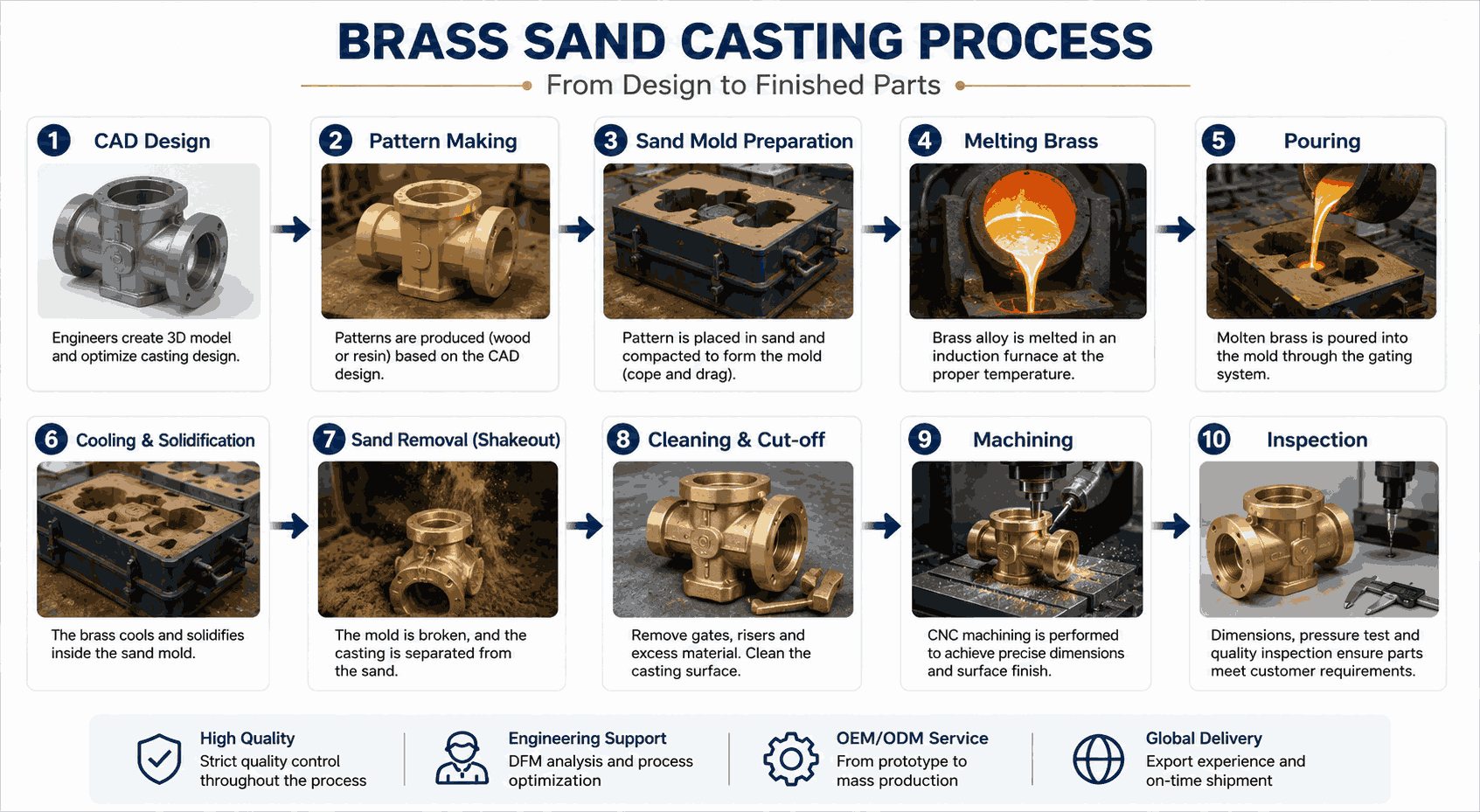
Step 1: Pattern Design
Engineers design the pattern with shrinkage allowance, machining allowance, draft angles, and gating systems.
Modern foundries often use CAD and simulation software to reduce defects before production.
Step 2: Sand Mold Preparation
The pattern is pressed into specially prepared molding sand to create the mold cavity.
Many brass sand casting foundries use:
- Green sand
- Resin sand
- No-bake sand
Green sand casting brass remains popular because it provides fast production and economical mold preparation.
Step 3: Melting the Brass Alloy
The brass alloy is melted in an induction furnace.
Temperature control is critical because overheating may increase zinc evaporation and oxidation.
Step 4: Pouring
Molten brass is poured into the mold through the gating system.
Proper pouring speed helps reduce turbulence and gas entrapment.
Step 5: Cooling and Solidification
The casting cools naturally inside the mold.
Controlled cooling minimizes shrinkage defects and internal stress.
Step 6: Shakeout and Cleaning
After cooling, the sand mold is broken apart.
Workers remove runners, risers, and excess material before surface cleaning.
Step 7: Machining and Inspection
Many OEM brass sand casting projects require:
- CNC machining
- Thread machining
- Pressure testing
- Dimensional inspection
- Material testing
Typical Production Flow
| Process | Purpose |
| Pattern Making | Create mold geometry |
| Mold Preparation | Form cavity |
| Brass Melting | Prepare molten alloy |
| Pouring | Fill mold |
| Cooling | Solidification |
| Cleaning | Remove excess material |
| Machining | Improve precision |
| Inspection | Verify quality |
What Are the Main Advantages and Limitations of Brass Sand Casting?
Every manufacturing process involves trade-offs. Understanding these helps engineers choose the right solution.
| Advantages | Limitations |
| Low tooling cost | Rougher surface finish than investment casting |
| Suitable for large parts | Lower dimensional accuracy |
| Flexible design | More machining may be required |
| Short tooling lead time | Draft angles are usually necessary |
| Economical for small batches | Thin-wall capability is limited |
For many industrial applications, these limitations are acceptable because machining can achieve the required tolerances at a lower total cost than more expensive casting methods.
Common Applications of Brass Sand Casting Parts
Because brass offers an excellent balance of strength, corrosion resistance, and machinability, sand casting brass parts are used across many industries.
| Industry | Typical Brass Sand Casting Parts |
| Plumbing | Valve bodies, pipe fittings |
| Marine | Pump housings, propeller components |
| Oil & Gas | Flanges, valve components |
| Agriculture | Irrigation fittings |
| Construction | Architectural hardware |
| Machinery | Bushings, bearing housings |
| Electrical | Connector bodies |
Many OEM manufacturers choose brass sand casting for components that require durability, corrosion resistance, and economical production.
Brass Sand Casting vs. Bronze Casting vs. Investment Casting: Which Process Is Right?
Selecting the right manufacturing process depends on performance requirements, production volume, and budget.
| Feature | Brass Sand Casting | Bronze Casting | Investment Casting |
| Material Cost | Moderate | Higher | Varies |
| Tooling Cost | Low | Low | Higher |
| Surface Finish | Good | Good | Excellent |
| Dimensional Accuracy | Moderate | Moderate | Excellent |
| Large Parts | Excellent | Excellent | Limited |
| Complex Geometry | Good | Good | Excellent |
| Production Volume | Low to Medium | Low to Medium | Medium to High |
When to Choose Brass Sand Casting
Choose brass sand casting if you need:
- Medium or large components
- Cost-effective tooling
- Fast prototype production
- Good machinability
- Moderate dimensional tolerance
Investment casting becomes the better choice when intricate geometries, thin walls, or tight tolerances are required.
What Factors Affect Brass Sand Casting Cost?
There is no fixed sand casting brass pricelist because each project has unique specifications.
Several factors determine the final quotation.
| Cost Factor | Impact |
| Brass alloy grade | High |
| Casting weight | High |
| Production quantity | High |
| Pattern cost | Medium |
| CNC machining | High |
| Heat treatment | Medium |
| Surface finishing | Medium |
| Inspection requirements | Medium |
| Shipping destination | Medium |
Generally:
- Higher quantities reduce unit cost.
- Larger castings require more metal and longer melting time.
- Additional machining increases overall production cost.
Most professional brass sand casting foundries provide custom brass sand casting quotes based on engineering drawings or samples.
How to Choose the Right Brass Sand Casting Foundry for Your Project?
Finding a reliable supplier is just as important as selecting the right manufacturing process.
Before placing an order, evaluate the foundry in the following areas.
Engineering Support
An experienced engineering team can optimize casting design before production, reducing defects and machining costs.
Manufacturing Capability
Look for suppliers offering:
- Sand casting
- CNC machining
- Surface treatment
- Assembly
- Custom packaging
This simplifies supply chain management.
Quality Control
Reliable foundries should provide:
- Chemical composition analysis
- Mechanical property testing
- CMM inspection
- Pressure testing
- Material traceability
Export Experience
An experienced exporter understands international standards, documentation, and shipping requirements.
Supplier Evaluation Checklist
| Evaluation Item | Why It Matters |
| ISO Quality System | Consistent production |
| Engineering Team | Better casting design |
| In-house Machining | Faster delivery |
| Material Certification | Product reliability |
| Inspection Equipment | Stable quality |
| Export Experience | Smooth international projects |
Why Choose JC Casting for OEM Brass Sand Casting?
At JC Casting, we specialize in producing high-quality OEM brass sand casting parts for customers worldwide.
Brass sand casting continues to be one of the most practical manufacturing methods for producing durable and cost-effective brass components. Its low tooling cost, excellent machinability, and flexibility make it an ideal choice for OEM projects across plumbing, marine, machinery, and industrial applications.
By understanding the casting process, material properties, cost drivers, and supplier selection criteria, engineers and buyers can make more informed sourcing decisions.
If you are looking for a trusted brass sand casting foundry, JC Casting offers complete OEM manufacturing services—from design optimization and mold development to machining, inspection, and global delivery.Our team will help you to bring high-quality brass castings to market with confidence.