
Many buyers searching for bronze casting foundries quickly discover that not every foundry offers the same capabilities. Some specialize in art sculptures, while others manufacture precision industrial components.
If you need bronze pump parts, marine hardware, valve bodies, bearings, or custom OEM castings, selecting the right bronze casting manufacturer directly affects product quality, lead time, and total project cost.
This guide explains how industrial bronze casting foundries work, what services they provide, and how to evaluate suppliers before placing an order.
What Can Bronze Casting Foundries Produce?
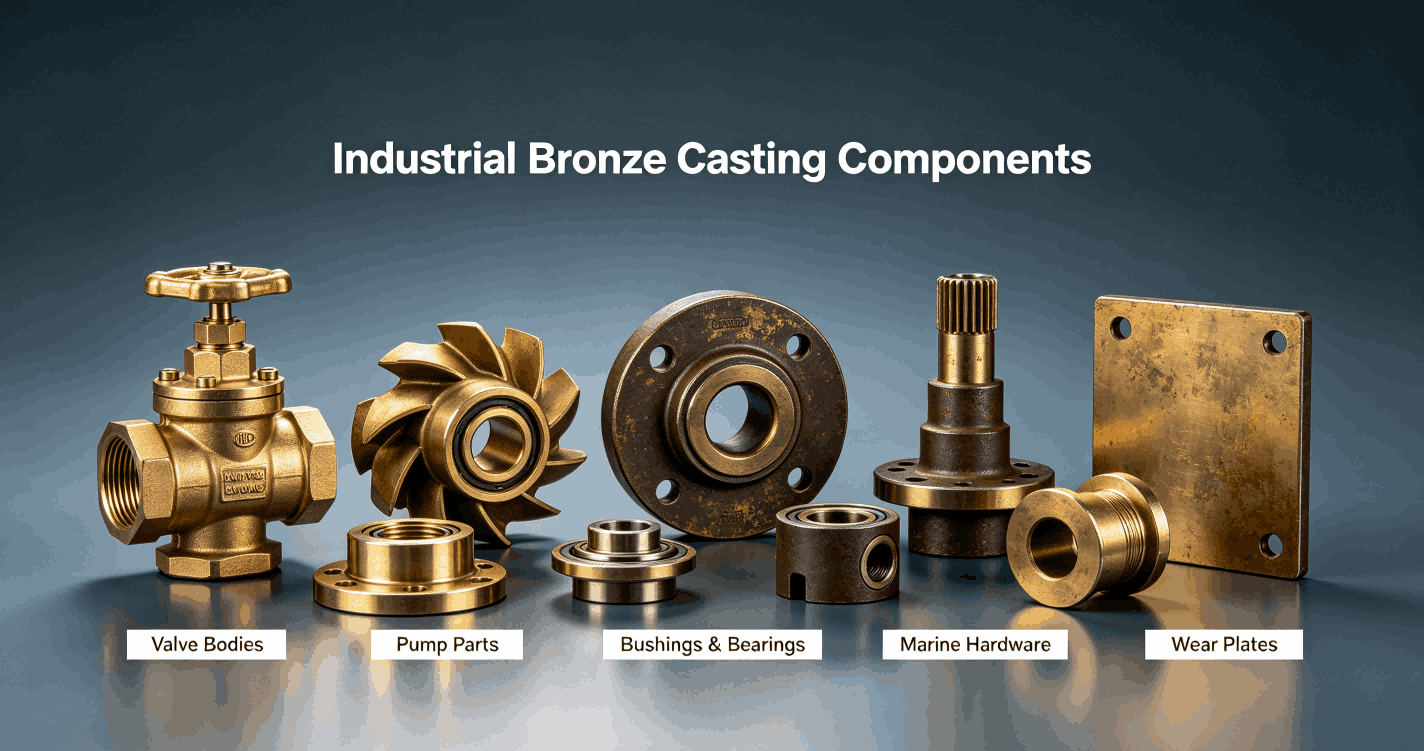
A professional bronze casting foundry can manufacture a wide range of custom bronze components for different industrial applications. The production capability depends on the foundry’s casting processes, equipment, material expertise, and machining capacity.
Unlike decorative bronze casting factories that mainly produce sculptures or artwork, industrial bronze casting manufacturers focus on precision components designed to operate under pressure, friction, corrosion, and heavy loads.
Common bronze castings produced by industrial foundries include:
| Bronze Casting Parts | Typical Applications |
| Bronze Valve Bodies | Water systems, marine valves, industrial pipelines |
| Bronze Pump Components | Pumps, impellers, housings, wear parts |
| Bronze Bushings & Bearings | Machinery, automotive, mining equipment |
| Marine Bronze Hardware | Ship components, propeller parts, marine fittings |
| Bronze Flanges and Fittings | Piping systems, chemical equipment |
| Bronze Wear Plates | Heavy machinery and sliding applications |
| Custom OEM Bronze Parts | Various industrial equipment |
For example, aluminum bronze castings are often selected for marine and offshore applications because they provide excellent seawater corrosion resistance and high strength. Tin bronze alloys are commonly used for bushings and bearings because of their excellent wear properties and machinability.
A capable bronze casting manufacturer should not only produce the casting itself but also support the complete manufacturing process, including pattern design, machining, surface treatment, and final inspection.
Bronze Casting Applications Across Industries
Industrial bronze castings are widely used because bronze provides a unique combination of strength, corrosion resistance, and wear performance.
Marine Industry
Marine environments require materials that can withstand saltwater corrosion and continuous mechanical stress.
Common bronze components include:
- Propeller components
- Marine valves
- Pump parts
- Bushings
- Ship hardware
Nickel aluminum bronze (NAB) is especially popular in marine applications due to its excellent seawater resistance and high mechanical strength.
Pump and Valve Industry
Bronze has been used in pump and valve manufacturing for decades because it offers:
- Good corrosion resistance
- Low friction characteristics
- Long service life
- Reliable sealing performance
Typical components include:
- Pump housings
- Impellers
- Valve bodies
- Valve seats
- Wear rings
Oil & Gas and Chemical Industries
Equipment used in oil, gas, and chemical environments often requires materials that can withstand aggressive conditions.
Bronze castings are commonly used for:
- Pressure valves
- Bushings
- Sealing components
- Special wear-resistant parts
The correct alloy selection is critical because different bronze grades provide different levels of corrosion resistance, hardness, and strength.
Mining and Heavy Equipment
Mining machinery operates under extreme loads and abrasive conditions. Bronze components are often used where low friction and wear resistance are required.
Examples include:
- Large bushings
- Sliding components
- Bearing parts
- Wear plates
A reliable bronze casting foundry should understand not only casting technology but also the actual working environment of the component. The right supplier can recommend suitable materials and manufacturing methods based on operating conditions rather than simply producing parts according to drawings.
Which Bronze Casting Process Is Best for Your Project?
Choosing the right casting process is one of the most important decisions when working with a bronze casting foundry. The best process depends on several factors, including part complexity, dimensional requirements, production volume, surface finish requirements, and total manufacturing cost.
A professional bronze casting manufacturer should help customers select the most suitable process instead of offering only one manufacturing method.
The most common bronze casting processes include investment casting, sand casting, centrifugal casting, and continuous casting.
Bronze Investment Casting
Bronze investment casting, also known as lost wax casting, is widely used for producing complex bronze components that require high accuracy and excellent surface finish.
The process uses a wax pattern to create a detailed ceramic mold. After the wax is removed, molten bronze is poured into the mold to create the final casting.
Advantages:
- High dimensional accuracy
- Excellent surface finish
- Suitable for complex geometries
- Reduced machining requirements
- Good for small to medium production volumes
Typical applications:
- Marine hardware
- Valve components
- Pump parts
- Precision industrial components
Investment casting is often the preferred solution when a component has complex internal structures, thin walls, or strict dimensional requirements.
Bronze Sand Casting
Bronze sand casting is one of the most traditional and widely used casting methods. It is suitable for larger components and projects where cost efficiency is important.
The process uses a sand mold created from a pattern. Molten bronze is poured into the mold and solidifies into the required shape.
Advantages:
- Suitable for large parts
- Lower tooling cost
- Flexible production quantities
- Good for heavy industrial components
Typical applications:
- Large valve bodies
- Pump housings
- Industrial machinery parts
- Heavy bronze components
For large bronze castings, sand casting usually provides a better balance between manufacturing cost and performance.
Centrifugal Bronze Casting
Centrifugal casting uses rotational force to distribute molten bronze evenly inside a mold.
This process is commonly used for components requiring excellent wear resistance and uniform structure.
Typical applications:
- Bronze bushings
- Bearings
- Sleeves
- Wear rings
The centrifugal force helps reduce internal defects and improves material density.
Continuous Bronze Casting
Continuous casting is mainly used for producing bronze bars, tubes, and standard profiles.
It provides:
- Consistent material structure
- High production efficiency
- Stable dimensions
It is commonly used for manufacturing bronze raw materials that will later be machined into finished components.
Bronze Casting Process Comparison
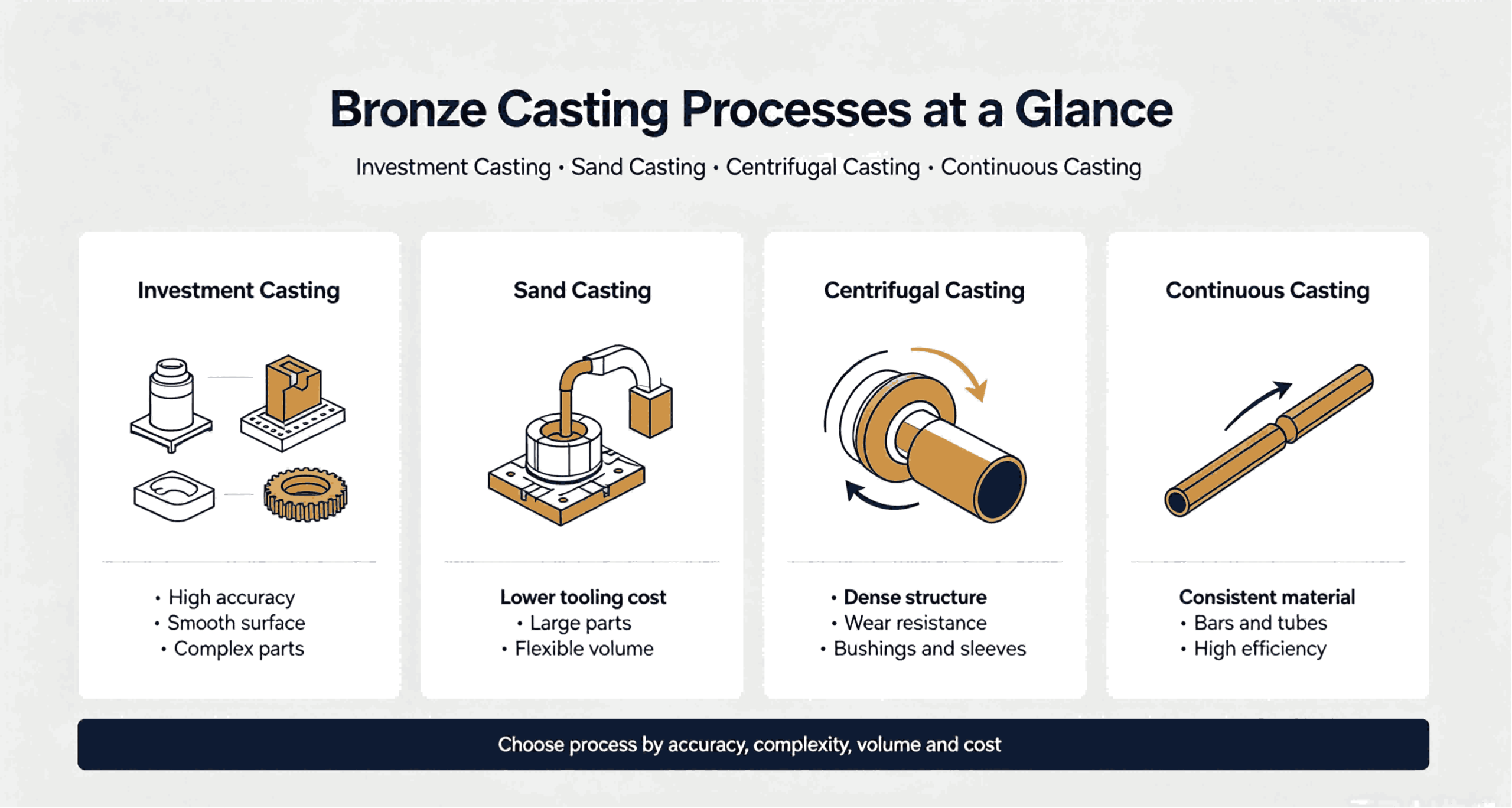
| Casting Process | Accuracy | Surface Finish | Production Volume | Best Applications |
| Investment Casting | High | Excellent | Low–Medium | Complex precision parts |
| Sand Casting | Medium | Moderate | Low–Large | Large industrial components |
| Centrifugal Casting | High | Good | Medium–Large | Bushings, bearings |
| Continuous Casting | High | Good | Large | Bronze bars and tubes |
For most OEM industrial projects, the decision is not simply choosing the “best” casting process. It is choosing the process that provides the best balance between:
- Part performance
- Manufacturing cost
- Production quantity
- Required accuracy
An experienced bronze investment casting factory can analyze your drawings and recommend the most economical solution before production begins.
Common Bronze Alloys Used by Industrial Foundries
Bronze is not a single material. Different bronze alloys provide different levels of strength, corrosion resistance, hardness, and wear performance.
When choosing a bronze casting manufacturer, engineers should confirm whether the foundry has experience with the required bronze grades and application requirements.
Common industrial bronze alloys include:
- Tin Bronze
- Aluminum Bronze
- Nickel Aluminum Bronze (NAB)
- Silicon Bronze
Tin Bronze
Tin bronze is widely used for applications requiring good wear resistance and machinability.
Key properties:
- Good corrosion resistance
- Low friction
- Excellent wear performance
- Good casting characteristics
Common applications:
- Bearings
- Bushings
- Pump components
- Valve parts
Aluminum Bronze
Aluminum bronze is preferred for high-strength applications requiring excellent corrosion resistance.
Key properties:
- Higher strength than traditional bronze alloys
- Excellent seawater corrosion resistance
- Good wear resistance
- Suitable for heavy-duty environments
Common applications:
- Marine components
- Offshore equipment
- Pumps
- Valves
Nickel Aluminum Bronze (NAB)
Nickel aluminum bronze is one of the most advanced bronze alloys for marine and demanding industrial applications.
Key properties:
- Excellent seawater resistance
- High tensile strength
- Superior wear resistance
- Good fatigue performance
Common applications:
- Ship components
- Marine valves
- Offshore equipment
- High-performance pumps
Silicon Bronze
Silicon bronze offers excellent corrosion resistance and good weldability.
Common applications:
- Marine hardware
- Fasteners
- Architectural components
- Industrial fittings
Bronze Alloy Comparison
| Bronze Alloy | Strength | Corrosion Resistance | Wear Resistance | Typical Applications |
| Tin Bronze | Medium | Good | Excellent | Bearings, bushings |
| Aluminum Bronze | High | Excellent | Very Good | Marine, pumps, valves |
| Nickel Aluminum Bronze | Very High | Excellent | Excellent | Offshore, ship components |
| Silicon Bronze | Medium | Excellent | Good | Marine hardware |
How to Select the Right Bronze Alloy
Material selection should be based on the actual working environment:
- Marine applications: Aluminum Bronze or Nickel Aluminum Bronze are preferred for seawater resistance.
- Bearings and bushings: Tin Bronze is commonly selected for low friction and wear resistance.
- High-load applications: Aluminum Bronze provides higher strength and durability.
- Highly corrosive environments: Silicon Bronze or NAB may offer better performance.
A reliable bronze casting foundry should provide material recommendations based on operating conditions, not only manufacture parts according to drawings.
Typical Industries and Applications for Bronze Castings
Bronze castings have been used in industrial applications for hundreds of years because they provide a valuable combination of corrosion resistance, strength, wear resistance, and long service life.
Today, professional bronze casting foundries supply OEM components for industries where material reliability is critical. From marine equipment operating in seawater to industrial pumps handling continuous loads, bronze remains an important engineering material.
A qualified bronze casting manufacturer should understand not only casting technology but also the operating conditions of different industries.
Marine Industry
The marine industry is one of the largest users of bronze castings. Components used in ships and offshore equipment must withstand saltwater corrosion, vibration, and long operating cycles.
Common bronze marine components include:
- Propeller components
- Marine valves
- Pump parts
- Bushings
- Steering system components
- Marine hardware
Nickel aluminum bronze (NAB) is widely selected for marine applications because it provides excellent seawater corrosion resistance and high mechanical strength.
For marine projects, buyers should choose a bronze casting foundry with experience in corrosion-resistant alloys and marine-grade inspection requirements.
Pump and Valve Industry
Bronze has excellent compatibility with fluid handling systems, making it a common material for pumps and valves.
Typical bronze castings include:
- Pump housings
- Impellers
- Valve bodies
- Valve seats
- Wear rings
- Pressure components
Bronze components are especially suitable for applications requiring:
- Corrosion resistance
- Low friction
- Good machinability
- Long service life
In industries such as water treatment, chemical processing, and industrial equipment, the quality of bronze castings directly affects equipment reliability.
Oil & Gas and Petrochemical Industry
Oil & gas equipment often operates under high pressure, temperature changes, and corrosive conditions.
Bronze castings are commonly used for:
- Valve components
- Bushings
- Sealing parts
- Pump components
- Wear-resistant components
For these applications, manufacturers must carefully control:
- Alloy composition
- Casting defects
- Mechanical properties
- Dimensional accuracy
Working with experienced bronze casting manufacturers helps reduce the risk of premature failure in demanding environments.
Mining and Heavy Equipment Industry
Mining machinery creates extreme challenges because components experience:
- Heavy loads
- Continuous friction
- Dust and abrasive particles
- Long working hours
Bronze components are often used where low friction and wear resistance are required.
Typical applications include:
- Large bushings
- Bearing components
- Sliding plates
- Wear parts
A reliable foundry should understand both the casting process and the final working conditions of the component.
Agricultural and Industrial Machinery
Bronze castings are also widely used in agricultural equipment and general industrial machinery.
Applications include:
- Gear components
- Bushings
- Bearing parts
- Hydraulic system components
- Custom OEM parts
Manufacturers often choose bronze because it provides a good balance between performance and cost.
Why Do Bronze Casting Foundry Prices Vary So Much?
A common question from purchasing teams is:
“Why do different bronze casting foundries quote very different prices for the same part?”
Bronze casting cost depends on much more than casting weight. Material grade, casting process, part complexity, machining requirements, inspection standards, and production volume all influence the final price.
A lower quotation does not always mean a better supplier. Some low-cost offers may exclude important processes such as machining, inspection, or proper material control. Understanding the cost factors helps buyers make better supplier decisions.
| Cost Factor | Impact on Price |
| Bronze Alloy Selection | Different alloys have different material costs |
| Casting Process | Investment casting usually costs more than sand casting |
| Part Complexity | Complex designs require more tooling and processing |
| Casting Weight | Larger parts consume more material and energy |
| Machining Requirements | Tight tolerances increase processing costs |
| Inspection Requirements | Testing and documentation add cost |
| Production Quantity | Higher volumes reduce unit cost |
Bronze contains copper, making it more expensive than many steel or iron alloys. Different bronze grades also have different costs. For example, aluminum bronze and nickel aluminum bronze (NAB) usually cost more than standard tin bronze because they provide higher strength, corrosion resistance, and performance in demanding environments. A professional bronze casting manufacturer should provide clear alloy specifications rather than quoting only a general “bronze” material.
The selected casting process also has a major impact on cost. Investment casting usually has higher tooling and processing costs due to wax patterns and ceramic shells, but it provides better accuracy, smoother surfaces, and reduced machining requirements. Sand casting offers lower tooling costs and is often more suitable for large bronze components where cost efficiency is important.
Part design and machining requirements can also significantly affect the final price. Features such as thin walls, complex geometries, internal passages, and tight tolerances require more advanced tooling and additional processing. Many industrial bronze castings require CNC machining operations such as milling, turning, drilling, and surface finishing.
A price difference of 30–50% between bronze casting foundries is not unusual. The difference often comes from manufacturing capability and quality standards.
| Difference Factor | Lower-Cost Supplier | Professional Foundry |
| Material Control | Basic alloy selection | Certified material control |
| Inspection | Limited checking | Complete inspection records |
| Machining | Outsourced | Integrated production |
| Engineering Support | Limited | DFM recommendations |
| Quality System | Basic control | Documented quality system |
For industrial applications, choosing the lowest quotation may create additional costs through rework, delays, quality failures, or supply interruptions.
The best bronze casting foundry is not always the one with the lowest initial price, but the one that provides the best total value through reliable quality, optimized processes, and long-term supply stability.
China Bronze Casting Foundries vs Local Suppliers
When sourcing bronze castings, many international buyers compare local suppliers with China bronze casting manufacturers. The right choice depends on project requirements, production volume, quality expectations, and total manufacturing cost.
China has developed a complete metal manufacturing supply chain covering casting, CNC machining, surface treatment, and inspection services. This allows many Chinese foundries to provide complete OEM manufacturing solutions instead of only supplying raw castings.
However, supplier capability varies significantly. Buyers should evaluate production capacity, quality systems, and engineering support before selecting a bronze casting foundry.
Advantages of Working with China Bronze Casting Foundries
A professional Chinese foundry can provide integrated manufacturing services, including:
- Pattern and tooling development
- Bronze casting
- CNC machining
- Heat treatment
- Surface finishing
- Inspection and testing
Combining multiple processes under one supplier helps improve process control, reduce communication costs, and ensure more consistent quality.
For OEM projects, experienced bronze casting manufacturers in China can also support custom components based on drawings, 3D models, and technical requirements. Common applications include:
- Pumps
- Valves
- Marine equipment
- Industrial machinery
- Oil & gas components
Strong engineering support during the design stage can help improve manufacturability, reduce defects, and control production costs.
Cost Advantages and Total Value
China remains competitive due to:
- Mature supply chains
- Skilled manufacturing workforce
- Large production capacity
- Efficient production systems
However, the lowest price should not be the only selection factor. Buyers should also compare:
- Material quality
- Manufacturing capability
- Inspection standards
- Delivery reliability
- Engineering support
A reliable bronze casting factory with slightly higher pricing can often provide lower total costs by reducing quality issues, delays, and rework.
China Foundry vs Local Supplier Comparison
| Factor | China Bronze Casting Foundry | Local Supplier |
| Manufacturing Cost | Competitive | Usually Higher |
| Production Capacity | Large | Depends on supplier |
| Casting Process Options | Multiple processes | May be Limited |
| CNC Machining Integration | Common | Depends on supplier |
| OEM Experience | Extensive | Varies |
| Supply Chain Support | Strong | Depends on region |
What International Buyers Should Consider
Choosing a Chinese supplier requires more than comparing quotations. Before cooperation, buyers should evaluate:
- Does the supplier manufacture in-house?
- Can they provide material certificates?
- Do they have experience with required bronze alloys?
- Can they provide CNC machining after casting?
- What inspection equipment is available?
- Can they meet international quality and export requirements?
A reliable bronze casting foundry in China should provide transparent manufacturing processes, clear quality documentation, and professional engineering support.
How to Choose the Right Bronze Casting Manufacturer
Selecting the right bronze casting manufacturer directly affects product quality, production stability, and long-term supply reliability. A lower quotation does not always mean better value. Suppliers with limited engineering experience or weak quality control may create additional costs through defects, delays, and rework.
When evaluating a bronze casting foundry, buyers should first consider manufacturing experience and technical capability. An experienced supplier should understand different bronze alloys, including tin bronze, aluminum bronze, silicon bronze, and nickel aluminum bronze, as well as key factors such as alloy control, mold design, and defect prevention.
The supplier’s production capability is also critical. Different components require different manufacturing methods. A qualified foundry should have experience with processes such as investment casting, sand casting, and CNC machining, and should recommend the most suitable process based on part requirements rather than production convenience.
Material and quality control are equally important. A reliable bronze casting manufacturer should control raw materials, chemical composition, melting processes, and final material verification. Inspection capabilities such as spectrometer analysis, dimensional inspection, CMM measurement, hardness testing, and non-destructive testing help ensure consistent product performance.
Beyond manufacturing, strong engineering support can significantly reduce project risks. Professional suppliers provide DFM suggestions, optimize casting structures, recommend cost-effective solutions, and support the transition from prototype development to mass production.
Before cooperation, buyers should evaluate key factors including:
| Evaluation Area | Questions to Ask |
| Experience | How many years of bronze casting experience? |
| Materials | Which bronze alloys can you produce? |
| Processes | Investment casting or sand casting capability? |
| Machining | Do you provide CNC machining? |
| Quality | What inspection equipment is available? |
| Engineering | Can you provide DFM support? |
Choosing a bronze casting manufacturer means selecting a long-term manufacturing partner. The right supplier helps improve product reliability, reduce production risks, and build a stable supply chain.
Why Choose JC Casting as Your Bronze Casting Foundry?
Selecting a reliable bronze casting foundry requires more than checking price. Buyers need a supplier with experience in material selection, casting processes, quality control, and consistent production capability.
With more than 20 years of precision casting experience, JC Casting provides custom bronze casting solutions for industrial applications, including marine equipment, pumps, valves, and machinery components.
Precision Casting Experience and Material Expertise
Bronze casting requires proper control of alloy composition, mold design, casting processes, and defect prevention.
JC Casting has experience with various bronze materials, including:
- Tin Bronze
- Aluminum Bronze
- Nickel Aluminum Bronze
- Silicon Bronze
- Customized bronze alloys
Based on application requirements, our engineering team helps customers select suitable materials and casting methods, such as corrosion-resistant alloys for marine environments or wear-resistant alloys for industrial applications.
Integrated Casting and Machining Capability
Many industrial projects require finished components rather than raw castings.
JC Casting provides:
- Bronze investment casting
- Bronze sand casting
- Pattern and tooling development
- CNC machining
- Surface finishing
- Heat treatment
- Final inspection
Combining casting and machining in one supply chain helps improve process coordination, reduce production complexity, and maintain consistent quality.
Custom Industrial Bronze Components
JC Casting focuses on industrial bronze castings based on customer drawings, 3D models, and technical specifications.
Typical components include:
- Valve bodies
- Pump parts
- Marine components
- Bushings and bearings
- Industrial equipment parts
Engineering support is provided during the early design stage to review casting feasibility, optimize manufacturability, and reduce potential issues such as shrinkage, porosity, and unnecessary machining costs.
Quality Control
For industrial bronze components, material consistency and dimensional accuracy are critical.
Quality control processes include:
- Chemical composition analysis
- Material verification
- Dimensional inspection
- CMM measurement
- Surface inspection
- Final inspection reports
Additional testing and third-party inspection can be arranged for projects with specific requirements.
JC Casting Capabilities at a Glance
| Capability | Customer Benefit |
| 20+ Years Casting Experience | Stable manufacturing knowledge |
| Investment & Sand Casting | Flexible process selection |
| CNC Machining | Finished components from one supplier |
| Multiple Bronze Alloy Experience | Suitable material solutions |
| OEM Manufacturing | Support for custom requirements |
| Quality Inspection System | Consistent product quality |
For companies looking for a reliable bronze casting foundry, JC Casting provides casting, machining, and inspection services to support custom industrial bronze component projects.
Frequently Asked Questions About Bronze Casting Foundries
1. What is a bronze casting foundry?
A bronze casting foundry is a facility that melts bronze alloys and produces custom components through casting processes. Many industrial foundries also provide machining, finishing, heat treatment, and inspection services.
2. What industries use bronze castings?
Bronze castings are widely used in marine equipment, pumps, valves, oil & gas systems, chemical equipment, mining machinery, and industrial applications. They are preferred for their corrosion resistance, wear resistance, and long service life.
3. What is the difference between bronze investment casting and bronze sand casting?
Investment casting provides higher accuracy, better surface finish, and is suitable for complex precision parts. Sand casting has lower tooling costs and is commonly used for larger bronze components.
| Feature | Investment Casting | Sand Casting |
| Accuracy | Higher | Medium |
| Surface Finish | Better | Rougher |
| Best For | Precision parts | Large components |
4. How do I choose a reliable bronze casting manufacturer?
Consider the supplier’s casting experience, material capability, quality control system, machining capacity, and engineering support. The lowest price is not always the best choice; stable quality and supply reliability are more important.
5. Why choose a China bronze casting manufacturer?
A qualified China bronze casting manufacturer can provide competitive costs, multiple casting processes, CNC machining, and OEM manufacturing capabilities. Buyers should still evaluate supplier experience, quality systems, and production capability before cooperation.