
Lots of engineers only link lost foam casting to gray iron or aluminum parts. But this process works really well for certain brass components too.If we get the process parameters right, brass lost foam casting can make complex one-piece parts. It cuts down a lot of post-casting machining, lowers tooling costs, and delivers excellent material utilization rates.
If you are evaluating different brass casting methods for industrial parts, this guide explains how the process works, where it performs best, and how it compares with other casting technologies.
What Is Brass Lost Foam Casting?
Brass lost foam casting is a near-net-shape casting process that uses an expendable foam pattern instead of a traditional mold cavity. During pouring, molten brass vaporizes the foam and fills its space, creating a metal casting that closely matches the original pattern.
Unlike conventional sand casting, the foam pattern remains inside the mold until molten metal replaces it. This eliminates the need to remove the pattern before pouring and reduces mold assembly complexity.
The process is especially suitable for:
- Complex brass components
- Hollow or integrated structures
- Medium-volume production
- Parts requiring reduced machining
Common brass alloys include leaded brass, silicon brass, naval brass, and aluminum brass, depending on the required strength and corrosion resistance.
How Does the Brass Lost Foam Casting Process Work?
Although the concept is simple, consistent quality depends on careful process control throughout production.
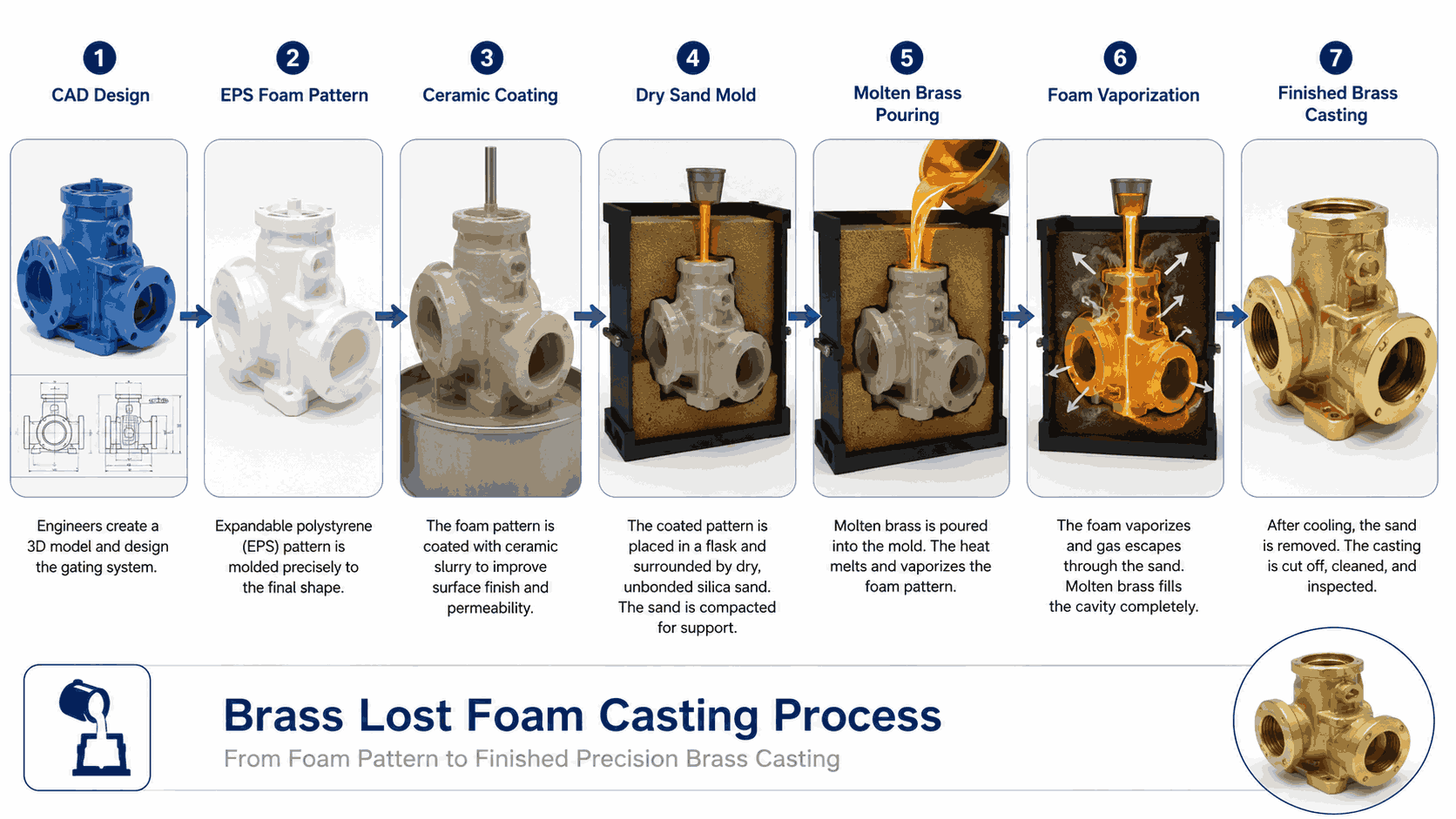
1. Foam Pattern Manufacturing
An expandable polystyrene (EPS) pattern is molded to the exact shape of the final casting. Multiple patterns can be assembled into a cluster to improve production efficiency.
2. Refractory Coating
The foam pattern is coated with a ceramic slurry that:
- Improves surface finish
- Controls gas escape
- Prevents sand penetration
- Enhances mold stability
The coating must dry completely before molding.
3. Sand Filling
The coated pattern is placed inside a flask and surrounded with dry, unbonded silica sand. Vibration compacts the sand around every feature without damaging the foam.
4. Molten Brass Pouring
Molten brass is poured directly into the gating system. The heat instantly vaporizes the foam while the liquid metal fills the cavity.
Stable pouring temperature and speed are critical for reducing gas defects.
5. Cooling and Cleaning
After solidification, the sand is removed and recycled. The casting is then cleaned, inspected, and machined if necessary.
Why Choose Brass Lost Foam Casting?
Many manufacturers select lost foam brass casting because it combines design flexibility with competitive production costs.
Excellent Design Freedom
Since the foam pattern is sacrificed during casting, complicated internal and external geometries can often be produced without separate cores.
This simplifies mold design while reducing assembly errors.
Lower Machining Costs
Near-net-shape castings require less machining than conventional sand castings, reducing production time and material waste.
Cost-Effective Tooling
Compared with investment casting, tooling costs are generally lower, making the process attractive for medium production volumes.
High Material Utilization
The simplified gating system and reduced machining allowance improve overall material efficiency.
Suitable for Large Components
Unlike investment casting, lost foam casting can economically produce relatively large brass components while maintaining consistent quality.
| Benefit | Customer Value |
| Complex geometry | Greater design flexibility |
| Reduced machining | Lower manufacturing cost |
| Lower tooling investment | Better ROI for medium batches |
| High material utilization | Less waste |
| Simplified mold assembly | Faster production |
Limitations of Brass Lost Foam Casting
Like every casting process, casting brass lost foam has limitations that engineers should consider during product design.
- Surface finish is generally not as smooth as investment casting.
- Gas generation from foam requires excellent process control.
- Extremely thin-wall components may be difficult to produce consistently.
- Dimensional accuracy is lower than precision investment casting.
- Pattern quality directly affects casting quality.
Understanding these limitations helps determine whether lost foam casting is the best solution for a specific application.
Brass Lost Foam Casting vs Sand Casting vs Investment Casting
Choosing the right casting process depends on part geometry, production volume, quality requirements, and budget.
| Feature | Lost Foam Casting | Sand Casting | Investment Casting |
| Surface Finish | Good | Fair | Excellent |
| Dimensional Accuracy | Good | Moderate | Excellent |
| Tooling Cost | Medium | Low | High |
| Complex Shapes | Excellent | Moderate | Excellent |
| Machining Required | Low | High | Very Low |
| Large Parts | Excellent | Excellent | Limited |
Choose Brass Lost Foam Casting When:
- Parts have complex geometries.
- Medium production volumes are required.
- Machining costs need to be reduced.
- Large castings are involved.
Choose Sand Casting When:
- Initial cost is the primary concern.
- Part geometry is relatively simple.
- Surface finish is not critical.
Choose Investment Casting When:
- Tight tolerances are essential.
- Superior surface quality is required.
- Small, highly detailed components are being manufactured.
Typical Applications of Brass Lost Foam Casting
The versatility of lost foam casting brass makes it suitable for many industrial sectors.
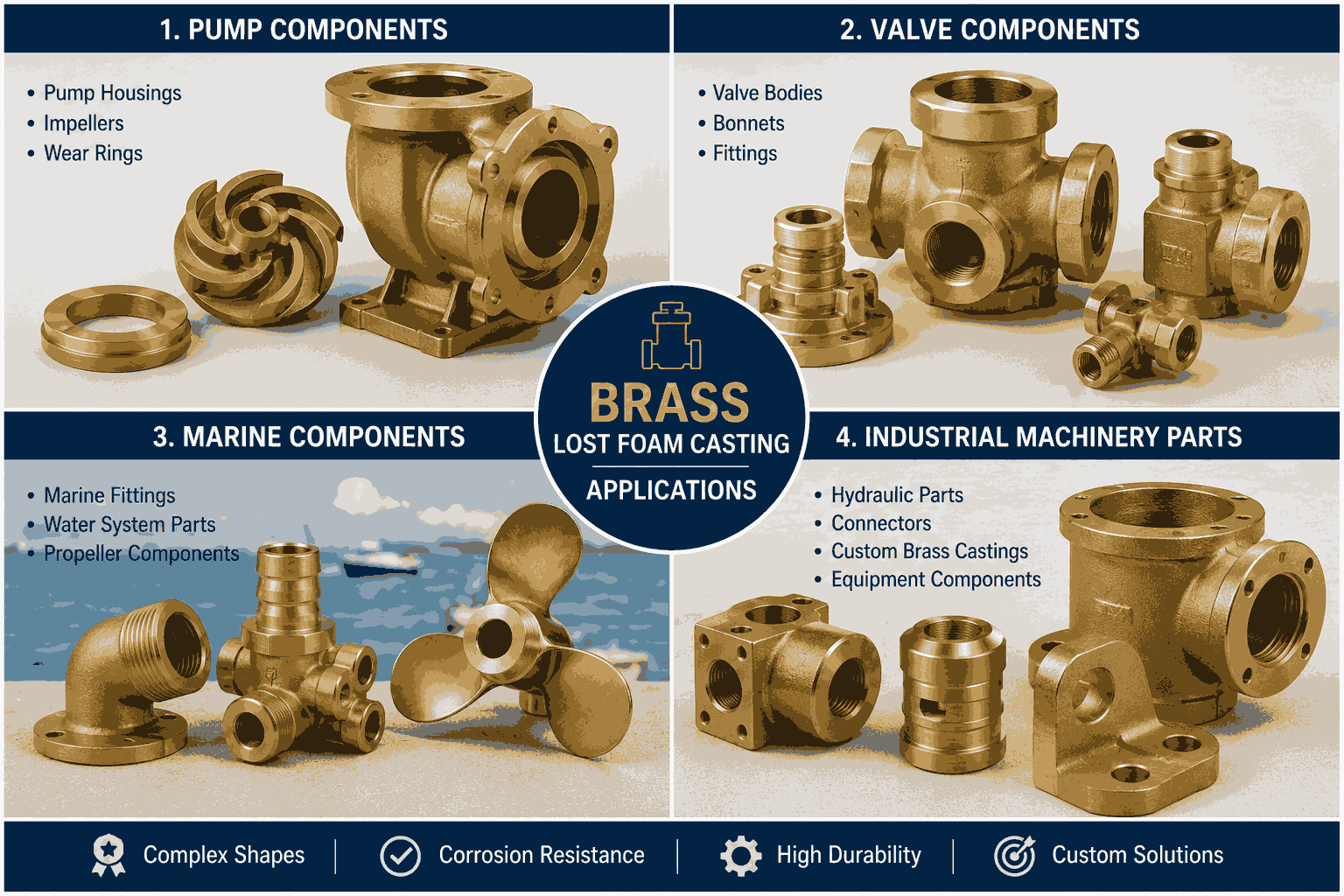
Pump Components
- Pump housings
- Impellers
- Wear components
Valve Components
- Valve bodies
- Valve bonnets
- Industrial fittings
Marine Industry
Brass naturally resists seawater corrosion, making it suitable for:
- Marine fittings
- Water system components
- Propeller accessories
Industrial Equipment
Manufacturers also use brass lost foam casting for:
- Hydraulic parts
- Machinery housings
- Equipment connectors
- Agricultural machinery components
Design Tips for Better Brass Lost Foam Castings
Good casting quality starts with good design.
Consider the following recommendations:
- Maintain uniform wall thickness whenever possible.
- Avoid sharp corners by adding generous fillets.
- Design smooth metal flow paths.
- Include proper machining allowance where required.
- Minimize sudden section changes.
- Optimize gating and riser locations with your casting supplier during DFM review.
Early engineering collaboration can significantly reduce defects and production costs.
What Affects Brass Lost Foam Casting Cost?
Several factors influence the final manufacturing cost.
| Cost Factor | Impact |
| Brass alloy | High |
| Part size | High |
| Structural complexity | Medium |
| Annual quantity | High |
| CNC machining | Medium to High |
| Surface finishing | Medium |
| Inspection requirements | Medium |
In many cases, simplifying the part design can reduce total manufacturing costs more effectively than selecting a cheaper alloy.
How to Choose a Reliable Brass Lost Foam Casting Manufacturer
Selecting the right supplier is just as important as selecting the right casting process.
Look for manufacturers that offer:
- Extensive brass casting experience
- Complete DFM engineering support
- Stable melting and pouring control
- CNC machining capability
- Material certification and traceability
- Comprehensive dimensional inspection
- Export experience for industrial markets
- ISO-certified quality management systems
An experienced supplier can often recommend design improvements before production begins, reducing both cost and lead time.
Frequently Asked Questions
Can brass be used in lost foam casting?
Yes. Brass can be successfully cast using the lost foam process when pouring temperature, coating quality, and gas control are carefully managed.
Is brass lost foam casting suitable for precision parts?
It provides good dimensional accuracy for many industrial components. However, investment casting remains the better choice for parts requiring extremely tight tolerances.
What industries commonly use brass lost foam castings?
Typical industries include pumps, valves, marine engineering, water treatment, industrial machinery, and agricultural equipment.
What is the biggest advantage of brass lost foam casting?
The process allows engineers to manufacture complex components with fewer cores, reduced machining, and lower tooling costs than many alternative casting methods.
JC Casting is a professional brass casting manufacturer. If you’re developing custom brass parts and need expert advice to pick the right casting process, send us your drawings. Our engineering team will review your designs, recommend the best production solution, and supply high-quality brass castings fully customized to your project needs.