
Many engineers choose silicon bronze casting because it combines corrosion resistance, strength, attractive appearance, and excellent castability.
Whether you’re designing marine hardware, architectural components, pump parts, or custom industrial castings, understanding the alloy and casting process helps improve both product performance and manufacturing efficiency.
This guide explains the key factors behind silicon bronze casting, including alloy composition, material advantages, casting processes, temperature control, common defects, applications, and how to select a reliable silicon bronze casting manufacturer.
What Is Silicon Bronze Casting?
Silicon bronze casting is a manufacturing process that produces components by melting a copper-based alloy containing silicon and forming it into a designed shape through casting.
Unlike traditional bronze alloys that mainly use tin as the strengthening element, silicon bronze uses silicon to improve strength, corrosion resistance, and casting performance.
Typical silicon bronze alloys contain approximately 2–4% silicon, with copper as the main element. Small amounts of manganese, zinc, and iron may also be added to improve strength, deoxidation, and overall material stability.
The addition of silicon provides several important benefits:
- Improved molten metal fluidity
- Better corrosion resistance
- Higher mechanical strength
- Good wear resistance
- Excellent weldability
- Attractive natural appearance
Because of these advantages, silicon bronze is often selected for parts exposed to seawater, outdoor environments, moisture, and industrial conditions.
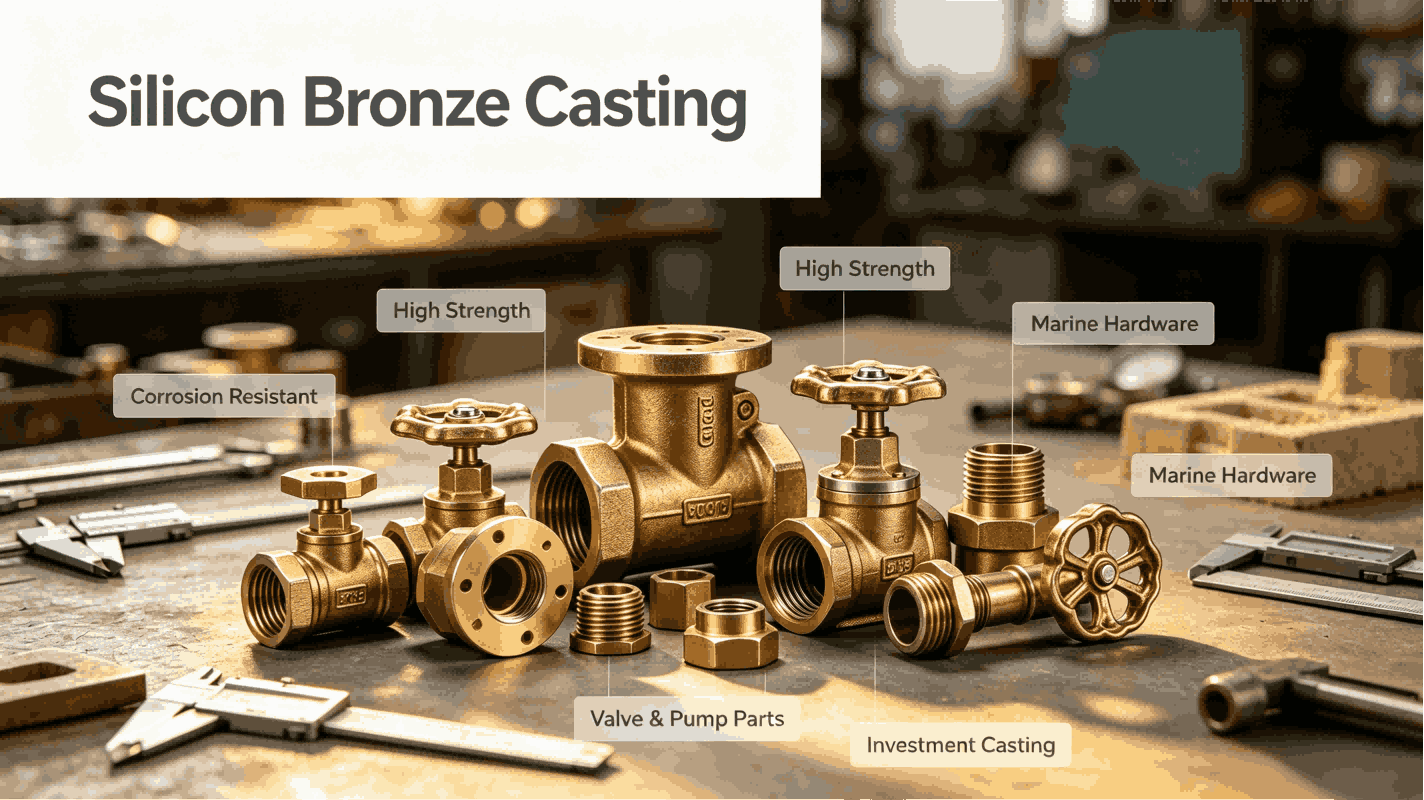
Common silicon bronze castings include:
- Marine hardware
- Valve components
- Pump parts
- Electrical fittings
- Architectural components
- Industrial machinery parts
Depending on production requirements, silicon bronze can be manufactured through different casting methods, including investment casting, sand casting, and permanent mold casting.
Silicon Bronze Alloy Composition and Material Properties
The performance of silicon bronze depends heavily on its chemical composition and manufacturing control.
Different standards may have slightly different compositions, but common silicon bronze casting alloys generally contain:
| Element | Typical Content |
| Copper (Cu) | Balance |
| Silicon (Si) | 2–4% |
| Manganese (Mn) | 0.5–1.5% |
| Zinc (Zn) | Small amount |
| Iron (Fe) | Trace |
Among commercial grades, C87300 silicon bronze is one of the most commonly used alloys for casting applications. It is also known as Everdur® silicon bronze in some markets. Some suppliers may use similar terms such as “silicon bronze casting alloy Everdur” when describing this material.
Key Properties of Silicon Bronze
Excellent Corrosion Resistance
Corrosion resistance is one of the main reasons engineers choose silicon bronze for casting.
The alloy performs well in:
- Marine environments
- Saltwater exposure
- Coastal applications
- Outdoor structures
- Industrial environments
Compared with many standard steels, silicon bronze provides longer service life without additional protective coatings.
Good Strength and Durability
Silicon bronze provides a balanced combination of strength and ductility.
Although aluminum bronze generally provides higher strength, silicon bronze offers easier casting and better fabrication characteristics, making it suitable for many precision components.
Typical advantages include:
- Good tensile strength
- Reliable fatigue performance
- Resistance to impact loading
- Stable performance over long service periods
Excellent Castability
For foundries, castability is a critical factor.
Silicon bronze flows well during pouring, allowing manufacturers to produce:
- Complex geometries
- Thin sections
- Detailed surfaces
- Precision components
Its good fluidity reduces the risk of incomplete filling and improves overall casting consistency.
Machinability and Weldability
After casting, many components require machining operations such as drilling, milling, or turning.
Silicon bronze offers good machinability compared with many high-strength copper alloys. It also has excellent weldability, which provides flexibility for repair, assembly, and fabrication.
Why Choose Silicon Bronze for Casting?
When selecting a casting alloy, engineers must consider more than just strength. The ideal material should provide a balance between performance, manufacturability, and long-term cost.
Silicon bronze has become a preferred choice because it performs well across multiple requirements.
Suitable for Harsh Operating Conditions
Marine and industrial components often face moisture, chemicals, and temperature changes.
Silicon bronze maintains reliable performance because of its natural corrosion resistance. This makes it suitable for:
- Boat hardware
- Pumps
- Valves
- Outdoor equipment
- Coastal structures
Better Casting Performance for Complex Components
Compared with some stronger bronze alloys, silicon bronze is easier to cast into complex shapes.
This advantage helps manufacturers produce components with:
- Reduced machining requirements
- Better surface quality
- Lower production risk
For precision components, investment casting silicon bronze is often selected because it combines dimensional accuracy with excellent surface finish.
Lower Lifecycle Cost
Although silicon bronze may have a higher material cost than some common alloys, its corrosion resistance and durability can reduce long-term expenses.
Benefits include:
- Longer service life
- Less maintenance
- Fewer replacements
- Reduced downtime
For industrial buyers, total lifecycle cost is often more important than the initial material price.
Silicon Bronze Casting Process Explained
The quality of silicon bronze casting depends not only on alloy selection but also on how well each manufacturing step is controlled. Proper melting, mold design, pouring, and solidification management are essential to achieve consistent mechanical properties and minimize casting defects.
For industrial components, a professional foundry usually follows a controlled process from raw material preparation to final inspection.
Step 1: Material Preparation and Melting
The casting process starts with selecting qualified silicon bronze ingots for casting. The raw material must meet the required chemical composition to ensure stable mechanical properties and corrosion resistance.
During melting, foundries typically use induction furnaces because they provide:
- Accurate temperature control
- Stable alloy composition
- Cleaner melting conditions
- Better energy efficiency
Before pouring, the molten bronze is checked for:
- Chemical composition
- Temperature
- Surface oxidation
- Metal cleanliness
Proper melt control helps reduce defects such as porosity and oxide inclusions.
Step 2: Mold Design and Preparation
The mold plays an important role in determining casting quality.
A well-designed mold controls how molten silicon bronze flows and solidifies. Poor mold design can lead to incomplete filling, shrinkage, or internal defects.
Important mold design factors include:
- Gating system design
- Riser placement
- Venting
- Wall thickness distribution
- Cooling conditions
For complex industrial components, foundries often use simulation tools to analyze metal flow and solidification before production.
This helps optimize the process and reduce trial production costs.
Step 3: Pouring and Solidification
During pouring, molten silicon bronze must fill the mold cavity smoothly before solidification begins.
The main goals are:
- Maintain stable pouring temperature
- Avoid excessive turbulence
- Reduce oxidation
- Ensure complete mold filling
After pouring, the casting cools and solidifies. The cooling process directly affects:
- Grain structure
- Mechanical properties
- Shrinkage behavior
- Surface quality
Controlled solidification allows the final casting to achieve better strength and dimensional stability.
Silicon Bronze Casting Process Selection
Different casting methods are suitable for different applications. The best process depends on part size, geometry, production volume, tolerance requirements, and cost targets.
Investment Casting Silicon Bronze
Investment casting is one of the most common processes for precision silicon bronze components.
The process uses a wax pattern covered with ceramic material to create a highly accurate mold.
Advantages include:
- Excellent dimensional accuracy
- Smooth surface finish
- Complex geometry capability
- Reduced machining allowance
- Suitable for thin-wall components
Typical applications include:
- Marine fittings
- Valve components
- Pump parts
- Precision industrial hardware
For engineers requiring detailed parts with tight tolerances, investment casting is often the preferred solution.
Sand Casting Silicon Bronze
Sand casting is widely used for larger components or projects requiring lower tooling costs.
Advantages include:
- Flexible production
- Lower mold cost
- Suitable for large castings
- Good for low- to medium-volume production
Typical applications:
- Large valve bodies
- Pump housings
- Industrial machinery components
Compared with investment casting, sand casting usually provides lower precision and requires more machining, but it remains a cost-effective option for larger parts.
Permanent Mold Casting
Permanent mold casting uses reusable metal molds instead of disposable molds.
Advantages include:
- Better repeatability
- Faster production cycles
- Improved surface finish compared with sand casting
However, it is generally more suitable for simpler geometries because mold design limitations make highly complex shapes more difficult to produce.
Comparison of Silicon Bronze Casting Methods
| Casting Process | Main Advantages | Best Applications |
| Investment Casting | High accuracy, excellent surface finish, complex shapes | Precision industrial parts |
| Sand Casting | Lower tooling cost, large component capability | Large valves, pumps, machinery parts |
| Permanent Mold Casting | Repeatable production, faster cycles | Medium-volume standard components |
Choosing the correct casting process helps balance product performance, manufacturing cost, and production efficiency.
Silicon Bronze Casting Shrinkage and Defect Prevention
Like all metals, silicon bronze contracts during cooling from liquid to solid state.
If the solidification process is not properly controlled, the volume reduction can create internal voids or surface defects.
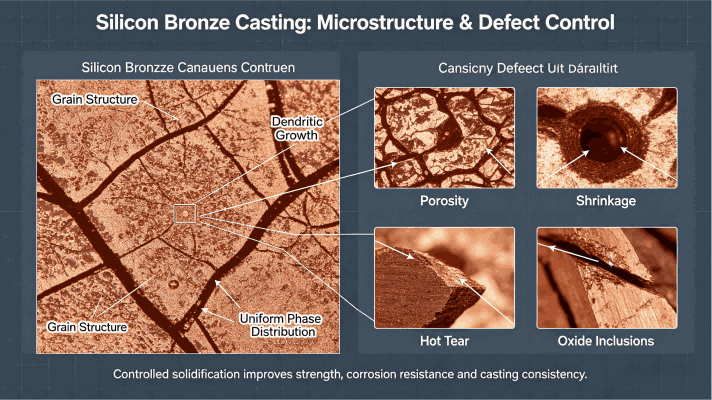
Silicon Bronze Casting Shrinkage
Silicon bronze casting shrinkage occurs mainly because different areas of the casting cool at different speeds.
Common causes include:
- Uneven wall thickness
- Poor feeding design
- Incorrect riser position
- Improper cooling control
To reduce shrinkage defects, foundries typically improve:
- Gating system design
- Riser size and location
- Casting geometry
- Solidification direction
A well-designed casting should allow liquid metal to continuously feed areas that solidify later.
Silicon Bronze Casting Shrinkage Tear (Hot Tear)
Another important concern is silicon bronze casting shrinkage tear, also known as hot tearing.
Hot tears occur during the final stage of solidification when the metal contracts but cannot move freely because of internal stress or mold restrictions.
Typical causes include:
- Sharp corners
- Sudden wall thickness changes
- Poor mold design
- Excessive thermal stress
Preventive methods include:
1. Improve Component Design
Engineers should avoid:
- Sharp transitions
- Extremely thick sections
- Uneven wall thickness
Instead, use:
- Smooth geometry changes
- Proper fillet radii
- Uniform sections
2. Optimize Casting Parameters
Foundries can reduce hot tearing through:
- Better pouring temperature control
- Improved feeding design
- Controlled cooling rates
3. Use Simulation Before Production
For complex components, casting simulation helps predict:
- Shrinkage locations
- Hot spots
- Solidification problems
This allows engineers to modify designs before expensive tooling production.
Grain Structure and Metallurgical Quality Control
The internal grain structure of silicon bronze directly affects strength, durability, and long-term performance.
A controlled silicon bronze casting grain structure helps improve:
- Tensile strength
- Fatigue resistance
- Toughness
- Machining performance
Grain size is influenced by:
- Cooling rate
- Mold material
- Pouring temperature
- Alloy composition
Professional foundries use quality control methods such as:
- Chemical composition testing
- Temperature monitoring
- Microstructure analysis
- Mechanical property testing
These controls ensure that silicon bronze castings meet engineering requirements for demanding applications.
Typical Applications of Silicon Bronze Castings
Because of its excellent corrosion resistance, good strength, and reliable casting performance, silicon bronze is widely used across industries where durability and long service life are critical.
Marine Industry
Marine applications are one of the most common uses of silicon bronze castings.
Components exposed to seawater require materials that can resist corrosion while maintaining mechanical performance. Silicon bronze is widely used for:
- Boat hardware
- Propeller components
- Marine fittings
- Deck hardware
- Pump components
Its resistance to saltwater corrosion makes it a preferred choice for long-term marine service.
Valve and Pump Industry
Silicon bronze is also widely used in fluid handling equipment.
Typical components include:
- Valve bodies
- Valve seats
- Pump housings
- Impeller components
- Connecting parts
The alloy provides a good balance of corrosion resistance, wear resistance, and castability, making it suitable for water, marine, and industrial fluid systems.
Architectural and Decorative Applications
Silicon bronze is valued not only for performance but also for appearance.
Its natural golden color and ability to develop an attractive patina make it popular for:
- Door hardware
- Building decorations
- Sculptures
- Custom architectural components
Unlike coated metals, silicon bronze can maintain its aesthetic value while providing excellent outdoor durability.
Industrial Equipment
Many industrial manufacturers use silicon bronze castings for components requiring stable performance under demanding conditions.
Applications include:
- Machinery parts
- Electrical components
- Industrial fittings
- Custom OEM castings
Its combination of strength, corrosion resistance, and manufacturability makes it suitable for customized engineering solutions.
Silicon Bronze vs Other Bronze Casting Alloys
Choosing the correct bronze alloy depends on the application’s requirements. Silicon bronze is not always the strongest bronze alloy, but it offers one of the best overall balances between performance and manufacturability.
The comparison below shows the differences between common bronze casting alloys.
| Property | Silicon Bronze | Aluminum Bronze | Tin Bronze |
| Corrosion Resistance | Excellent | Excellent | Good |
| Strength | High | Very High | Medium |
| Castability | Excellent | Good | Good |
| Machinability | Good | Moderate | Good |
| Weldability | Excellent | Moderate | Good |
| Marine Applications | Excellent | Excellent | Good |
| Typical Cost | Medium | Higher | Medium |
Silicon Bronze vs Aluminum Bronze
Aluminum bronze generally provides higher strength and better wear resistance, making it suitable for heavy-duty applications such as:
- Offshore equipment
- High-load valves
- Industrial machinery
However, aluminum bronze is usually more difficult to machine and cast compared with silicon bronze.
Silicon bronze is often preferred when manufacturers need:
- Better castability
- Easier machining
- Excellent corrosion resistance
- Decorative appearance
Silicon Bronze vs Tin Bronze
Tin bronze has a long history in bearing and wear applications.
However, silicon bronze often provides:
- Better corrosion resistance
- Higher strength
- Better weldability
- Improved casting performance
For marine and architectural applications, silicon bronze is frequently the more suitable choice.
Design Considerations for Silicon Bronze Castings
Good casting quality starts before production begins.
A well-designed component reduces manufacturing problems, improves reliability, and lowers production costs.
Engineers should consider the following factors when designing silicon bronze castings.
Maintain Uniform Wall Thickness
Large differences in wall thickness can create uneven cooling and increase the risk of shrinkage defects.
Recommended practices:
- Avoid unnecessary thick sections
- Use gradual transitions
- Maintain consistent geometry
Add Proper Fillets and Radii
Sharp corners create stress concentration and restrict metal flow.
Using proper radii helps:
- Improve filling
- Reduce hot tearing
- Increase casting durability
Consider Machining Allowance
Although precision casting can achieve good accuracy, additional machining allowance may be required for:
- Critical surfaces
- Threaded areas
- Sealing surfaces
- Tight tolerance locations
Early cooperation between designers and foundries helps determine the most cost-effective solution.
How to Choose the Right Silicon Bronze Casting Manufacturer
Choosing the right silicon bronze casting manufacturer is essential for achieving consistent quality, reliable delivery, and long-term product performance.
A qualified supplier should provide more than casting production. The right partner should have strong material knowledge, engineering support, and quality control capabilities throughout the entire manufacturing process.
Key factors to evaluate include:
Casting Experience and Technical Capability
Silicon bronze requires careful control of alloy composition, melting temperature, mold design, and solidification. A manufacturer with experience in copper alloy casting can better prevent common issues such as porosity, shrinkage, and dimensional variation.
Look for suppliers with experience in:
- Silicon bronze and copper alloy castings
- Complex component production
- Casting defect prevention
- Process optimization
Material Control and Quality Inspection
Reliable suppliers should maintain strict material and quality control systems, including:
- Material certificates
- Chemical composition testing
- Production traceability
- Dimensional inspection
- Mechanical testing when required
These controls ensure that each casting meets the required specifications and performance expectations.
Engineering Support and Manufacturing Services
A strong casting partner should support the project from design to production through:
- Design for Manufacturability (DFM) review
- Casting process recommendations
- CNC machining
- Surface finishing
- Final inspection
This integrated capability helps reduce development time, simplify supply chains, and improve production consistency.
About JC Casting
JC Casting is an experienced precision casting manufacturer in China specializing in custom metal castings, including silicon bronze casting, stainless steel casting, carbon steel casting, aluminum casting, and CNC machining services.
With over 20 years of casting experience, JC Casting supports customers from initial design evaluation and casting process development to machining, finishing, and quality inspection.
By combining advanced casting technology, engineering expertise, and strict quality control, JC Casting helps global customers produce reliable components for marine, valve, pump, industrial equipment, and other demanding applications.
Frequently Asked Questions About Silicon Bronze Casting
1. What is silicon bronze casting?
Silicon bronze casting is a process that produces metal components by melting silicon bronze alloy and forming it into a required shape using a mold. It is commonly used for marine, industrial, and architectural applications because of its corrosion resistance and excellent castability.
2. What is silicon bronze used for?
Silicon bronze is commonly used for:
- Marine hardware
- Valves
- Pumps
- Architectural components
- Electrical fittings
- Industrial machinery parts
3. What is the melting temperature of silicon bronze?
The melting range of silicon bronze is typically around 950–1060°C, while the recommended pouring temperature is usually higher, depending on the alloy grade and casting process.
Actual values vary according to casting design, mold type, and production requirements.
4. Is silicon bronze good for marine applications?
Yes. Silicon bronze is one of the most popular bronze alloys for marine environments because it provides excellent resistance to seawater corrosion and maintains good mechanical properties over long service periods.
5. What casting process is best for silicon bronze?
The best process depends on the application.
- Investment casting is suitable for complex precision parts.
- Sand casting is suitable for larger components.
- Permanent mold casting is suitable for repeated production.