
Chromate conversion coating is a chemical conversion coating. It forms a thin protective film on a metal surface by immersing metal parts in an acidic solution that contains chromates, such as chromic acid or dichromates. This treatment improves corrosion resistance and increases coating adhesion.
Read this article to learn more about chromate conversion coating.
What Is Chromate Conversion Coating?
Chromate conversion coating is a chemical surface treatment. During the process, metal parts are immersed in an acidic solution containing chromates, such as chromic acid or dichromates. A chemical reaction takes place between the metal surface and the solution. This reaction creates a thin protective conversion coating on the metal.
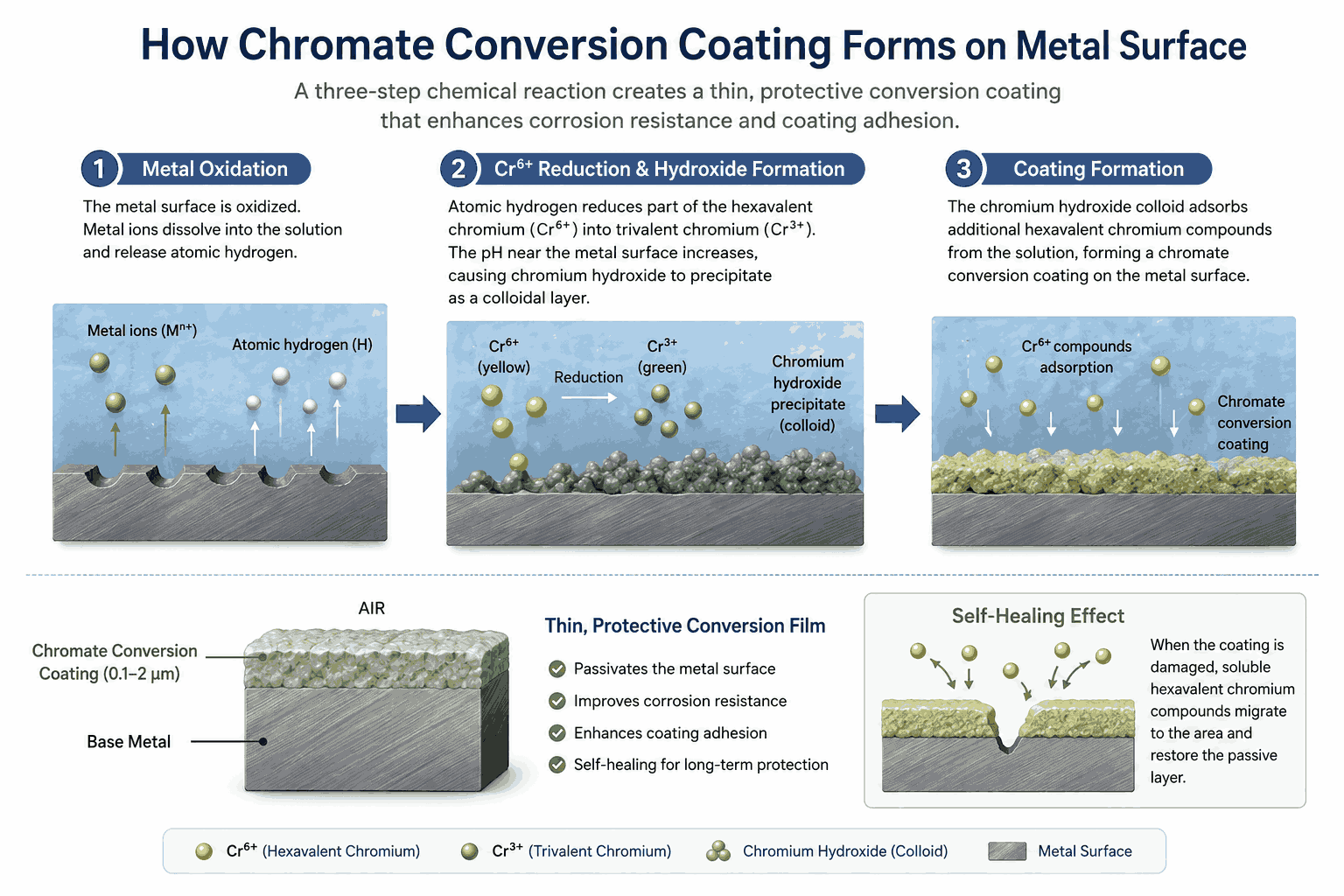
Chromate conversion coating is a complex multi-phase reaction that occurs at the interface between the metal and the solution. In general, the coating forms through three main steps.
Step 1
The metal surface is first oxidized. Metal ions dissolve into the solution and release atomic hydrogen.
Step 2
The atomic hydrogen reduces part of the hexavalent chromium (Cr⁶⁺) into trivalent chromium (Cr³⁺). At the same time, the pH value near the metal surface increases. This causes chromium hydroxide to precipitate as a colloidal layer.
Step 3
The chromium hydroxide colloid adsorbs additional hexavalent chromium compounds from the solution. Together, they form a chromate conversion coating on the metal surface.
If the coating experiences minor damage, soluble hexavalent chromium compounds can migrate to the damaged area and restore the passive layer. This self-healing effect helps protect the metal from corrosion.
Features of Chromate Conversion Coating
Chromate conversion coating is chemically stable and highly effective for metal surface protection. It passivates the metal surface, improves corrosion resistance, increases coating adhesion, and enhances appearance.
Corrosion Protection
Chromate conversion coating improves corrosion resistance by forming a protective film on the metal surface. This barrier prevents moisture, oxygen, and corrosive substances from reaching the base metal.
Key Benefits
- Self-healing capability: Soluble chromate compounds migrate into scratched or worn areas and help restore the protective layer.
- Chemical stability: The coating resists attack from water, oxygen, and many chemicals.
- Environmental resistance: It performs well in marine atmospheres and high-humidity environments.
Surface Cleaning
Chromate conversion solutions remove oil, dirt, and other surface contaminants. This leaves the metal cleaner and better prepared for subsequent finishing processes.
Improved Surface Hardness
The treatment forms a dense passive layer on the metal surface. This layer increases surface hardness and wear resistance while also improving the coating’s color and appearance.
Better Coating Adhesion
Chromate conversion coating provides an excellent base for paints, powder coatings, and adhesives. Its porous structure and chemical activity create a strong bonding surface.
Key Benefits
- Chemical bonding: The coating forms strong chemical bonds with paints and coatings.
- Higher adhesion strength: Surface properties improve coating adhesion to the metal.
- Increased surface roughness: More contact points help create stronger mechanical bonding.
Electrical Conductivity
Although chromate conversion coating mainly improves corrosion resistance and adhesion, it also maintains a certain level of electrical conductivity. This makes it valuable for applications that require reliable electrical grounding.
Key Benefits
- Electrical connections: It allows components such as aircraft landing gear and control systems to maintain good electrical continuity.
- Low electrical resistance: The coating provides relatively low contact resistance compared with many other protective coatings.
Decorative Appearance
Chromate conversion coating can also improve the appearance of metal parts. Different process parameters produce different colors, making the surface more attractive while maintaining protection.
Available colors include:Clear、Transparent、Milky white、Yellow Gold、Light green、Green、Olive green、Dark green、Brown and Black
Applications of Chromate Conversion Coating in Machined Products
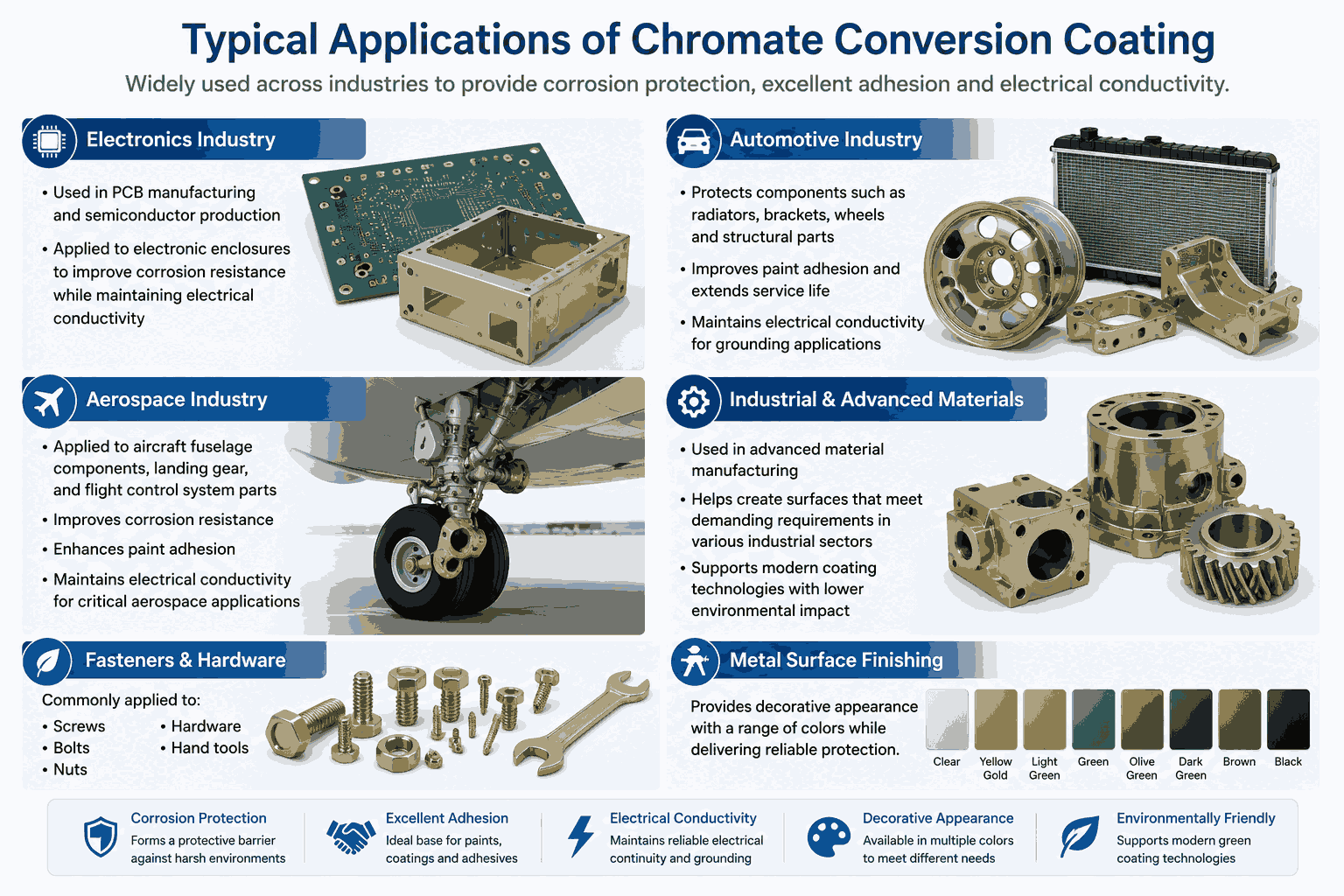
Chromate conversion coating is widely used across many manufacturing industries because it combines corrosion protection, good adhesion, and electrical conductivity.
Electronics Industry
- Used in printed circuit board (PCB) manufacturing and semiconductor production, where high-purity chemical processes are required.
- Applied to electronic enclosures to improve corrosion resistance while maintaining electrical conductivity.
Automotive Industry
- Protects automotive components such as radiators, wheels, brackets, and structural parts from corrosion.
- Improves paint adhesion while increasing the durability and service life of metal components.
- Maintains electrical conductivity for grounding applications.
Aerospace Industry
- Applied to aircraft fuselage components, landing gear, and flight control system parts.
- Improves corrosion resistance.
- Enhances paint adhesion.
- Maintains electrical conductivity for critical aerospace applications.
Advanced Material Manufacturing
Many machined parts require materials with specialized performance. Chromate conversion coating helps create surfaces that meet demanding requirements in different industrial sectors.
Environmentally Friendly Coatings
As environmental regulations become stricter, environmentally friendly coating systems are becoming more popular. Chromate conversion coating supports modern coating technologies that reduce harmful substances and lower environmental impact.
Fasteners
Chromate conversion coating is commonly applied to:
- Screws
- Bolts
- Nuts
- Hardware
- Hand tools
The treatment often gives these parts a distinctive yellow or rainbow iridescent finish while improving corrosion resistance.
Metal Surface Finishing
Surface finishing is essential for machined metal components. Chromate conversion coating protects metal against oxidation and corrosion while improving durability and overall performance.
At Zintilon, this process is widely used as part of our environmentally friendly coating solutions and professional metal surface finishing services.
Advantages of Chromate Conversion Coating
Chromate conversion coating is not suitable for every metal, but it is commonly used on:
- Aluminum
- Aluminum alloys
- Zinc
- Copper
- Steel
- Iron
- Tin
- Cadmium
Its major advantages include the following.
Environmentally Friendly Process
Compared with traditional chromate production methods, modern chromate conversion processes use more environmentally friendly materials and manufacturing methods. These processes reduce harmful emissions and help protect the environment.
Sustainable Resource Utilization
Traditional processes often rely on limited chemical resources such as chlorine. Modern chromate conversion technologies use more sustainable raw materials, including aluminum powder and ammonium chloride. This helps improve resource efficiency and supports long-term sustainability.
Precautions for Chromate Conversion Coating
Chromate conversion coating is highly corrosive during processing. Operators must follow all safety procedures, maintain good ventilation, and use proper protective equipment.
Coated metal surfaces also require proper maintenance during use. Avoid mechanical scratches and chemical attack that may damage the protective film.
Chromate conversion coating works especially well for large metal parts and irregularly shaped components. For very small parts, other surface treatment methods may be more suitable.
Different base metals require different chromate conversion solution formulas. As a result, the final coating color and composition will vary depending on the substrate.
Environmental and Health Concerns
Chromate conversion coating performs extremely well in industrial applications. However, increasing regulations now limit the use of hexavalent chromium because of environmental and health concerns.
Hexavalent chromium compounds are considered highly toxic. They are associated with cancer risks and can cause environmental damage if released into the environment.
Development of Alternatives
a.Trivalent Chromium (Cr³⁺)
Trivalent chromium is becoming a common alternative. It provides good corrosion resistance while significantly reducing health and environmental risks compared with hexavalent chromium.
b.Chromium-Free Treatments
Manufacturers are also developing chromium-free surface treatment technologies. These processes aim to reduce the environmental impact of metal finishing.
Traditional chromate production methods that use chlorine and hydrogen can be hazardous and may negatively affect the environment.
Modern chromate conversion processes use safer raw materials and offer a more environmentally friendly and efficient solution.
Zintilon’s Chromate Conversion Coating Services
Chromate conversion coating helps improve corrosion resistance and coating adhesion on metal surfaces. Because the process is relatively cost-effective, it is widely used across many industries.
Zintilon provides chromate conversion coating services for a wide range of metal components. From part manufacturing to surface finishing, we deliver efficient and high-quality solutions.
Whether you need custom part production or professional surface treatment, our team can help you find the right solution for your project.
If you would like to learn more about our services or request a quote, please feel free to contact us.
Frequently Asked Questions
How Thick Is a Chromate Conversion Coating?
Typical range: approximately 0.01–3 μm (10–3000 nm), depending on the base metal, process, and application.
Common thickness ranges
- Aluminum and aluminum alloys: about 0.1–1 μm.
- Zinc or cadmium plated parts: about 0.25–3 μm (for example, according to MIL-DTL-5541).
Key Feature
The coating is very thin, but it provides significant corrosion protection and usually has minimal effect on dimensional accuracy.
What Is the Purpose of Chromate Conversion Coating?
Chromate conversion coating serves several important functions.
| Function | Purpose |
| Corrosion resistance | Forms a passive protective layer that reduces metal oxidation. |
| Paint adhesion | Improves bonding for paint, powder coating, and other finishes. |
| Electrical conductivity | Some coatings, such as clear or iridescent finishes, maintain good electrical conductivity. |
| Decorative appearance | Produces colors such as gold, rainbow, or olive brown depending on the process. |
| Wear resistance | Sealed coatings can improve surface durability. |
What Standards Apply to Chromate Conversion Coatings?
International and General Standards
- ISO 4520 — Chromate coatings on zinc and cadmium.
- ASTM B201 — Test methods for chromate conversion coatings on aluminum.
- MIL-DTL-5541 (U.S. military standard):
·Type I: Hexavalent chromium (Cr⁶⁺), traditional process.
· Type II: Non-hexavalent coatings (Cr³⁺), RoHS-compliant.
Industry-Specific Standards
| Industry | Common Standards |
| Aerospace | AMS 2473 (aluminum), AMS 2474 (magnesium) |
| Automotive | OEM-specific standards such as Ford WSS-M21P-A |
Environmental Regulations
- RoHS / REACH: Restrict the use of hexavalent chromium and promote trivalent chromium alternatives.
- Department of Defense (DoD) policies: Allow limited exemptions for hexavalent chromium in certain critical applications.