
Whether you’re sourcing aerospace brackets, automotive housings, robotics components, or customized industrial equipment. Aluminum CNC Machining strikes a perfect balance.It offers great machinability, solid structural strength, reliable corrosion resistance and affordable cost.
This guide covers key practical knowledge. It explains how aluminum CNC machining works. It clarifies applicable scenarios for casting and CNC hybrid processing. It introduces the best-performing aluminum grades. It also teaches you how to select a dependable manufacturing partner.
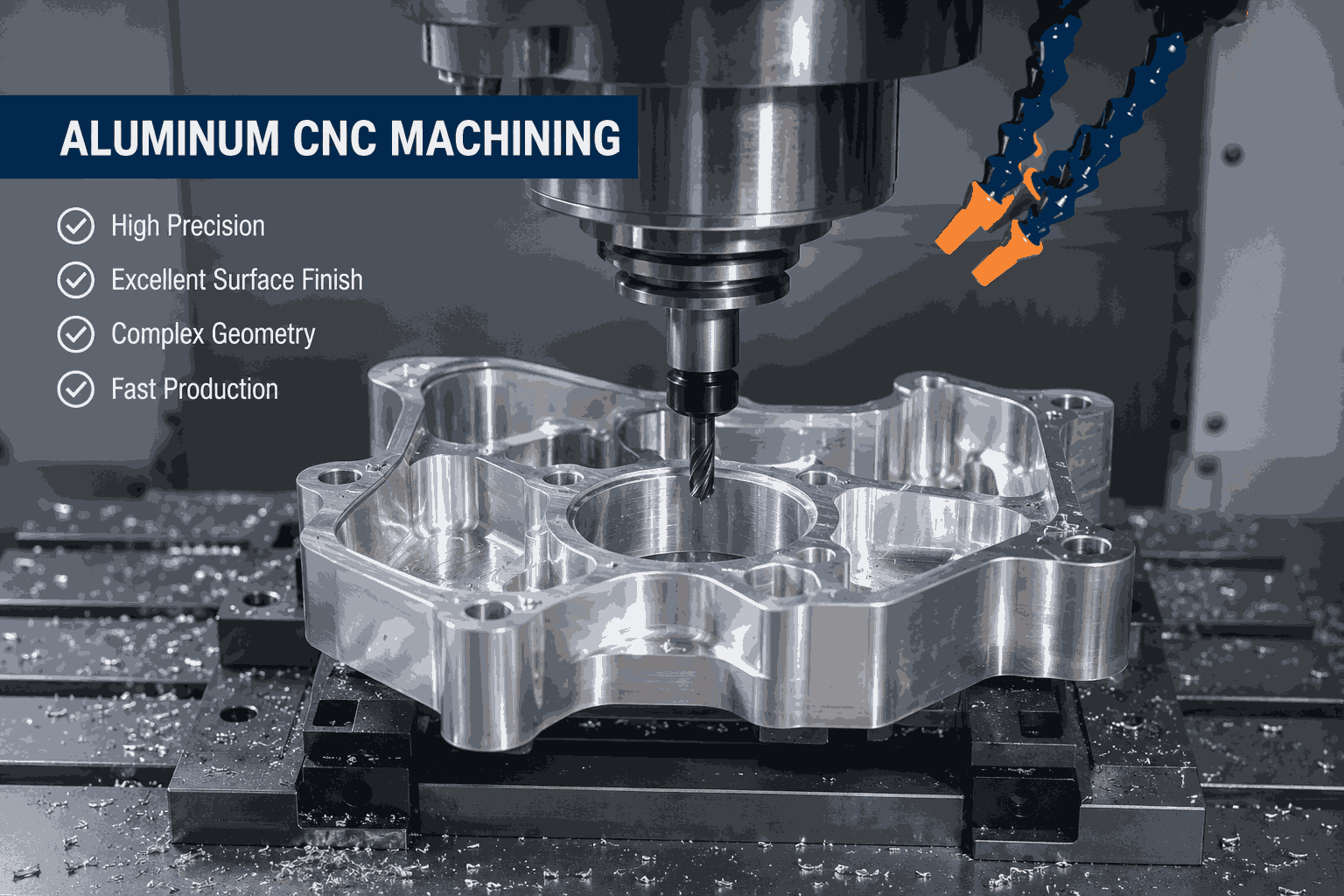
What Is Aluminum CNC Machining?
Aluminum CNC machining is a subtractive manufacturing process in which computer-controlled machine tools remove material from an aluminum workpiece to create highly accurate parts.
Modern CNC machining centers can perform multiple operations, including:
- CNC milling
- CNC turning
- Drilling
- Tapping
- Thread milling
- Boring
- Surface finishing
Because aluminum is relatively soft compared with steel and titanium, it can be machined quickly while maintaining excellent dimensional accuracy.
Typical machining tolerance includes:
| Feature | Typical Value |
| Dimensional tolerance | ±0.01–0.05 mm |
| Surface roughness | Ra 0.8–3.2 μm |
| Repeatability | ±0.005 mm |
| CNC machining speed | Higher than stainless steel |
This excellent machinability explains why aluminum for CNC remains one of the most widely used engineering materials across numerous industries.
2. Casting + CNC: The Most Practical Hybrid Manufacturing Process
Pure CNC machining works well for small, high-precision parts, but it wastes raw materials for large, complex structural components. Pure aluminum casting creates low-cost blanks but fails to meet strict assembly tolerance standards. The combined casting and CNC process solves both problems perfectly and becomes the mainstream solution for modern industrial production.
Qualified aluminum cnc machining factories adopt this two-step production flow. First, workers produce rough aluminum castings with complete structural shapes. Then professional cnc machined aluminum finishing removes casting burrs, corrects dimension deviations, and polishes mounting surfaces. This hybrid method balances low production cost, high structural integrity, and precise fitting accuracy.
Casting blanks cut over 60% of raw material waste compared to full CNC cutting. Subsequent CNC finishing ensures parts fit standard industrial assembly requirements. This process suits heavy equipment parts, automotive structural components, and mechanical shell accessories perfectly.
3. Why Industrial Projects Choose Aluminum CNC Parts
Industrial engineers and global buyers prefer cnc machined aluminium parts over steel, iron, and other metal components for six core practical advantages. These benefits directly reduce project costs and improve equipment operating efficiency.
3.1 Lightweight design cuts energy loss
Aluminum CNC parts deliver lightweight performance. Aluminum weighs 35% less than steel with equivalent structural strength. This feature lowers equipment load, saves energy consumption, and extends mechanical service life.
3.2 Natural anti-corrosion performance
Aluminum holds outstanding corrosion resistance. It forms a natural protective oxide layer and adapts to humid, outdoor, and weak corrosive working environments without extra anti-rust treatment.
3.3 High machinability lowers production cost
Aluminum for cnc milling shows excellent machinability. It cuts faster and causes less tool wear than hard metals, which shortens production cycles and lowers processing costs.
3.4 Smooth surface with diverse finish options
Finished parts achieve ultra-smooth surfaces and support anodizing, sandblasting, and other surface treatments to boost durability and appearance.
3.5 Full flexible custom manufacturing
Aluminum CNC parts support flexible customization. Factories adjust sizes, holes, and structures fully according to client drawings.
3.6 Stable physical property without deformation
Sixth, these parts feature stable physical performance and no deformation under normal working load, which guarantees long-term equipment stability.
4.Best Aluminum Grades for CNC Machining
Not all aluminum alloys perform the same during machining.
The following grades are among the most commonly used.
| Alloy | Machinability | Corrosion Resistance | Strength | Typical Applications |
| 6061 | Excellent | Excellent | Medium | General machinery |
| 6063 | Excellent | Excellent | Medium | Architectural profiles |
| 6082 | Very Good | Good | High | Structural components |
| 7075 | Good | Moderate | Very High | Aerospace parts |
| A356 | Good | Excellent | Medium | Castings requiring CNC finish |
6061 Aluminum
6061 is the industry’s most versatile aluminum alloy.
Advantages include:
- Easy machining
- Excellent weldability
- Good corrosion resistance
- Wide availability
- Competitive cost
It is often the first recommendation for general aluminum CNC machining projects.
7075 Aluminum
When strength is critical, 7075 is a preferred option.
Common applications include:
- Aircraft fittings
- Defense equipment
- Precision fixtures
- High-load mechanical components
A356 Casting Alloy
A356 is widely used for aluminum castings that require secondary CNC machining.
Typical products include:
- Pump housings
- Valve bodies
- Automotive components
- Machinery housings
5.Typical Parts Produced by Aluminum CNC Machining
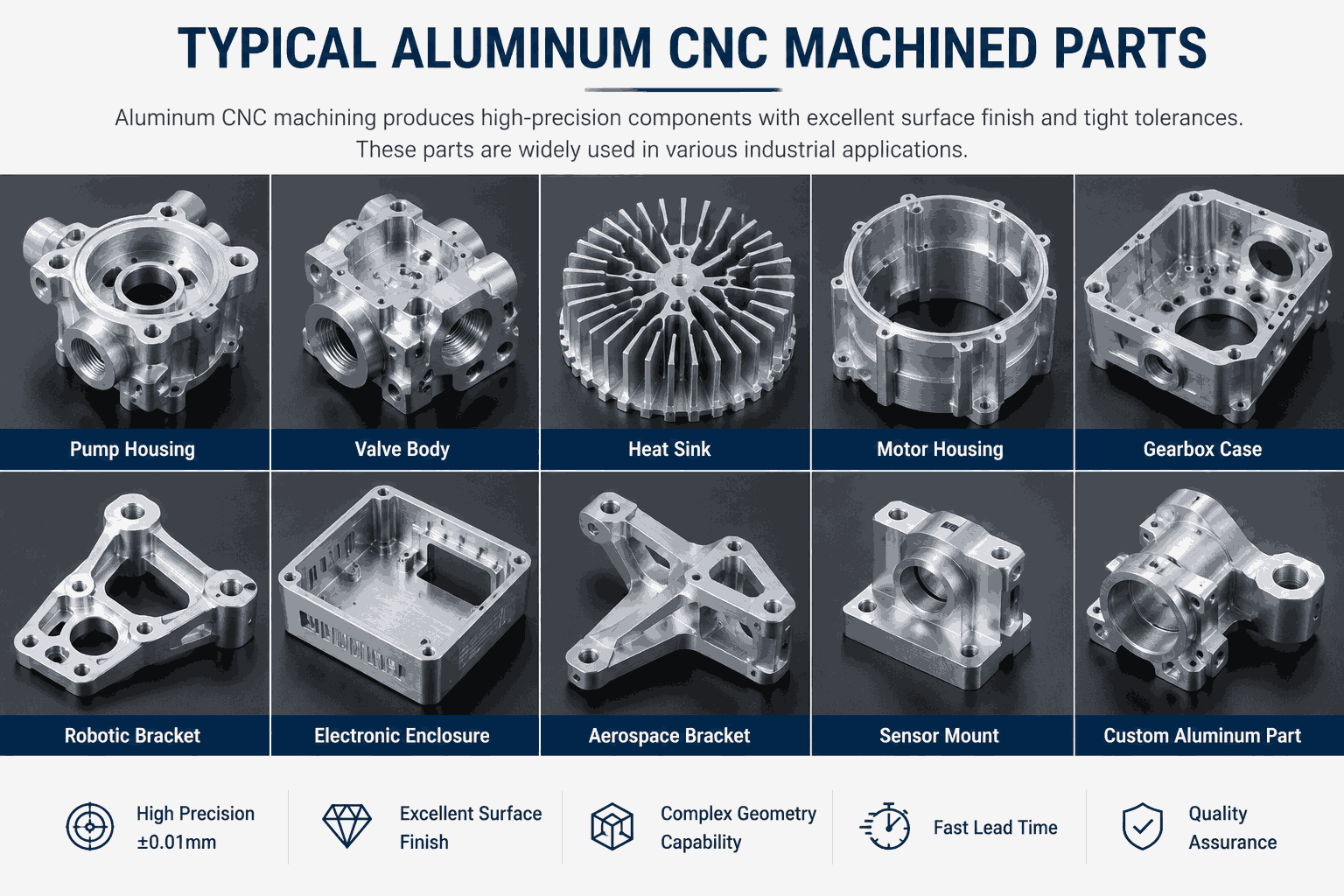
Modern aluminum CNC machining factories manufacture a wide variety of precision components.
Typical products include:
- Pump housings
- Valve components
- Heat sinks
- Robotic brackets
- Electronic enclosures
- Motor housings
- Gearbox covers
- Sensor mounts
- Automotive parts
- Aerospace brackets
- Medical equipment components
- Food machinery parts
Depending on production volume, manufacturers may choose billet machining, casting plus machining, or extrusion plus machining.
6. Industrial Applications of Custom Aluminum CNC Parts
Custom aluminum CNC parts serve nearly all modern manufacturing industries thanks to their versatile performance and flexible customization. Each industry forms stable demand for aluminum for cnc and aluminum for cnc milling processing.
Automotive Industry: Manufacturers apply aluminum CNC parts to new energy vehicle structural components, heat dissipation systems, and lightweight chassis accessories. These parts reduce overall vehicle weight and enhance driving endurance and stability.
Automation & Machinery Industry: Industrial robots, automated production lines, and general machinery widely use custom aluminum structural parts. These parts ensure equipment operation precision and reduce long-term operating energy consumption.
Marine & Petrochemical Industry: Anti-corrosion aluminum CNC components adapt to marine salt spray and petrochemical weak corrosive environments. They replace traditional steel parts to lower maintenance frequency and costs.
Electronic & Electrical Industry: Precision aluminum heat sinks, conductive accessories, and equipment shells support stable operation of power equipment, communication devices, and intelligent electronic products.
Aerospace & Precision Equipment: High-strength 7075 aluminum CNC parts meet ultra-high precision and load requirements for aviation and precision instrument structural components.
7.How to Select a Reliable Aluminum CNC Machining Supplier
Choosing the right supplier is about much more than comparing prices. A capable manufacturing partner can reduce project risk, improve quality consistency, and shorten lead times.
When evaluating aluminum CNC machining factories, consider the following factors:
Manufacturing Capability
Look for suppliers that integrate:
- Precision casting
- CNC milling
- CNC turning
- Heat treatment
- Surface finishing
- Assembly services
A one-stop manufacturer simplifies communication and quality control.
Material Expertise
A reliable supplier should have experience machining a wide range of aluminum alloys, including:
- 6061
- 6063
- 6082
- 7075
- A356
They should also be able to recommend the most suitable material based on strength, corrosion resistance, weight, and cost.
Quality Control
Verify whether the factory uses:
- Coordinate Measuring Machines (CMM)
- Spectrometers for material verification
- Hardness testers
- Surface roughness testers
- Dimensional inspection reports
These systems help ensure consistent product quality from prototype to mass production.
Engineering Support
The best suppliers review customer drawings before production, offering suggestions that improve manufacturability, reduce machining time, and lower overall costs without compromising performance.
Why Choose JC Casting for Aluminum CNC Machining?
At JC Casting, we specialize in aluminum CNC machining by combining precision casting with advanced CNC machining. This integrated process enables us to manufacture complex aluminum components with excellent dimensional accuracy, lower material waste, and cost-effective production.
We machine a wide range of aluminum alloys, including A356, 6061, 6063, 6082, and 7075, serving industries such as pumps and valves, automotive, marine, food processing, robotics, and industrial machinery.
Our capabilities include:
- Precision aluminum casting and CNC machining
- CNC milling, turning, drilling, and tapping
- Machining tolerances up to ±0.01 mm
- Heat treatment and surface finishing
- Comprehensive quality inspection with CMM
- OEM & ODM manufacturing for global customers
We complete casting and CNC machining in our own factory. This all-in-one workflow cuts your lead time. It simplifies your purchasing process too. We also keep steady, uniform quality for all parts.
We support prototype samples and mass bulk production. JC Casting acts as your reliable partner. We deliver custom aluminum CNC services and precision CNC machined aluminum parts.