How Much Cr Is in High Chrome Cast Iron?
High chrome cast iron is one of the most common materials used for wear-resistant castings. It is widely used in mining, cement, power plants, slurry pumps, crushers, grinding mills, and other heavy-duty equipment.
The key element in this material is chromium, also called Cr.
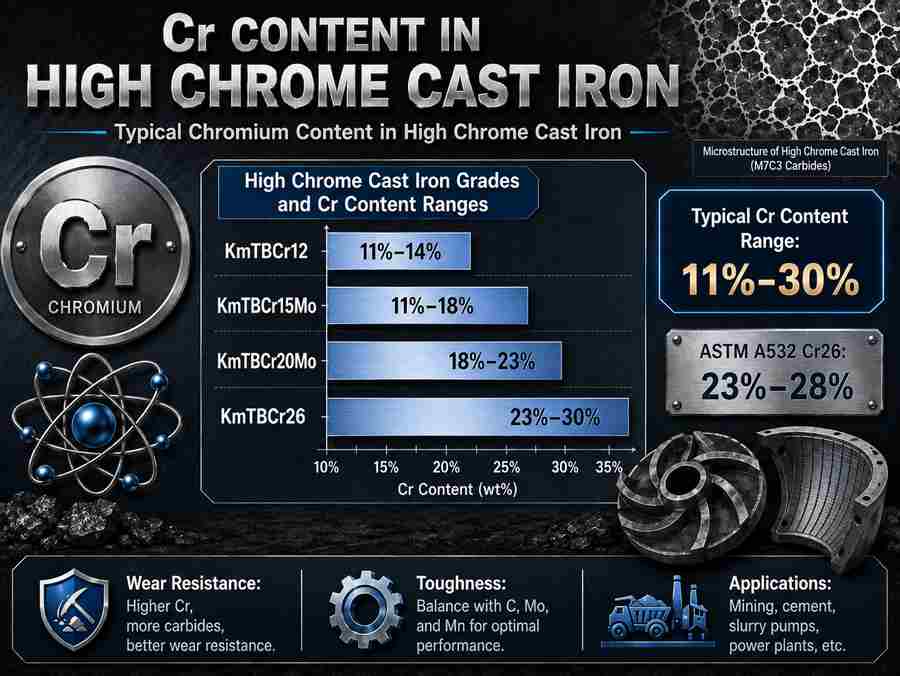
In most high chrome cast iron grades, the chromium content is usually between 11% and 30%. This high chromium level helps the casting form hard chromium carbides. These carbides give the material strong wear resistance and high hardness.
For buyers, engineers, and sourcing managers, understanding Cr content is important. It helps you choose the right grade for the right working condition.
Typical Cr Content in High Chrome Cast Iron
Different standards and grades have different chromium ranges. In Chinese standard GB/T 8263 for abrasion-resistant white cast iron, common grades include:
| Grade | Typical Cr Content |
|---|---|
| KmTBCr12 | 11.0%–14.0% |
| KmTBCr15Mo | 11.0%–18.0% |
| KmTBCr20Mo | 18.0%–23.0% |
| KmTBCr26 | 23.0%–30.0% |
In many international projects, buyers also refer to ASTM A532 high chrome iron grades. One common grade is Cr26 high chrome cast iron. Its chromium content is often around 23%–28%, depending on the exact specification and application.
A typical Cr26 Chemical composition may include:
| Element | Typical Range |
| Chromium / Cr | 23%–28% |
| Carbon / C | 2.4%–3.0% |
| Manganese / Mn | ≤1.5% |
| Silicon / Si | ≤1.0% |
| Sulfur / S | ≤0.05% |
| Phosphorus / P | ≤0.10% |
The exact chemical composition should always follow the customer’s drawing, standard, or purchase specification.
Why Is Chromium Important?
Chromium is important because it creates hard carbides inside the cast iron. These carbides are usually M7C3 type chromium carbides. They are very hard and help the casting resist abrasion.
This is why high chrome cast iron is often used for parts that face sand, ore, cement, coal, slurry, or stone.
Common high chrome cast iron parts include:
- Crusher liners
- Blow bars
- Grinding mill liners
- Slurry pump impellers
- Slurry pump liners
- Wear plates
- Chute liners
- Hammer heads
- Cement mill parts
- Coal mill liners
When these parts work, they are often hit or rubbed by hard particles. The chromium carbides help slow down wear and extend service life.
Does Higher Chromium Always Mean Better Performance?
Not always.
This is a common mistake. Some buyers think that higher Cr content always means better quality. In reality, the best Cr content depends on the working condition.
Higher chromium can improve wear resistance and corrosion resistance. But it may also reduce toughness if the material design is not balanced. A casting that is too brittle may crack under strong impact.
That is why carbon, chromium, molybdenum, manganese, silicon, and heat treatment must be controlled together.
For example:
- For strong abrasion but low impact, higher chromium grades like Cr26 may work well.
- For medium abrasion and some impact, Cr20 may be a better balance.
- For lower wear or cost-sensitive applications, Cr12 or Cr15 may be enough.
The right choice is not only about chromium percentage. It is also about hardness, impact load, working temperature, particle size, corrosion, and part design.
Cr12, Cr15, Cr20, and Cr26: How to Choose?
Here is a simple guide:
Cr12 high chrome cast iron
This grade has about 11%–14% chromium. It can be used for general wear parts where the wear condition is not extremely severe.
Cr15 high chrome cast iron
This grade is widely used for common wear-resistant castings. It offers better wear resistance than lower chromium cast iron and can be a cost-effective option.
Cr20 high chrome cast iron
This grade has about 18%–23% chromium. It is suitable for more serious wear applications. It can be used in mining, cement, and industrial equipment.
Cr26 high chrome cast iron
This grade normally has about 23%–30% chromium, or 23%–28% in many ASTM-related specifications. It is suitable for severe abrasion. It is often used in slurry pumps, mill liners, crusher parts, and high-wear mining equipment.
Chromium and Hardness
High chrome cast iron usually has high hardness after proper heat treatment. Many high chrome cast iron castings can reach around HRC 58–65, depending on the grade, section thickness, and heat treatment process.
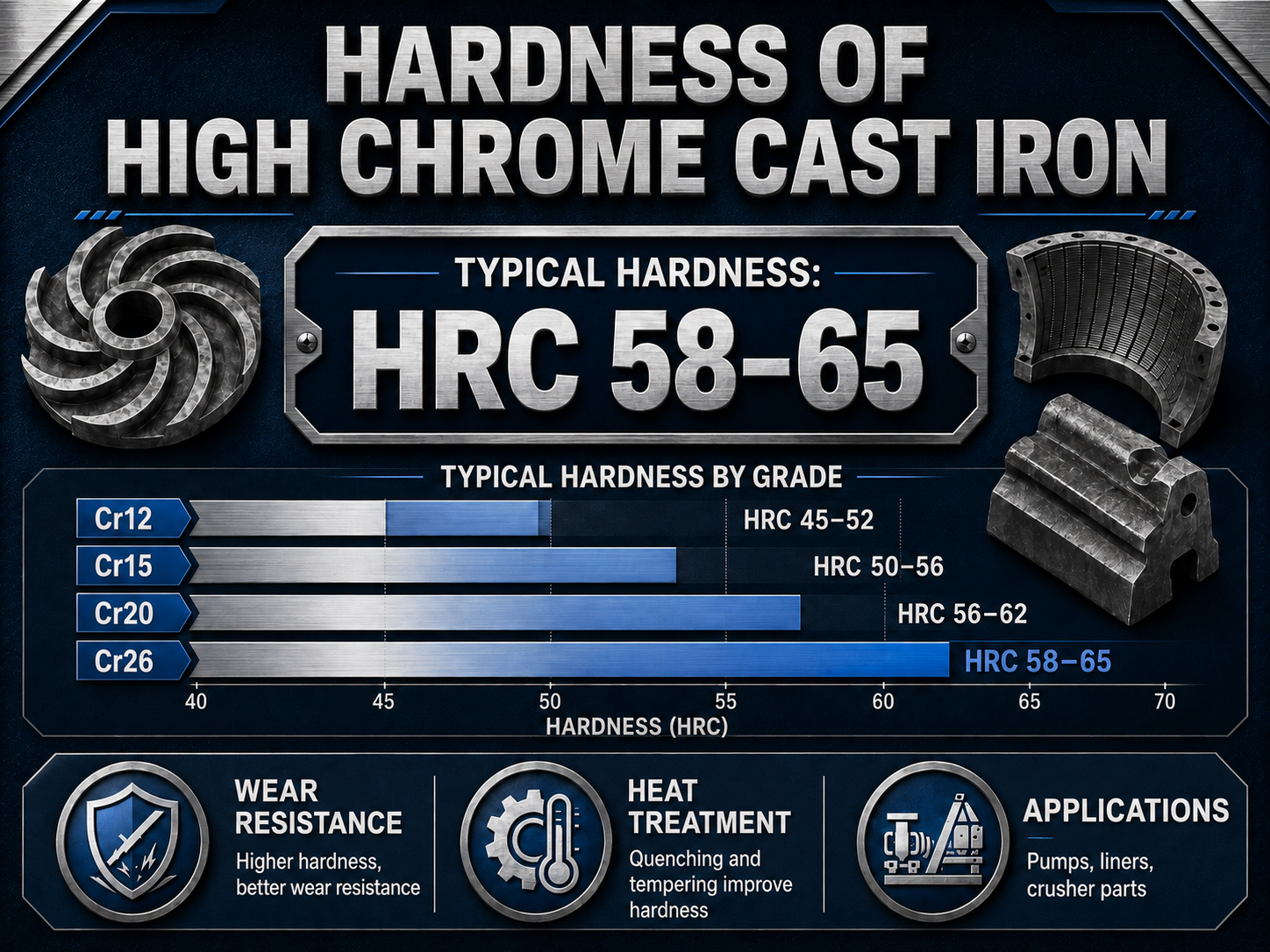
But hardness alone is not enough.
A part with high hardness but poor toughness may fail early. A part with good toughness but low hardness may wear quickly. Good material design must balance hardness and toughness.
This is especially important for parts like crusher hammers, blow bars, and pump impellers.
Chromium and Corrosion Resistance
Chromium can also improve corrosion resistance. This is useful when the casting works with slurry, wet minerals, chemicals, or acidic environments.
However, high chrome cast iron is mainly selected for wear resistance, not for the same corrosion resistance as stainless steel. If the working condition has strong corrosion, the buyer should provide the liquid type, pH value, temperature, and solid content. Then the foundry can help choose a better material.
What Should Buyers Confirm Before Ordering?
Before ordering high chrome cast iron parts, buyers should not only ask for the Cr percentage. They should confirm the full technical requirement.
Important details include:
- Required material grade
- Chemical composition
- Hardness range
- Heat treatment requirement
- Drawing and dimensions
- Working condition
- Impact level
- Wear type
- Required inspection report
- Annual quantity or batch quantity
If the buyer only says “high chrome cast iron,” the foundry may not know which grade is best. Clear technical information helps avoid wrong material selection and early part failure.
The chromium content in high chrome cast iron is usually between 11% and 30%. Common grades include Cr12, Cr15, Cr20, and Cr26. For Cr26 high chrome cast iron, the Cr content is usually around 23%–30%, and many ASTM-related specifications use about 23%–28%.
Chromium improves wear resistance by forming hard chromium carbides. It can also improve corrosion resistance in some working conditions. But higher chromium is not always better. The best grade depends on abrasion, impact, corrosion, heat treatment, and part design.
For heavy-duty wear parts, choosing the right Cr content can help reduce downtime, extend service life, and lower total replacement cost.
Keywords: high chrome cast iron, chromium content in high chrome cast iron, Cr26 cast iron, high chromium cast iron, wear resistant cast iron, ASTM A532 high chrome iron, Cr content cast iron
Need high chrome cast iron wear parts for mining, cement, or slurry pump applications? JC Casting can produce custom high chrome cast iron castings according to your drawings, material grade, hardness requirements, and working conditions.