
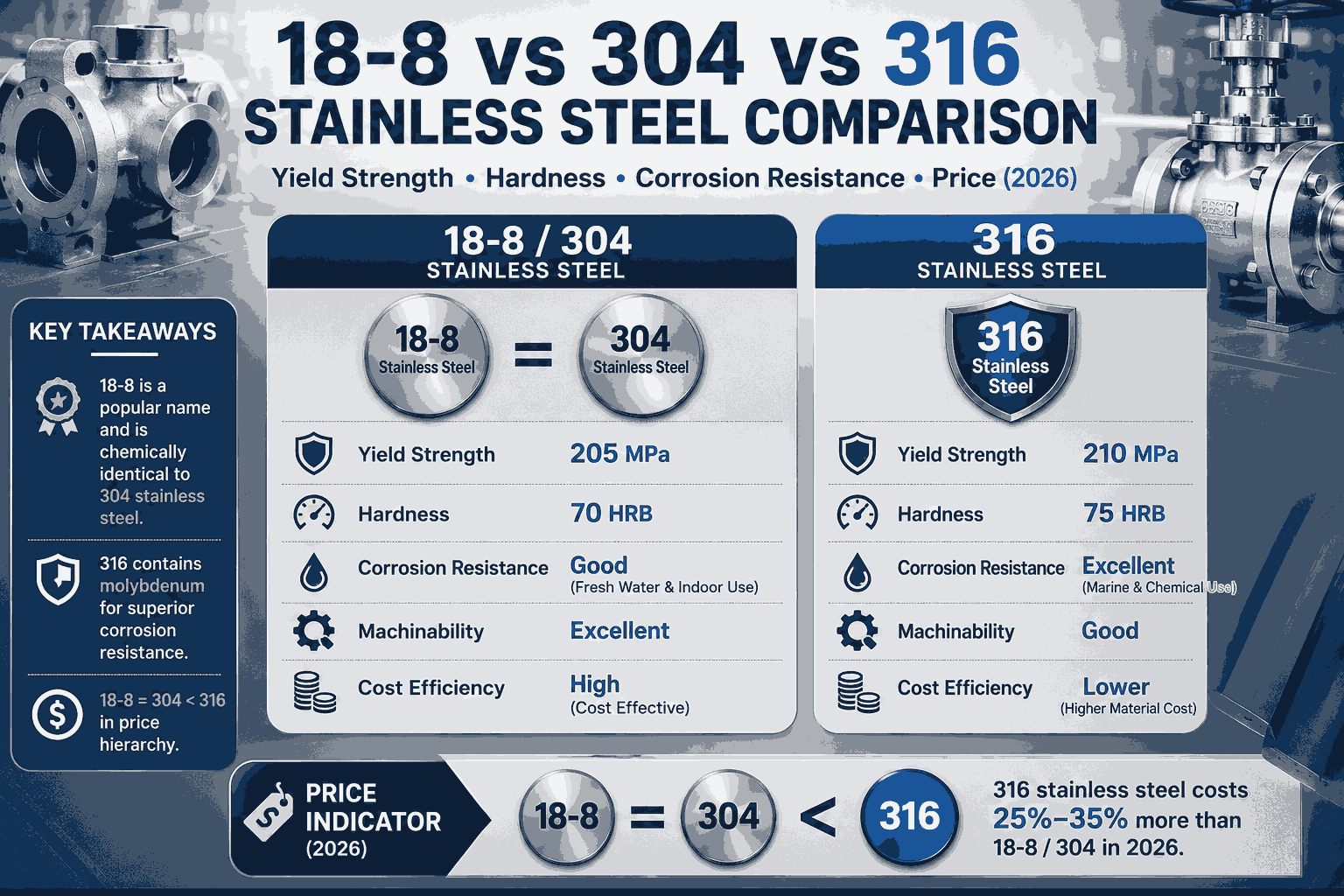
In this updated 2026 dedicated buyer’s guide, we exclusively focus on three key factors that directly drive your sourcing decisions: yield strength, material hardness, and the latest real-time stainless steel prices. Our main goal is to help casting buyers and engineers stop guessing and start picking the right steel grades of 304 and 316 Stainless Steel with data instead of personal experience. And that’s not all! Besides detailed data comparisons,we’ve also included a super practical material selection formula and casting-focused recommendations at the end.This will help you finalize the best solution quickly and cost-effectively.
Many professionals engaged in industrial casting, pump & valve manufacturing, oil & gas and water treatment projects often fall into the same sourcing pitfall. Most buyers select stainless steel purely based on past experience rather than actual working conditions and updated market data. This outdated selection method easily triggers common issues, including component cracking, excessive machining difficulty, poor part durability, and overspending on unnecessary raw material costs.
18-8, 304 and 316 are the most widely used austenitic stainless steel grades for precision investment casting and sand casting. These versatile alloys cover mainstream industrial working conditions and serve countless mechanical components across global industries. Here is one critical fact every buyer must know: 18-8 is only a popular casual name based on alloy composition, and it is chemically and functionally identical to standard 304 stainless steel.
1. What Are 18-8, 304 and 316 Stainless Steel?
All three alloys belong to the austenitic stainless steel family. They offer excellent weld ability, stable casting performance, and basic rust resistance for general industrial applications. Still, their chemical makeup creates clear performance gaps for marine and petrochemical projects.
- 18-8/304 Stainless Steel: Contains 18% chromium and 8% nickel. It serves as the most popular universal stainless steel for standard casting parts and daily industrial equipment.
- 316 Stainless Steel: Adds 2%–3% molybdenum and extra nickel on top of chromium. The molybdenum element directly boosts resistance against salt spray and acidic chemical corrosion.
2. Mechanical Performance & Hardness Comparison
Yield strength and hardness control two key parts of your project: maximum bearing pressure and overall machining cost. Harder steel wears down cutting tools faster and raises your CNC processing expenses. We organized all core parameters into one easy-to-read comparison table.
2.1 Stainless Steel Performance Data Table
| Material Grade | Yield Strength(MPa) | Hardness(HRB) | Corrosion Resistance | Best Machinability |
| 18-8 / 304 | 205 | 70 HRB | Good (Fresh Water & Indoor Use) | Excellent |
| 316 Stainless Steel | 210 | 75 HRB | Excellent (Marine & Chemical Use) | Good |
2.2 Yield Strength Analysis
18-8 and 304 share identical yield strength at 205 MPa. 316 stainless steel shows a tiny upgrade at 210 MPa. The gap stays insignificant for regular low-pressure castings like common valve bodies and pump parts. After cold working, 316 holds structural stability better than 18-8/304, so it works better for high-pressure petrochemical pipelines.
3.3 Hardness & Machinability
18-8/304 features lower hardness and simpler cutting processes. It saves your team time and reduces tool replacement costs for large-batch casting orders. 316 is slightly harder to machine. We only recommend 316 when your working environment requires strong anti-corrosion ability instead of simple structural support.
3. 2026 Stainless Steel Price Breakdown
Material pricing is directly driven by global raw material fluctuations, especially nickel and molybdenum. In 2026, stainless steel cost differences are no longer just “grade premiums” — they are a reflection of alloy chemistry, corrosion performance, and lifecycle reliability.
For casting buyers, the key question is not only “how much more expensive 316 is,” but also “what operational cost it eliminates over time.”
3.1 Why 316 Stainless Steel Costs More (Structural Cost Drivers)
The price gap between 304 and 316 stainless steel is mainly driven by two alloying elements:
- Nickel (Ni):
316 contains higher nickel content than 304. Nickel is a critical stabilizer for the austenitic structure and improves toughness, corrosion resistance, and performance in aggressive environments. However, nickel is a globally volatile and high-cost metal, and its price directly impacts base alloy cost. - Molybdenum (Mo):
316 adds approximately 2%–3% molybdenum, which is not present in 304. Molybdenum significantly improves resistance to chloride pitting and crevice corrosion. It is also one of the more expensive and supply-sensitive alloying elements in stainless steel production.
From a production perspective, 316 is not “slightly upgraded 304” — it is a chemically reinforced alloy system that requires higher raw material input costs and tighter melting control.
This is the primary reason why 316 stainless steel consistently maintains a 25%–35% price premium over 304 in 2026 global casting markets.
3.2 Is the Higher Price of 316 Worth It? (Lifecycle Value Perspective)
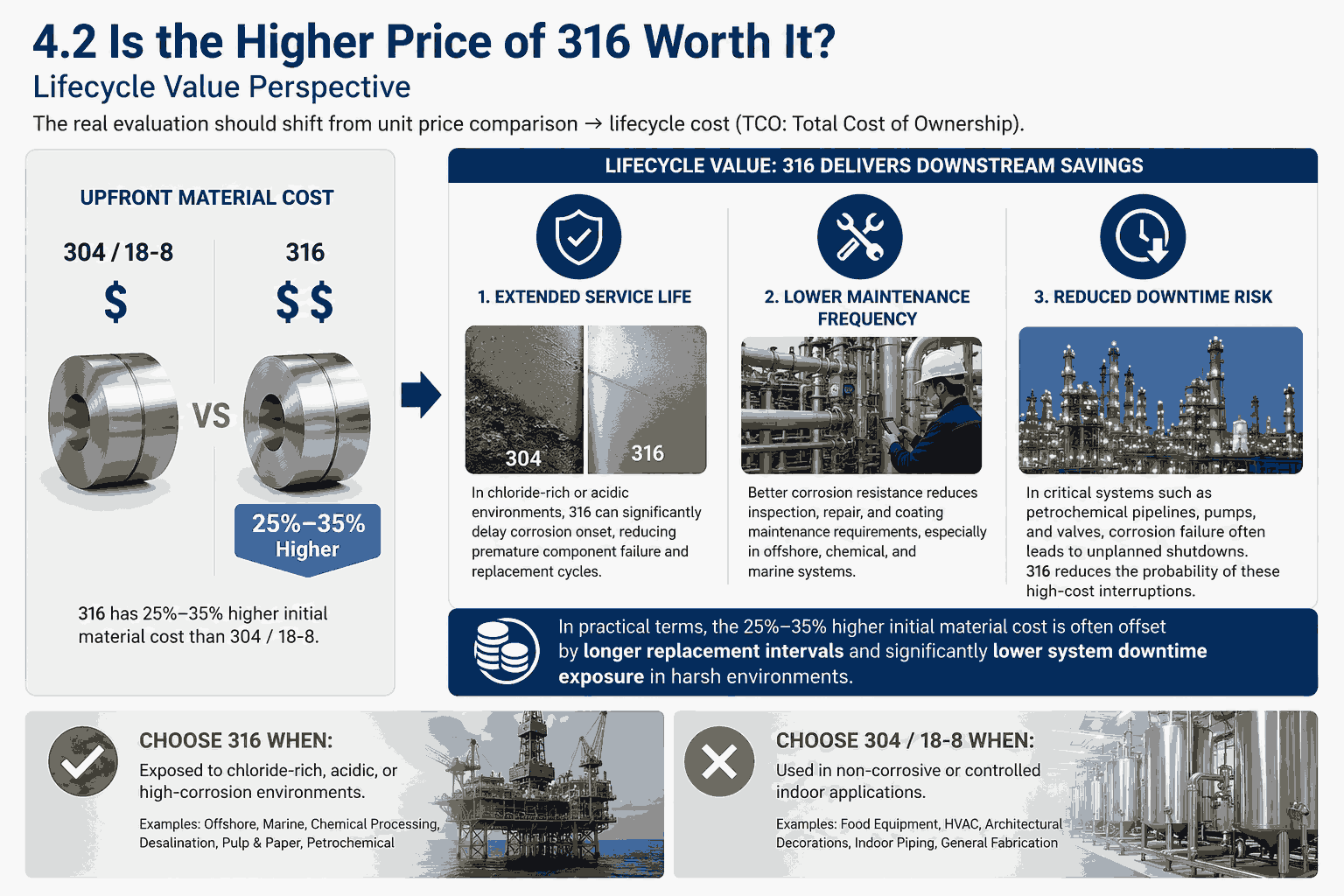
For procurement decisions, the real evaluation should shift from unit price comparison → lifecycle cost (TCO: Total Cost of Ownership).
Although 316 increases upfront material cost, its value is reflected in three downstream savings:
- Extended service life:
In chloride-rich or acidic environments, 316 can significantly delay corrosion onset, reducing premature component failure and replacement cycles. - Lower maintenance frequency:
Better corrosion resistance reduces inspection, repair, and coating maintenance requirements, especially in offshore, chemical, and marine systems. - Reduced downtime risk:
In critical systems such as petrochemical pipelines, pumps, and valves, corrosion failure often leads to unplanned shutdowns. 316 reduces the probability of these high-cost interruptions.
In practical terms, the 25%–35% higher initial material cost is often offset by longer replacement intervals and significantly lower system downtime exposure in harsh environments.
However, in non-corrosive or controlled indoor applications, these advantages are not fully utilized — making 304/18-8 the more rational economic choice.
3.3 Market Conclusion for 2026
- 304 / 18-8: Optimized for cost efficiency and stable performance in general industrial and indoor environments.
- 316: Designed for environments where corrosion failure cost exceeds material savings — such as marine, chemical, and offshore systems.
4. Material Selection Guide for Casting Projects
4.1 Choose 18-8 / 304 If You Need:
Cost-effective standardized castings for freshwater systems, indoor mechanical devices, general valves, and conventional pump components. 18-8/304 simplifies machining and lowers upfront costs for all types of regular industrial casting applications.
4.2 Choose 316 Stainless Steel If You Need:
Corrosion-resistant parts for offshore terminals, salt-rich coastal areas, acidic petrochemical workshops, and high-pressure fluid control systems. 316 stainless steel resists chloride erosion and extends component service life in extreme working conditions.\
5. SUMMARY
To summarize the key takeaways: 18-8 is interchangeable with 304 stainless steel, delivers solid performance and outstanding cost efficiency for daily industrial castings. 316 stainless steel offers upgraded hardness and industry-leading corrosion resistance for marine, mining, and petrochemical scenarios at a reasonable 25%–35% price premium.
If you are looking for custom 18-8/304 and 316 stainless steel castings for pumps, valves, or industrial machinery parts, JC Casting has got you covered. We specialize in investment casting and sand casting for CF8(304), CF8M(316), and duplex stainless steel alloys.
Our in-house engineers actually provide free material consulting,so we can help you find the perfect match for your budget and working conditions. Whether you need OEM or ODM for bulk orders, we deliver top-quality stainless steel components to marine, petrochemical, and manufacturing clients all over the world.