
Aluminum bronze casting is widely used for marine, valve, pump, oil & gas, and industrial components that require high strength, corrosion resistance, and long service life.
This guide explains the key factors engineers and procurement teams need to know when sourcing aluminum bronze castings, including material advantages, casting processes, common applications, quality considerations, and supplier selection.
Whether you are looking for aluminum bronze valve castings, sand casting solutions, investment castings, or custom OEM parts, this article will help you choose the right casting method and supplier for your project.
What Is Aluminum Bronze Casting?
Aluminum bronze casting is the process of producing metal components from aluminum bronze alloys by pouring molten metal into a mold. After the metal solidifies, the casting is cleaned, machined if necessary, and inspected before delivery.
Unlike standard bronze alloys, aluminum bronze contains approximately 5% to 12% aluminum, with additional elements such as iron, nickel, and manganese added to improve strength and corrosion resistance. These alloying elements create a dense protective oxide layer on the surface, allowing aluminum bronze to perform exceptionally well in seawater and other aggressive environments.
Because of these properties, aluminum bronze has become one of the most popular copper-based casting materials for demanding industrial applications.
Key Properties of Aluminum Bronze
Compared with conventional bronze, aluminum bronze provides several performance advantages:
- Excellent resistance to seawater corrosion
- High tensile and yield strength
- Outstanding wear and abrasion resistance
- Good resistance to cavitation and erosion
- Long service life with minimal maintenance
- Good machinability after casting
These characteristics make aluminum bronze an excellent choice for components that operate under high mechanical loads or in harsh outdoor environments.
Aluminum Bronze vs Traditional Bronze Casting
Although both materials belong to the copper alloy family, they are designed for different applications.
| Property | Aluminum Bronze | Traditional Bronze |
| Strength | Excellent | Good |
| Corrosion Resistance | Excellent, especially in seawater | Good |
| Wear Resistance | Excellent | Moderate |
| Marine Performance | Excellent | Good |
| Service Life | Longer | Standard |
| Material Cost | Higher | Lower |
Traditional bronze is suitable for many general engineering applications. However, when equipment operates in seawater, offshore platforms, desalination plants, or corrosive chemical environments, aluminum bronze casting often provides a better long-term return on investment despite its higher initial material cost.
For this reason, many engineers consider aluminum bronze an effective alternative to bronze casting when durability and reliability are top priorities.
Why Engineers Choose Aluminum Bronze Casting?
Material selection directly affects product reliability, maintenance costs, and equipment lifespan. For industries such as marine, oil & gas, power generation, and industrial manufacturing, aluminum bronze has become one of the most trusted casting materials because it combines mechanical strength with excellent corrosion resistance.
Here are the main reasons engineers and procurement teams choose aluminum bronze castings.
Superior Corrosion Resistance in Marine and Chemical Environments
One of the biggest advantages of aluminum bronze is its ability to resist corrosion in seawater.
When exposed to saltwater, the aluminum in the alloy forms a thin, stable oxide film that protects the casting from further corrosion. This natural protective layer makes aluminum bronze ideal for offshore and marine applications where ordinary bronze or carbon steel may deteriorate over time.
Common marine applications include:
- Marine valve bodies
- Pump casings and impellers
- Ship propellers
- Offshore platform components
- Seawater piping systems
Because of its outstanding corrosion resistance, aluminum bronze also performs well in desalination plants and chemical processing equipment.
High Strength for Heavy-Duty Applications
Aluminum bronze offers significantly higher mechanical strength than many conventional copper alloys.
This allows engineers to design components that can withstand:
- High operating pressures
- Heavy mechanical loads
- Repeated impact
- Cyclic stress
- Abrasive working conditions
As a result, aluminum bronze is widely used for critical components such as valve bodies, pump housings, bearing carriers, bushings, and heavy industrial machinery parts where structural reliability is essential.
Excellent Wear Resistance and Longer Service Life
Many industrial components fail because of friction rather than corrosion.
Aluminum bronze provides excellent resistance to sliding wear, abrasion, and cavitation erosion. This reduces maintenance requirements and extends the service life of moving components operating under continuous load.
Compared with many standard bronze alloys, aluminum bronze castings typically deliver:
- Lower maintenance costs
- Longer replacement intervals
- Improved equipment reliability
- Reduced production downtime
For manufacturers and plant operators, these benefits often outweigh the higher material cost, resulting in a lower total cost of ownership over the lifetime of the equipment.
Common Aluminum Bronze Casting Parts
Aluminum bronze is used in a wide range of industrial equipment where strength, corrosion resistance, and long service life are critical. While the alloy itself offers excellent mechanical properties, the performance of the final component also depends on selecting the right casting process and maintaining strict quality control throughout production.
Below are some of the most common aluminum bronze casting parts used across marine, oil & gas, mining, and heavy industrial applications.
Aluminum Bronze Valve Castings
One of the largest applications for aluminum bronze casting is valve manufacturing.
Valve components often operate in seawater, corrosive fluids, or high-pressure systems. Aluminum bronze provides excellent resistance to corrosion, erosion, and cavitation, making it a preferred material for critical flow control equipment.
Typical aluminum bronze valve castings include:
- Valve bodies
- Valve bonnets
- Valve discs
- Valve seats
- Valve glands
- Check valve components
For marine and offshore projects, aluminum bronze valve castings are commonly specified because they maintain strength and corrosion resistance even after years of exposure to saltwater.
Pump Components
Pumps used in seawater handling, mining, chemical processing, and power generation face constant wear from fluid flow and suspended particles.
Aluminum bronze helps extend pump life by resisting corrosion and abrasion.
Common pump castings include:
- Pump casings
- Impellers
- Wear rings
- Diffusers
- Pump covers
- Bearing housings
Compared with standard bronze or cast iron, aluminum bronze pump parts typically require fewer replacements and lower maintenance over their service life.
Marine Hardware and Propulsion Components
The marine industry has relied on aluminum bronze for decades because of its outstanding resistance to seawater corrosion and marine biofouling.
Typical marine castings include:
- Boat propellers
- Stern tube bearings
- Rudder components
- Marine brackets
- Deck hardware
- Mooring equipment
These components are exposed to saltwater 24 hours a day. A properly manufactured aluminum bronze casting can continue performing reliably for many years with minimal maintenance.
Bushings, Bearings, and Wear Parts
Many industrial machines include components that experience continuous sliding contact.
Aluminum bronze offers a combination of strength and low friction, making it suitable for wear-resistant applications such as:
- Bushings
- Sleeve bearings
- Guide plates
- Wear pads
- Thrust washers
- Mechanical linkage components
These parts are commonly found in mining equipment, construction machinery, steel mills, and heavy manufacturing plants.
Custom OEM Aluminum Bronze Castings
Many industrial projects require custom-designed castings instead of standard catalog parts.
An experienced foundry can manufacture OEM aluminum bronze castings based on:
- 2D engineering drawings
- 3D CAD models
- Existing samples
- Reverse-engineered components
Typical OEM services include:
- Alloy selection
- Casting design optimization
- CNC machining
- Heat treatment
- Surface finishing
- Dimensional inspection
- Material certification
Working with a supplier that provides both casting and machining helps reduce lead time and ensures better dimensional consistency throughout production.
Aluminum Bronze Casting Process
Understanding the aluminum bronze casting process helps engineers select the right manufacturing method, improve part reliability, and avoid common casting problems.
Although different foundries use different production systems, the overall process usually includes five key stages: melting, mold preparation, pouring, finishing, and inspection.
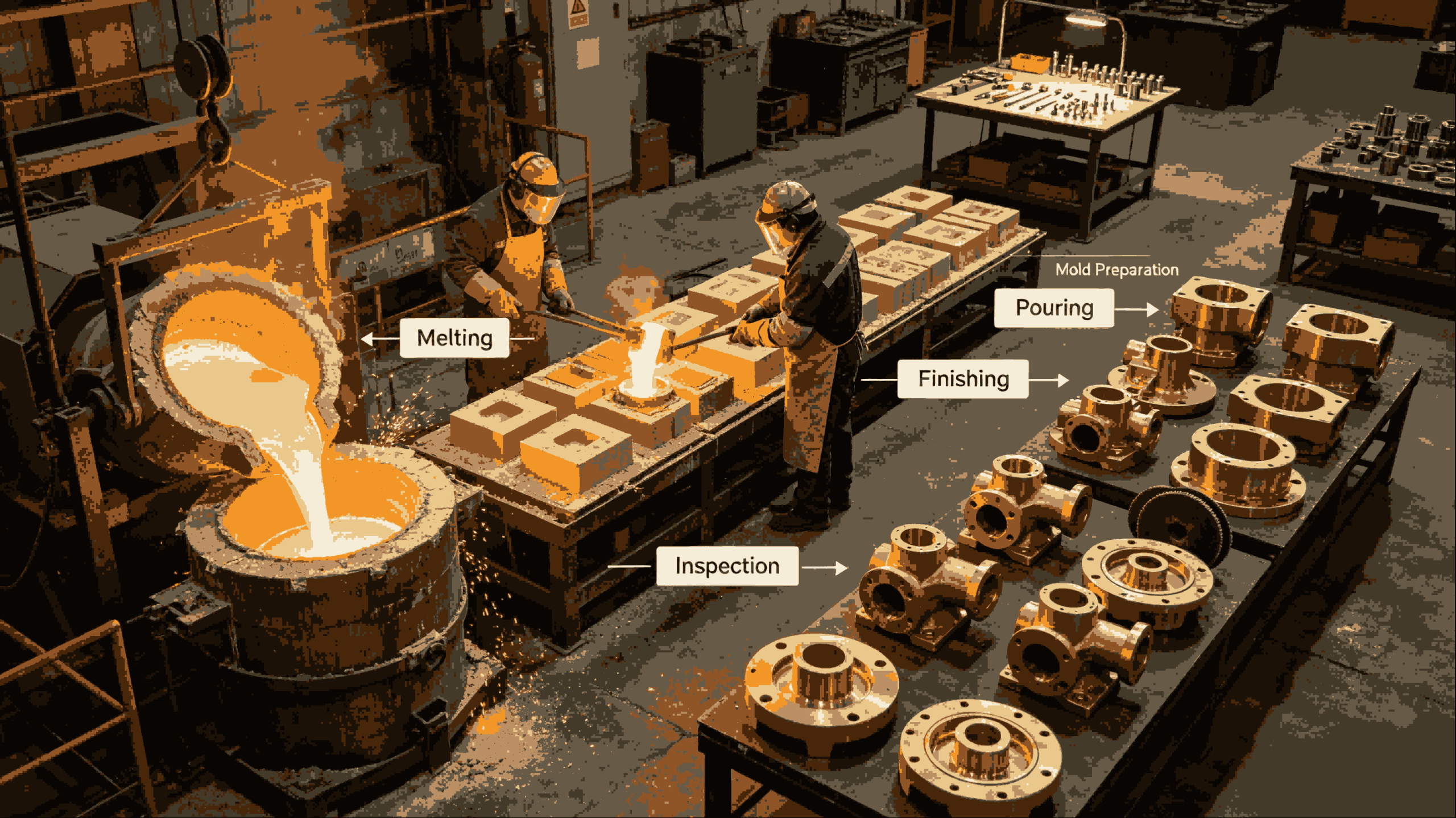
Step 1: Alloy Melting and Composition Control
The process starts with carefully selected raw materials, including copper, aluminum, and alloying elements such as iron, nickel, and manganese.
Because chemical composition directly affects strength, hardness, and corrosion resistance, professional foundries strictly control:
- Alloy chemistry
- Melting temperature
- Oxidation control
- Slag removal
Before casting, manufacturers typically use spectrometer testing to confirm that the molten metal meets the required alloy standards.
Step 2: Mold Design and Preparation
The mold design has a direct impact on casting accuracy, surface quality, and internal soundness.
Depending on part requirements, manufacturers usually select:
- Sand casting for large and heavy aluminum bronze components
- Investment casting for complex parts requiring tighter tolerances
A well-designed gating and riser system helps ensure smooth metal flow and reduces defects such as shrinkage and porosity.
Step 3: Pouring and Solidification
Pouring is a critical step in aluminum bronze casting.
Professional foundries carefully control:
- Pouring temperature
- Filling speed
- Solidification process
Proper control prevents common problems such as incomplete filling, oxidation, and internal cavities, improving the final casting’s mechanical performance.
Step 4: Finishing and CNC Machining
After casting, the parts go through cleaning and finishing operations.
Depending on customer requirements, manufacturers may provide:
- Heat treatment
- Shot blasting
- Grinding and polishing
- CNC turning and milling
- Drilling and tapping
A supplier that combines casting and machining capabilities can provide finished components with better dimensional consistency and shorter supply chains.
Step 5: Inspection and Quality Control
Quality inspection ensures that aluminum bronze castings meet engineering requirements before shipment.
Typical inspections include:
- Chemical composition testing
- Mechanical property testing
- Dimensional inspection
- Surface inspection
- Non-destructive testing (NDT)
- Pressure testing for valves and pumps
A reliable supplier with strong process control can consistently produce aluminum bronze castings with high strength, dimensional accuracy, and long-term durability.
Aluminum Bronze Sand Casting vs Investment Casting: Which Process Is Right for Your Project?
Choosing the right casting method is critical when sourcing aluminum bronze casting parts. The best process depends on factors such as part size, design complexity, dimensional accuracy, production volume, and cost requirements.
For aluminum bronze components, manufacturers mainly use two casting methods:
- Aluminum bronze sand casting
- Aluminum bronze investment casting
Each process has its own advantages. Selecting the right method helps improve part performance, reduce machining costs, and achieve better production efficiency.
When to Choose Aluminum Bronze Sand Casting
Aluminum bronze sand casting is the preferred choice for large, heavy, and cost-sensitive components.
This process is suitable when you need:
- Large part dimensions
- Lower tooling investment
- Flexible production for custom parts
- Low to medium production volumes
Typical applications include:
- Large valve bodies
- Pump housings
- Marine components
- Heavy industrial parts
Sand casting provides a practical solution for projects where size and cost are more important than extremely tight tolerances or fine surface finishes.
When to Choose Aluminum Bronze Investment Casting
Aluminum bronze investment casting is ideal for precision components that require complex designs, better surface finish, and tighter dimensional control.
This process is suitable when you need:
- Complex geometries
- Thin walls and detailed features
- Higher dimensional accuracy
- Reduced machining operations
Typical applications include:
- Precision valve components
- Marine hardware
- Small pump parts
- Custom OEM aluminum bronze castings
Investment casting helps produce near-net-shape components, reducing additional machining and improving design flexibility.
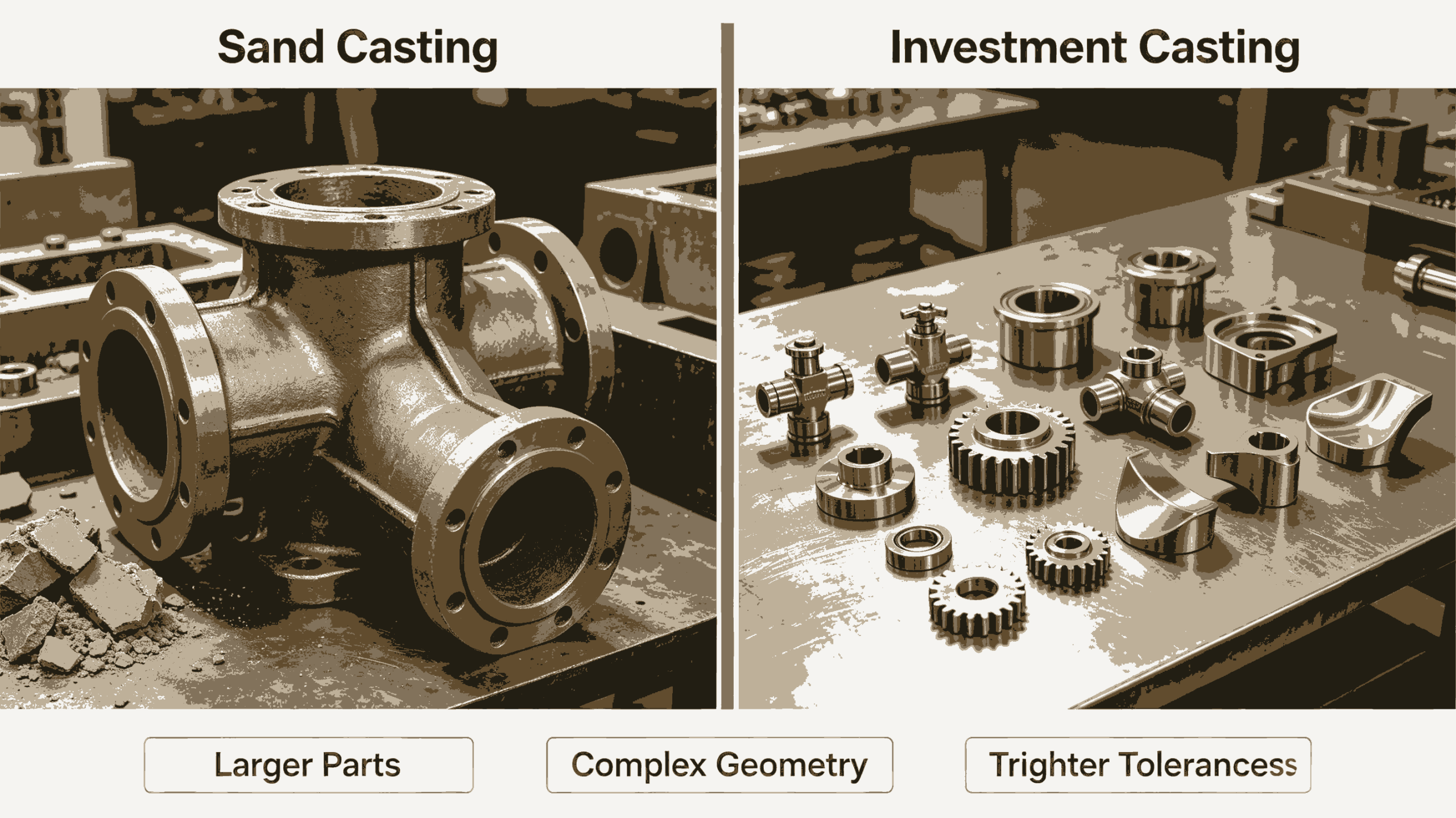
Aluminum Bronze Sand Casting vs Investment Casting Comparison
| Factor | Aluminum Bronze Sand Casting | Aluminum Bronze Investment Casting |
| Part Size | Large and heavy components | Small to medium precision parts |
| Dimensional Accuracy | Moderate | High |
| Surface Finish | Good | Excellent |
| Tooling Cost | Lower | Higher |
| Production Volume | Low to medium | Medium to high |
| Design Complexity | Suitable for simple to moderate designs | Suitable for complex designs |
| Machining Requirement | Usually higher | Usually lower |
| Best Applications | Valves, pumps, large marine parts | Precision valves, marine hardware, OEM parts |
How to Select the Right Process?
A simple guideline:
- Choose aluminum bronze sand casting for large, heavy, and cost-effective components.
- Choose aluminum bronze investment casting for precision parts with complex shapes and tighter tolerances.
For projects requiring both casting quality and machining accuracy, working with a supplier that provides casting, CNC machining, and inspection services can simplify the supply chain and improve final part consistency.
Can Aluminum Bronze Replace Traditional Bronze Casting?
Many engineers search for alternative to bronze casting because traditional bronze does not always provide enough performance for modern industrial applications.
The answer depends on the working environment.
Aluminum bronze can replace traditional bronze in many demanding applications because it provides:
- Higher mechanical strength
- Better seawater corrosion resistance
- Improved wear resistance
- Better resistance to erosion and cavitation
However, aluminum bronze is not always the best choice for every product.
When Aluminum Bronze Is a Better Choice
Marine Equipment
For seawater applications, aluminum bronze is often preferred because it maintains strength and corrosion resistance in saltwater environments.
Examples:
- Ship propellers
- Marine valves
- Offshore components
High-Wear Applications
When components experience continuous friction or impact, aluminum bronze often performs better than standard bronze.
Examples:
- Bearings
- Bushings
- Wear plates
High-Strength Industrial Components
Equipment operating under heavy loads benefits from aluminum bronze’s higher mechanical strength.
Examples:
- Pump components
- Pressure valves
- Industrial machinery parts
When Traditional Bronze May Still Be Suitable
Traditional bronze can remain a good option when:
- The environment is less corrosive
- Mechanical loads are lower
- Cost is the main consideration
- Decorative appearance is important
For general-purpose applications, bronze may provide sufficient performance at a lower material cost.
Aluminum Bronze Alloy Selection Matters
Not all aluminum bronze alloys provide identical performance. Engineers should select the alloy based on operating conditions.
Common aluminum bronze grades include:
| Alloy Grade | Characteristics | Typical Applications |
| C95400 | Good strength and corrosion resistance | Valves, pumps, marine parts |
| C95500 | Higher strength and hardness | Heavy-duty industrial components |
| C95800 | Excellent seawater resistance | Marine propellers, offshore equipment |
A professional casting supplier can help select the most suitable alloy based on:
- Operating temperature
- Corrosion environment
- Mechanical loads
- Wear requirements
- Industry standards
Common Aluminum Bronze Casting Defects and How to Prevent Them
Although aluminum bronze offers excellent mechanical properties and corrosion resistance, the final casting quality still depends heavily on the manufacturing process. Poor melting control, improper mold design, or incorrect pouring conditions can lead to defects that reduce part strength and service life.
For engineers and procurement teams, understanding common aluminum bronze casting defects helps them evaluate suppliers and avoid quality problems before production begins.
The most common defects include:
- Porosity
- Shrinkage defects
- Oxide inclusions
- Surface defects
- Dimensional variations
A professional foundry reduces these risks through strict process control, proper casting design, and continuous inspection.
Porosity Problems in Aluminum Bronze Castings
Porosity is one of the most common problems in copper alloy castings.
It occurs when gas becomes trapped inside the molten metal during melting or pouring. After solidification, these trapped gases create small holes or cavities inside the casting.
Porosity can reduce:
- Mechanical strength
- Pressure resistance
- Fatigue life
- Corrosion performance
For applications such as aluminum bronze valve casting and pump components, internal porosity can become a serious reliability issue.
Common Causes of Porosity
- Poor melt cleaning
- Excessive turbulence during pouring
- Incorrect pouring temperature
- Gas absorption during melting
- Poor venting design
How Professional Foundries Prevent Porosity
Experienced manufacturers control porosity through:
- Proper melting temperature management
- Slag removal before pouring
- Controlled pouring speed
- Optimized gating system design
- X-ray or ultrasonic inspection when required
Shrinkage Defects Caused by Improper Solidification
When molten aluminum bronze cools and changes from liquid to solid, the metal naturally contracts.
If the casting design does not provide enough feeding material during solidification, shrinkage cavities may form inside the casting.
Shrinkage defects can affect:
- Structural strength
- Leak resistance
- Long-term durability
These defects are especially important for pressure-containing components such as:
- Valve bodies
- Pump housings
- Hydraulic components
Solutions for Shrinkage Control
Foundries prevent shrinkage defects by improving:
- Riser design
- Metal feeding paths
- Cooling conditions
- Mold design
Computer simulation software is also commonly used to predict solidification behavior before production begins.
This allows engineers to optimize the casting design and reduce trial-and-error during manufacturing.
Oxide Inclusions During Aluminum Bronze Melting
Aluminum bronze reacts easily with oxygen during melting because aluminum has a strong affinity for oxygen.
If oxidation is not controlled, oxide particles may become trapped inside the casting.
Oxide inclusions can cause:
- Reduced mechanical properties
- Cracking risks
- Poor machining performance
- Lower fatigue resistance
How Suppliers Control Oxide Inclusions
A professional aluminum bronze casting manufacturer manages oxidation through:
- Clean melting practices
- Proper furnace control
- Careful metal transfer
- Reduced turbulence during pouring
- Effective filtration methods
These steps help produce cleaner castings with better internal quality.
Applications of Aluminum Bronze Castings
Because aluminum bronze combines strength, corrosion resistance, and wear resistance, it is widely used in industries where component failure can create high maintenance costs or safety risks.
Marine Industry Applications
The marine industry is one of the largest users of aluminum bronze casting parts.
Seawater creates one of the most challenging operating environments because of:
- Salt corrosion
- Continuous exposure to moisture
- Cavitation damage
- Mechanical impact
Common marine aluminum bronze castings include:
- Boat propellers
- Marine valves
- Pump components
- Rudder fittings
- Stern tube bearings
Aluminum bronze remains one of the preferred materials for marine applications because it provides reliable performance in saltwater environments.
Valve and Flow Control Applications
Aluminum bronze valve casting is widely used in industries that require corrosion-resistant and pressure-resistant components.
Typical applications include:
- Marine valves
- Oil & gas valves
- Chemical processing valves
- Water treatment equipment
Valve manufacturers choose aluminum bronze because it provides:
- Good pressure resistance
- Excellent corrosion protection
- Resistance to erosion
- Long service life
For critical systems, selecting an experienced aluminum bronze valve casting supplier is essential because casting quality directly affects valve reliability.
Oil & Gas and Petrochemical Applications
Oil and gas equipment often operates under extreme conditions involving:
- Corrosive fluids
- High pressure
- Continuous operation
Aluminum bronze castings are used for:
- Pump components
- Valve bodies
- Sealing parts
- Offshore equipment
The alloy’s corrosion resistance makes it suitable for both offshore and onshore applications.
Mining and Heavy Industrial Equipment
Mining equipment faces severe wear caused by dust, minerals, and heavy mechanical loads.
Aluminum bronze components are commonly used for:
- Bushings
- Bearings
- Wear plates
- Mechanical components
Their wear resistance helps reduce downtime and improves equipment reliability.
How to Choose an Aluminum Bronze Casting Supplier
Choosing the right aluminum bronze casting supplier is critical to ensuring part quality, delivery reliability, and long-term performance.
A qualified supplier should not only produce castings but also provide material expertise, suitable casting solutions, machining capability, and strict quality control.
When evaluating a supplier, consider the following factors:
Material Control and Certification
Aluminum bronze performance depends heavily on chemical composition and manufacturing control.
A reliable supplier should provide:
- Material certificates
- Chemical composition reports
- Mechanical testing reports
- Quality inspection records
The supplier should also have experience working with common aluminum bronze grades such as C95400, C95500, and C95800 to ensure the final parts meet required performance standards.
Casting and Manufacturing Capability
Different components require different production methods.
An experienced supplier should understand when to use:
- Sand casting for large components
- Investment casting for precision parts
- CNC machining for finished OEM components
This process knowledge helps optimize part quality, production cost, and lead time.
Machining and Quality Inspection Capability
Many industrial customers need ready-to-install components rather than raw castings.
A reliable supplier should provide:
- CNC machining
- Dimensional inspection
- Surface finishing
- Pressure testing when required
- Non-destructive testing (NDT)
Integrated manufacturing capability reduces supply chain complexity and improves consistency.
Why Choose JC Casting for Aluminum Bronze Castings?
With more than 20 years of precision casting experience, JC Casting provides custom aluminum bronze casting solutions for marine, valve, pump, and industrial applications.
Our advantages include:
Complete Casting and Machining Solutions
JC Casting supports the full manufacturing process, including:
- Sand casting
- Investment casting
- CNC machining
- Surface finishing
- Quality inspection
This allows customers to source finished aluminum bronze components from a single supplier.
Experience With Industrial Applications
We manufacture custom castings for demanding industries, including:
- Marine equipment
- Valves and pumps
- Oil & gas systems
- Industrial machinery
Our engineering team helps customers select suitable alloys, optimize casting designs, and reduce production risks.
Strict Quality Control
JC Casting focuses on consistent quality through:
- Material composition control
- Dimensional inspection
- Mechanical testing
- Process monitoring
Each casting is produced according to customer drawings and technical requirements.
OEM Customization Support
From prototype development to mass production, JC Casting works with engineers and procurement teams to provide:
- Drawing review
- Casting feasibility analysis
- Custom production
- Machining solutions
By combining casting expertise, machining capability, and OEM manufacturing experience, JC Casting helps customers achieve reliable aluminum bronze castings with better performance and lower total costs.
Frequently Asked Questions About Aluminum Bronze Casting
What is aluminum bronze casting used for?
Aluminum bronze casting is commonly used for marine components, valves, pumps, oil & gas equipment, mining machinery, and industrial wear parts because of its strength and corrosion resistance.
Is aluminum bronze better than traditional bronze?
In demanding environments, aluminum bronze usually provides better strength, corrosion resistance, and wear resistance than traditional bronze. However, traditional bronze may still be suitable for lower-cost and less demanding applications.
Can aluminum bronze be investment cast?
Yes. Aluminum bronze investment casting is widely used for precision components that require complex shapes, tight tolerances, and excellent surface finish.
Can aluminum bronze be sand cast?
Yes. Aluminum bronze sand casting is commonly used for large components such as valve bodies, pump housings, and marine equipment parts.
What industries use aluminum bronze casting parts?
Major industries include:
- Marine
- Oil & gas
- Petrochemical
- Valve manufacturing
- Pump manufacturing
- Mining
- Heavy machinery