
Bronze casting is a really proven process. It gives you highly durable parts with excellent corrosion and wear resistance, plus great strength. Whether it’s for marine gear, pumps, valves, or industrial machinery, bronze castings just hold up really well, even in tough conditions.
However, the quality of a bronze component depends heavily on how it is manufactured. The bronze casting process affects dimensional accuracy, surface finish, internal structure, and long-term performance.
This guide explains the complete bronze casting process steps, including lost wax casting, shell building, spruing design, quality control, and how to select the right casting method for your application.
What Is the Bronze Casting Process?
Bronze casting is a really proven process. It gives you highly durable parts with excellent corrosion and wear resistance, plus great strength. Whether it’s for marine gear, pumps, valves, or industrial machinery, bronze castings just hold up really well, even in tough conditions.
Bronze alloys are selected based on application requirements. Common bronze materials include:
- Tin Bronze: Excellent wear resistance and good mechanical strength
- Aluminum Bronze: Outstanding corrosion resistance, especially in seawater environments
- Silicon Bronze: Good corrosion resistance and weldability
Different casting methods can be used depending on part design, production volume, and required accuracy. The most common methods include investment casting, sand casting, and centrifugal casting.
Bronze Casting Process Steps: From Wax Pattern to Finished Casting
A professional foundry follows a controlled sequence to produce high-quality bronze components. Each step influences the final product performance.
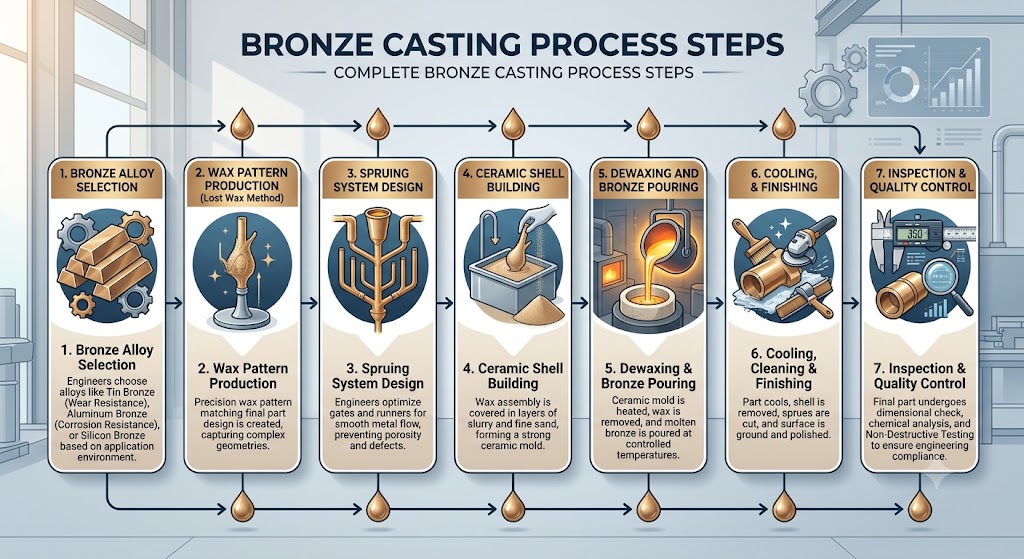
Step 1: Bronze Alloy Selection
Material selection is the first step in the casting process.
Engineers choose the bronze alloy according to operating conditions such as:
- Corrosion exposure
- Mechanical load
- Wear requirements
- Temperature conditions
For example, marine components often use aluminum bronze because it provides excellent resistance against seawater corrosion and cavitation.
Choosing the wrong alloy can lead to premature failure even when the casting process is completed correctly.
Step 2: Wax Pattern Production
One of the most widely used methods for precision bronze components is the bronze casting process lost wax method, also known as investment casting.
The process starts by creating a wax pattern that matches the final component design. The wax pattern reproduces complex details, thin walls, and precise dimensions.
Lost wax casting provides several advantages:
- Excellent surface finish
- High dimensional accuracy
- Ability to produce complex geometries
- Reduced machining requirements
This makes it ideal for bronze parts with complicated structures or strict tolerance requirements.
Step 3: Spruing System Design
The bronze casting process spruing stage plays a critical role in casting quality.
Sprues, runners, and gates create the path for molten bronze to flow into the mold cavity. A well-designed system ensures:
- Smooth metal flow
- Proper feeding during solidification
- Reduced shrinkage defects
- Better internal quality
Poor spruing design may cause problems such as porosity, incomplete filling, or uneven solidification.
Experienced foundries optimize the spruing system based on part geometry, alloy characteristics, and casting simulation results.
Step 4: Ceramic Shell Building
In the bronze casting process shell stage, the wax assembly is covered with multiple layers of ceramic material.
The typical shell-building process includes:
- Dipping the wax pattern into ceramic slurry
- Applying fine ceramic sand
- Drying each layer
- Repeating the process until the required shell thickness is achieved
A strong ceramic shell must withstand the high temperature of molten bronze while maintaining dimensional stability.
The quality of the ceramic shell directly affects surface finish and casting accuracy.
Step 5: Dewaxing and Bronze Pouring
After the ceramic shell is completed, the wax inside the mold is removed through a dewaxing process.
The ceramic mold is then prepared for bronze pouring.
During pouring, foundries carefully control:
- Bronze melting temperature
- Mold temperature
- Pouring speed
- Metal cleanliness
Proper temperature control helps prevent defects such as cold shuts, gas porosity, and incomplete filling.
Step 6: Cooling, Cleaning, and Finishing
After pouring, the bronze casting cools and solidifies inside the ceramic shell.
The following operations are performed:
- Ceramic shell removal
- Cutting of gates and runners
- Surface cleaning
- Grinding and polishing
- Heat treatment if required
- CNC machining for final dimensions
Casting is not complete after metal pouring. Finishing processes are essential to achieve the required appearance, tolerance, and performance.
Step 7: Inspection and Quality Control
Quality inspection ensures that bronze castings meet engineering requirements.
Common inspection methods include:
| Inspection Method | Purpose |
| Dimensional Inspection | Verify part accuracy |
| Chemical Analysis | Confirm alloy composition |
| Visual Inspection | Check surface defects |
| Non-Destructive Testing | Detect internal issues |
A reliable casting supplier uses inspection throughout the production process, not only at the final stage.
Bronze Casting Process Flow Chart
The complete bronze casting process can be summarized as:
Wax Pattern Production
↓
Spruing Design
↓
Ceramic Shell Building
↓
Dewaxing
↓
Bronze Melting
↓
Metal Pouring
↓
Cooling and Shell Removal
↓
Finishing and Machining
↓
Inspection and Delivery
This workflow helps engineers understand how raw bronze alloy becomes a finished precision component.
Lost Wax Bronze Casting vs Other Bronze Casting Methods
Different casting methods provide different advantages. The right choice depends on part requirements.
| Casting Method | Accuracy | Surface Finish | Best Application |
| Lost Wax Investment Casting | Excellent | Excellent | Complex precision bronze parts |
| Sand Casting | Moderate | Fair | Large and simple components |
| Centrifugal Casting | High | Good | Bushings, rings, cylindrical parts |
For complex bronze components requiring tight tolerances and smooth surfaces, lost wax casting is usually the preferred option.
Sand casting is often more suitable for larger parts where lower tooling cost is more important than precision.
Common Bronze Casting Defects and How to Prevent Them
Even experienced foundries must carefully control the process to prevent casting defects.
| Defect | Main Cause | Prevention |
| Porosity | Gas trapped inside metal | Improve degassing and pouring control |
| Shrinkage | Poor feeding design | Optimize spruing and risers |
| Misrun | Insufficient metal flow | Control temperature and pouring speed |
| Inclusions | Contaminated molten metal | Improve melt preparation |
Proper process control, material management, and inspection significantly reduce casting risks.
Industrial Applications of Bronze Castings
Bronze castings are widely used in industries where durability and corrosion resistance are essential.
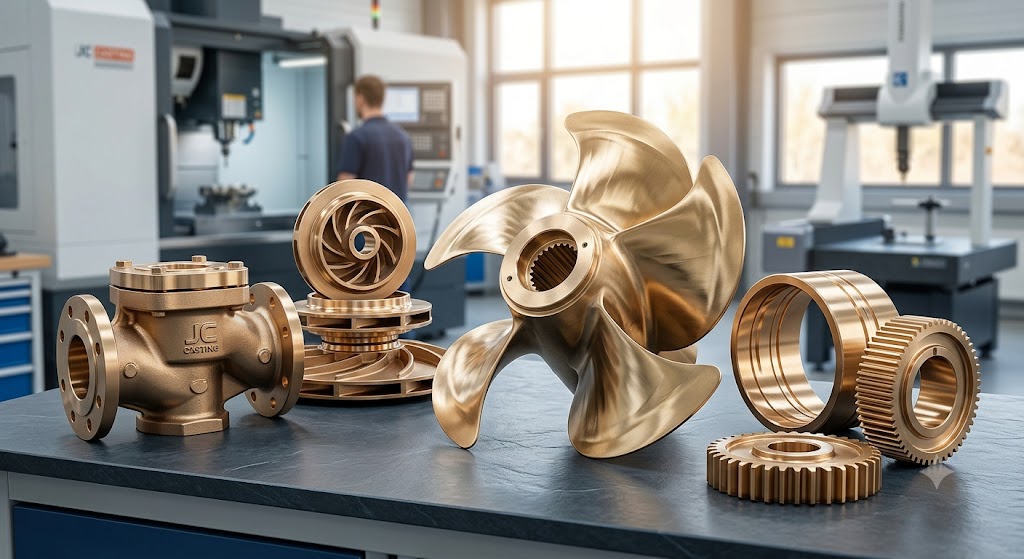
Marine Industry
Bronze is commonly used for:
- Propellers
- Pump components
- Marine hardware
- Bearings
Its excellent seawater resistance makes it suitable for harsh marine environments.
Oil & Gas Industry
Bronze components are used in:
- Valve parts
- Bushings
- Wear components
Pumps and Industrial Equipment
Bronze castings provide reliable performance in:
- Pump housings
- Impellers
- Mechanical components
Mining and Heavy Equipment
Bronze alloys are selected for wear-resistant parts operating under heavy loads.
How to Choose the Right Bronze Casting Process
Selecting the correct casting method requires evaluating several factors:
Part Complexity
Complex geometries with thin walls usually benefit from investment casting.
Production Volume
Large production runs may require different solutions compared with prototype or low-volume manufacturing.
Performance Requirements
Marine and chemical applications often require bronze alloys with superior corrosion resistance.
Machining Requirements
Precision casting can reduce machining costs by producing components closer to final dimensions.
A good supplier should help evaluate the entire manufacturing process, not only provide a casting price.
Choosing a Reliable Bronze Casting Supplier
A qualified bronze casting supplier should provide more than basic casting capability.
Important factors include:
- Experience with bronze alloys
- Stable casting processes
- Engineering support
- Quality inspection capability
- Machining and finishing services
With more than 20 years of precision casting experience, JC Casting provides custom bronze casting solutions, including investment casting, CNC machining, surface finishing, and quality inspection.
Our engineering team works with customers to optimize casting design, improve reliability, and reduce manufacturing costs.
Frequently Asked Questions About Bronze Casting Process
What is the bronze casting process?
The bronze casting process melts bronze alloy and forms it into components through molds, followed by cleaning, finishing, and inspection.
What are the main bronze casting process steps?
The main steps include alloy selection, wax pattern production, spruing, shell building, dewaxing, pouring, finishing, and inspection.
Why is lost wax casting used for bronze?
Lost wax casting provides excellent accuracy, smooth surface finish, and the ability to produce complex bronze components.
What is spruing in bronze casting?
Spruing creates the metal flow system that guides molten bronze into the mold and helps reduce casting defects.
Which bronze casting method is best for precision parts?
Investment casting is usually the best choice for complex bronze parts requiring high accuracy and excellent surface quality.
The bronze casting process involves many carefully controlled steps, from alloy selection and wax pattern production to pouring, finishing, and inspection. Every stage affects the final quality and reliability of the finished component.
For engineers and procurement teams, choosing the right casting method and an experienced manufacturing partner can significantly improve product performance and reduce production risks.