
When it comes to choosing the right metal, it really comes down to three things: performance, lifespan, and cost.Now, even though Silicon Bronze and Brass are both copper alloys, they’re built for completely different jobs.Think of Silicon Bronze as the tough guy. It’s super durable and highly corrosion-resistant, so it’s perfect for harsh environments.On the other hand, Brass is like the all-rounder. It’s incredibly easy to machine, looks great, and is much more budget-friendly.So, when we select the material for your parts, it all depends on which features matter most for your specific application.
If you are selecting a material for investment castings, valve components, marine hardware, pump parts, or other custom metal parts, understanding the differences between these two alloys can help avoid unnecessary costs and premature component failure.
In this guide, we compare silicon bronze vs brass in terms of:
- Chemical composition
- Mechanical properties
- Corrosion resistance
- Machining and casting performance
- Typical industrial applications
- Material selection recommendations
By the end of this article, you’ll have a clear understanding of which alloy best fits your application and how to optimize both product performance and manufacturing cost.
Silicon Bronze vs Brass: Quick Comparison
The table below provides a high-level comparison of the two materials before discussing each property in detail.
| Property | Silicon Bronze | Brass |
| Primary Alloying Element | Silicon | Zinc |
| Corrosion Resistance | Excellent | Good |
| Mechanical Strength | Higher | Moderate |
| Wear Resistance | Excellent | Moderate |
| Machinability | Good | Excellent |
| Weldability | Excellent | Fair |
| Marine Applications | Highly Recommended | Limited |
| Investment Casting | Excellent | Excellent |
| Relative Material Cost | Higher | Lower |
Neither alloy is universally better. The right choice depends on the operating environment, required mechanical performance, manufacturing process, and project budget.
What Is Silicon Bronze?
Silicon bronze is a copper-based alloy containing approximately 2–4% silicon, with small additions of elements such as manganese, iron, or zinc depending on the alloy grade. Unlike brass, which improves machinability by adding zinc, silicon bronze is engineered to provide better corrosion resistance, higher strength, and improved wear performance.
The addition of silicon forms a stable protective oxide film on the material surface, allowing silicon bronze to resist seawater, moisture, industrial atmospheres, and many mildly corrosive chemicals. This makes it one of the preferred materials for components that operate in outdoor or marine environments.
Compared with many traditional copper alloys, silicon bronze also offers excellent casting fluidity and low solidification shrinkage, making it well suited for investment casting of complex components with thin walls and intricate geometries. It is commonly used to manufacture:
- Marine hardware
- Pump impellers
- Valve bodies
- Bearings and bushings
- Architectural hardware
- Heavy-duty industrial components
For applications where long service life and corrosion resistance are critical, silicon bronze often delivers a lower total lifecycle cost despite its higher initial material price.
What Is Brass?
Brass is a copper-zinc alloy typically containing 55–70% copper, with zinc as the primary alloying element. Depending on the application, manufacturers may also add lead, tin, aluminum, or manganese to improve machinability or specific mechanical properties.
The greatest advantage of brass is its excellent machinability. Zinc reduces cutting forces, improves chip formation, and extends tool life, allowing manufacturers to achieve higher machining efficiency and lower production costs. As a result, brass remains one of the most widely used materials for precision machined parts and high-volume production.
Brass also offers good casting performance and an attractive golden appearance, making it suitable for both functional and decorative applications. Typical products include:
- Plumbing fittings
- Valve and pipe fittings
- Electrical connectors
- Instrument components
- Decorative hardware
- Precision machined parts
However, compared with silicon bronze, brass provides lower resistance to seawater and chloride-rich environments. In applications where long-term corrosion resistance is the primary concern, engineers often choose silicon bronze instead.
Silicon Bronze vs Brass: Composition Comparison
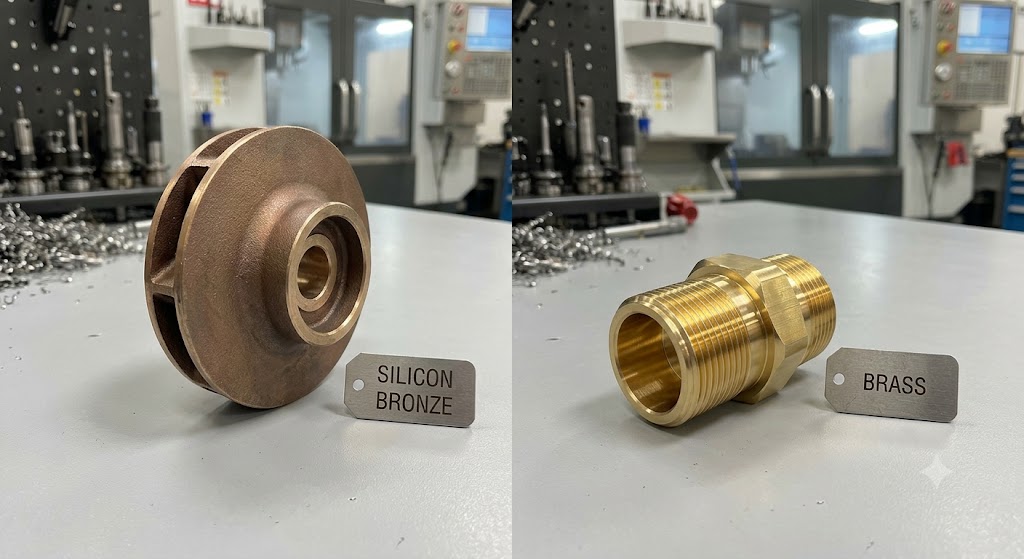
Although silicon bronze and brass are both copper alloys, the difference in their alloying elements leads to distinct microstructures and engineering performance.
Silicon bronze typically contains 94–97% copper with 2–4% silicon and small additions of manganese, iron, or zinc. Brass, in contrast, replaces a larger portion of copper with 30–40% zinc, while some grades include lead to improve machinability.
| Element | Silicon Bronze | Brass | Primary Function |
| Copper (Cu) | 94–97% | 55–70% | Base metal providing ductility and conductivity |
| Silicon (Si) | 2–4% | — | Improves corrosion resistance, strength, and castability |
| Zinc (Zn) | Trace | 30–40% | Increases machinability and reduces material cost |
| Other Elements | Mn, Fe, Zn | Pb, Sn, Al | Tailor specific mechanical or machining properties |
The alloying strategy directly influences how each material performs in service.
Silicon dissolves into the copper matrix and improves both strength and oxidation resistance without significantly reducing ductility. It also enhances molten metal fluidity, allowing the alloy to fill thin sections and complex mold cavities more effectively during investment casting. This makes silicon bronze an excellent choice for precision cast components with intricate geometries.
Zinc plays a different role. It increases hardness and significantly improves machinability, allowing brass to be cut at higher speeds with lower tool wear. However, higher zinc content also makes brass more susceptible to corrosion mechanisms such as dezincification when exposed to seawater or chloride-rich environments for long periods.
For most industrial buyers, the composition difference can be summarized simply:
- Choose silicon bronze when corrosion resistance and service life are the priority.
- Choose brass when machining efficiency and production cost are the primary concerns.
Silicon Bronze vs Brass: Mechanical Properties
Material selection should never be based on a single property. In industrial applications, engineers typically evaluate a combination of strength, hardness, wear resistance, ductility, and fatigue performance to ensure components operate reliably throughout their service life.
The table below compares the typical engineering characteristics of the two alloys.
| Property | Silicon Bronze | Brass |
| Tensile Strength | Higher | Moderate |
| Yield Strength | Higher | Moderate |
| Hardness | Higher | Moderate |
| Ductility | Excellent | Excellent |
| Wear Resistance | Excellent | Good |
| Fatigue Resistance | Better | Moderate |
Silicon bronze generally provides higher tensile and yield strength than standard casting brass grades. This allows components to withstand greater mechanical loads with less permanent deformation, making the alloy suitable for valve components, marine hardware, pump parts, and heavy-duty industrial equipment.
Another important advantage is wear resistance. Silicon increases surface hardness and reduces adhesive wear between contacting metal surfaces. Components such as bushings, bearings, valve stems, and sliding mechanisms therefore experience less material loss during long-term operation, reducing maintenance frequency and replacement costs.
Brass, while slightly lower in strength, offers excellent ductility and dimensional stability during machining. This makes it ideal for precision fittings, threaded components, and parts requiring extensive CNC machining after casting.
In many engineering projects, the performance difference becomes more significant as operating conditions become harsher. For lightly loaded indoor equipment, brass often provides adequate mechanical performance at a lower cost. However, for equipment subjected to continuous vibration, heavy loads, or abrasive service conditions, silicon bronze generally delivers greater reliability and a longer service life.
Rather than focusing only on initial material cost, procurement teams should also consider the total cost of ownership. A component that lasts significantly longer with fewer maintenance interventions often provides better long-term value than a lower-cost alternative.
Silicon Bronze vs Brass: Corrosion Resistance
Corrosion resistance is one of the biggest reasons engineers choose silicon bronze over brass.
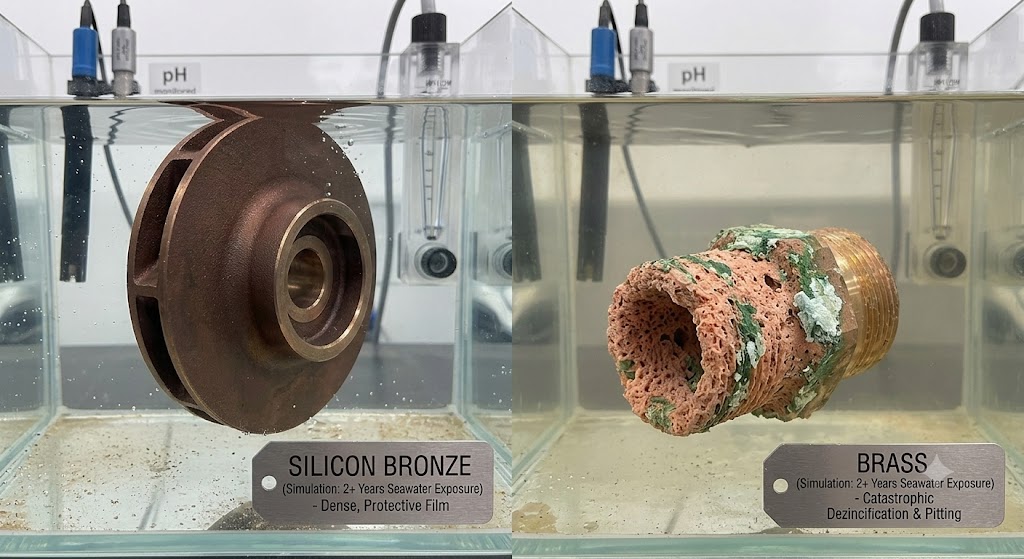
Although both materials naturally form protective oxide films, the composition of those films differs considerably. The silicon-rich oxide layer formed on silicon bronze is dense, stable, and highly resistant to moisture and chloride attack. As a result, the alloy maintains its mechanical properties even after prolonged exposure to marine or industrial environments.
Brass performs well under normal indoor conditions, but prolonged exposure to seawater, salt spray, or certain chemicals can gradually attack the zinc-rich phases within the alloy. In severe environments, this may lead to dezincification, where zinc is selectively removed from the material, leaving behind a weakened porous copper structure that reduces both strength and pressure resistance.
The following table illustrates which alloy is generally better suited to different operating environments.
| Service Environment | Recommended Material |
| Seawater | Silicon Bronze |
| Marine Atmosphere | Silicon Bronze |
| Coastal Outdoor Equipment | Silicon Bronze |
| Industrial Chemical Exposure | Silicon Bronze |
| Fresh Water Systems | Both |
| Indoor Dry Environment | Brass |
| Decorative Indoor Hardware | Brass |
For manufacturers producing pumps, valves, marine fittings, or offshore equipment, corrosion resistance directly affects product reliability and warranty performance. Although silicon bronze typically has a higher material cost, its longer service life often offsets the initial investment by reducing maintenance, downtime, and replacement frequency.
For applications where corrosion exposure is minimal and machining efficiency is the primary objective, brass remains a highly economical and practical choice.
Silicon Bronze vs Brass: Machinability and Casting Performance
Material selection affects not only component performance but also manufacturing efficiency and production cost. Both silicon bronze and brass can be produced through investment casting, sand casting, and CNC machining, but their different alloy compositions create different manufacturing advantages.
Brass is well known for its excellent machinability. The zinc content improves chip formation, reduces cutting forces, and allows higher machining speeds. For high-volume production requiring extensive CNC operations, brass often provides lower manufacturing costs and shorter production cycles.
Silicon bronze offers advantages in casting performance, especially for complex precision components. Silicon improves molten metal fluidity, allowing the alloy to fill intricate mold cavities and produce detailed parts with excellent surface quality. This makes silicon bronze a preferred choice for investment cast components that require corrosion resistance, strength, and minimal post-machining.
| Manufacturing Factor | Silicon Bronze | Brass |
| Investment Casting | Excellent | Excellent |
| Complex Geometry | Excellent | Good |
| CNC Machining | Good | Excellent |
| Surface Finish | Excellent | Excellent |
| Weldability | Excellent | Fair |
For OEM projects, the best choice depends on the complete manufacturing process. Silicon bronze is usually preferred when the component requires complex geometry, harsh operating environments, or long service life. Brass is often more economical when machining efficiency and production volume are the main considerations.
Silicon Bronze vs Brass: Common Applications
Silicon bronze and brass serve different industrial needs. Selecting the right alloy depends mainly on operating environment, mechanical requirements, and expected service life.
| Industry | Silicon Bronze | Brass |
| Marine Equipment | Valves, hardware, pump components | Limited use |
| Pumps & Valves | Corrosion-resistant components | General fluid fittings |
| Industrial Machinery | Bearings, bushings, wear parts | Precision machined parts |
| Plumbing Systems | High-performance applications | Common fittings |
| Electrical Components | Limited use | Connectors and terminals |
| Decorative Products | Architectural hardware | Widely used |
Silicon bronze is commonly selected for marine, pump, valve, and industrial applications where corrosion resistance and durability are critical. Its ability to maintain mechanical performance in seawater and humid environments makes it suitable for long-life components.
Brass remains a cost-effective choice for plumbing fittings, electrical components, and precision-machined parts where good machinability and appearance are important.
Silicon Bronze vs Brass: How to Choose the Right Alloy?
The correct material depends on balancing performance requirements and manufacturing costs.
Choose silicon bronze when:
- The component operates in seawater or corrosive environments.
- High strength and wear resistance are required.
- Long service life is more important than initial material cost.
- The part requires precision investment casting.
Choose brass when:
- CNC machining efficiency is the priority.
- Production volume is high.
- The working environment is relatively mild.
- Cost control is a major consideration.
For custom cast components, material selection should be evaluated together with casting method, machining requirements, and final operating conditions. Working with an experienced casting manufacturer helps ensure the selected alloy delivers the expected performance without unnecessary manufacturing costs.
Why Choose JC Casting for Silicon Bronze and Brass Castings?
Selecting the right copper alloy is only the first step. The quality of the final component also depends on the casting process, manufacturing experience, quality control system, and supplier capability.
At JC Casting, we provide custom copper alloy casting solutions for industrial customers worldwide, including silicon bronze casting, brass casting, investment casting, CNC machining, and surface finishing services.
With more than 20 years of precision casting experience, our engineering team helps customers select suitable materials and manufacturing processes based on actual application requirements, including corrosion conditions, mechanical loads, production volume, and dimensional requirements.
Our copper alloy casting capabilities include:
- Precision investment casting for complex silicon bronze and brass components
- Sand casting for larger industrial parts
- CNC machining for tight-tolerance finished components
- Material and process recommendations to improve product performance and reduce manufacturing costs
- Quality inspection to ensure consistent production results
Whether you need marine hardware, pump components, valve parts, industrial equipment components, or custom OEM castings, JC Casting can provide a complete manufacturing solution from prototype development to mass production.
Choosing an experienced casting partner helps reduce material selection risks, improve production efficiency, and ensure the final component meets long-term service requirements.
Frequently Asked Questions About Silicon Bronze vs Brass
Is silicon bronze stronger than brass?
Yes. In most industrial applications, silicon bronze provides higher tensile strength, yield strength, and wear resistance compared with standard brass alloys. This makes it more suitable for heavy-duty components exposed to mechanical stress, vibration, or harsh environments.
However, brass offers better machinability, which can make it the more economical choice for precision-machined parts produced in large quantities.
Which has better corrosion resistance, silicon bronze or brass?
Silicon bronze generally provides better corrosion resistance, especially in marine and chloride-rich environments.
The silicon content helps form a stable protective surface layer, allowing the alloy to maintain performance during long-term exposure to seawater, humidity, and outdoor conditions.
Brass performs well in normal environments but may experience dezincification when exposed to aggressive water or chemical conditions for extended periods.
Is silicon bronze more expensive than brass?
Yes, silicon bronze usually has a higher material cost because it contains a higher percentage of copper and provides improved performance characteristics.
However, the initial material price should not be the only consideration. In applications where corrosion resistance and durability are important, silicon bronze may reduce long-term costs by lowering maintenance requirements and extending component life.
Can silicon bronze and brass both be used for investment casting?
Yes. Both materials have excellent casting characteristics and can be manufactured through investment casting.
Silicon bronze is particularly suitable for complex castings requiring high corrosion resistance, strength, and dimensional accuracy. Brass is often selected for castings where cost efficiency and machining performance are more important.
Which alloy is better for marine applications?
For most marine applications, silicon bronze is the preferred choice.
Marine components are exposed to seawater, salt spray, and continuous moisture. Silicon bronze provides better resistance against corrosion and maintains mechanical performance over long service periods.
Common marine applications include valves, pump components, fasteners, and hardware.
How do I choose between silicon bronze and brass for my project?
The best choice depends on several factors:
- Operating environment
- Required corrosion resistance
- Mechanical loading
- Manufacturing process
- Production quantity
- Total lifecycle cost
If you need maximum durability in harsh environments, silicon bronze is usually the better option. If machining efficiency and cost control are the main priorities, brass may be more suitable.