
What sets trustworthy flange export suppliers apart from manufacturers that constantly delay deliveries and produce defective goods?
Industry research indicates unstable supply chains and inconsistent product quality rank as the top two triggers of procurement delays for industrial projects. These problems directly lead to sharp budget overruns and costly equipment downtime.
- Global demand for cast flanges continues to grow across marine, water treatment, mining, oil & gas, and industrial equipment sectors.
- Choosing the right flange exporter is about more than price.
- This guide explains what engineers and buyers should look for when selecting those best sand casting flange exporters.
Why Global Industries Depend on Sand Casting Flanges
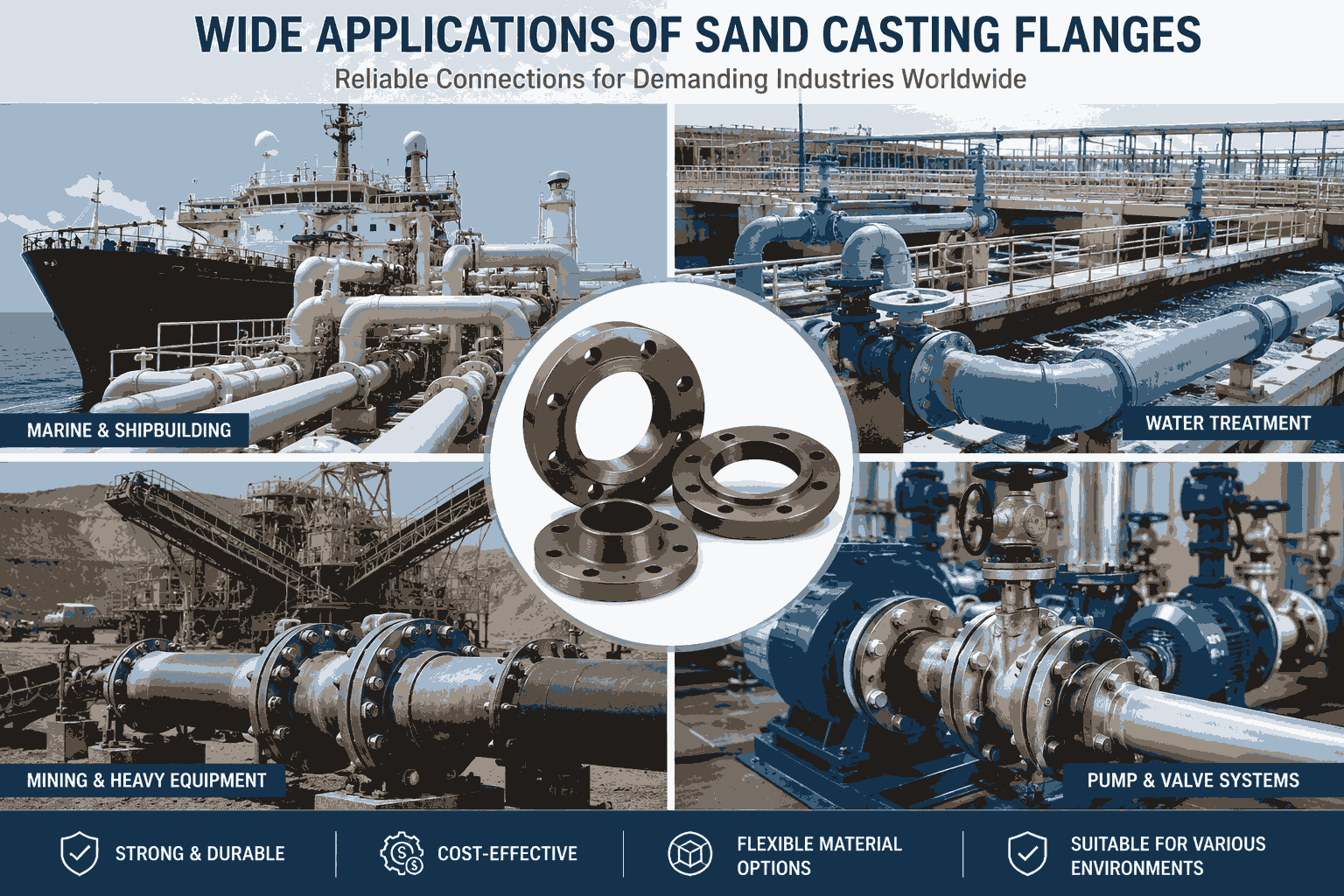
Sand casting flanges are widely used in almost every industrial piping system, from marine vessels and water treatment plants to mining equipment and pump assemblies. They play a key role in connecting pipes, valves, and machinery in a safe and reliable way.
Their popularity comes down to a simple balance of cost, flexibility, and performance. Compared with other manufacturing methods, sand casting can produce large or complex flange designs without significantly increasing production costs.
Material flexibility is another major advantage. These flanges can be made from carbon steel, stainless steel, duplex stainless steel, and other alloys, making them suitable for different working environments such as seawater exposure, high temperatures, or abrasive conditions.
For engineers and procurement teams, sand casting also simplifies sourcing. It supports both small custom orders and large-scale production, allowing buyers to adjust more easily to project requirements, delivery schedules, and budget constraints.
What Makes the Best Flange Exporters Stand Out?
Not all flange exporters deliver the same level of consistency. In global sourcing, the difference usually shows up after the first few orders—when quality stability, documentation, and communication either hold up or start to break down.
A strong flange exporter usually starts with a solid quality management system. This includes full material traceability, meaning every batch of castings can be tracked back to its raw materials and production records. For buyers, this reduces risk and makes it easier to handle audits, inspections, or project compliance checks.
International certification is another key factor. Many reliable suppliers operate under ISO 9001 systems, which means their production processes follow structured quality control rules. On top of that, serious exporters typically support full inspection documentation, including chemical composition reports, mechanical property testing, and non-destructive testing (NDT) results. These checks help confirm that the flange will perform safely under real working conditions.
Engineering capability is also what separates basic suppliers from true partners. The best flange exporters don’t just produce according to drawings—they can also support design improvements, material selection, and customization requests. They maintain tight dimensional control to ensure flanges meet required tolerances, especially for high-pressure or precision piping systems.
In short, strong exporters combine certified processes, reliable testing, and practical engineering support to reduce uncertainty for global buyers.
Key Factors Buyers Should Evaluate Before Choosing Flange Exporters
In global procurement, selecting the right flange exporter is not just about price. It is mainly about reducing supply risk. A supplier may appear qualified on paper, but weak production control or poor logistics can still disrupt project schedules.
Production Capacity & Lead Time
A reliable exporter must have stable production capability across different order types.
Core considerations
- Ability to handle both custom orders and mass production
- Stable production planning without bottlenecks
Key performance indicator
- Average production cycle time (from drawing approval to shipment)
Delivery consistency
On-time delivery is critical. Even small delays can affect:
- Pipeline installation progress
- Equipment assembly schedules
- Shipbuilding or infrastructure timelines
Export Experience & Logistics Capability
Flange export is not only manufacturing—it also involves logistics coordination and documentation.
What experienced exporters typically manage well
- Customs clearance and export documentation
- Container loading and shipment arrangement
- International transport coordination
Key evaluation points
- Main export markets (e.g., Europe, North America, Southeast Asia, Middle East)
- Experience with full container load (FCL) shipments
- Export packaging standards to prevent corrosion or damage
A supplier with strong logistics experience can reduce both shipping risks and hidden costs.
Communication Efficiency & Technical Responsiveness
In engineering projects, communication speed directly affects execution efficiency.
What good exporters usually provide
- Fast RFQ response time
- Clear feedback on drawings and specifications
- Technical support before production starts
Why it matters
This becomes especially important in custom flange projects, where unclear requirements can lead to rework, delays, or cost overruns.
Key Data Points Buyers Should Review
Before final selection, procurement teams typically evaluate:
- Average lead time (samples vs. bulk production)
- Export coverage (number of countries served)
- Shipping frequency and container loading experience
- On-time delivery (OTD) performance
These indicators provide a realistic view of whether a flange exporter can support long-term, stable supply chain requirements.
Common Challenges in Global Flange Sourcing and How to Avoid Risks
Global procurement of flanges offers access to wider supply options and better pricing, but it also introduces real operational risks. Many issues only become visible after production starts or shipments are already in transit, which makes early risk control extremely important.
Material Quality Inconsistency
One of the most common problems in global flange sourcing is unstable material quality. Even when specifications look correct on paper, actual chemical composition or mechanical performance may vary between batches.
To reduce this risk, buyers should:
- Request full material traceability records
- Require chemical composition and mechanical test reports before shipment
- Work with suppliers that provide consistent batch-to-batch documentation
These steps help ensure the flange will perform safely under real operating conditions.
Delivery Delays and Production Disruptions
Another frequent issue is delayed delivery. This often happens when suppliers lack proper production planning or overcommit their capacity.
To avoid this, procurement teams should:
- Confirm realistic production lead times before placing orders
- Track on-time delivery (OTD) performance from past shipments
- Align order schedules with supplier capacity, not just project deadlines
A stable production timeline is often more valuable than a slightly lower price.
Incomplete Documentation and Certification Gaps
In industrial applications, missing or incomplete documents can cause customs delays or even project rejection. This includes inspection reports, material certificates, and compliance documentation.
Best practices include:
- Requesting EN10204 3.1 certificates or equivalent standards
- Checking NDT (non-destructive testing) reports before shipment
- Confirming packaging and labeling meet export requirements
Good documentation is not just paperwork—it is part of the product’s reliability.
Communication Gaps and Technical Misalignment
Miscommunication between buyers and suppliers can lead to incorrect casting specifications or machining errors. This risk increases in custom flange projects where drawings require clarification.
To minimize this issue:
- Ensure fast RFQ response and engineering feedback cycles
- Clarify technical requirements before production approval
- Maintain consistent communication channels during the entire order process
Clear communication reduces rework, delays, and unnecessary cost escalation.
Practical Risk Control Approach
In practice, successful buyers treat risk management as a structured process rather than a one-time check. They evaluate suppliers based on:
- Production stability
- Quality consistency across multiple orders
- Export experience and documentation accuracy
- Communication responsiveness
By combining these factors, companies can significantly improve supply chain reliability and reduce uncertainty in global flange sourcing.
Our Global Export Service Process
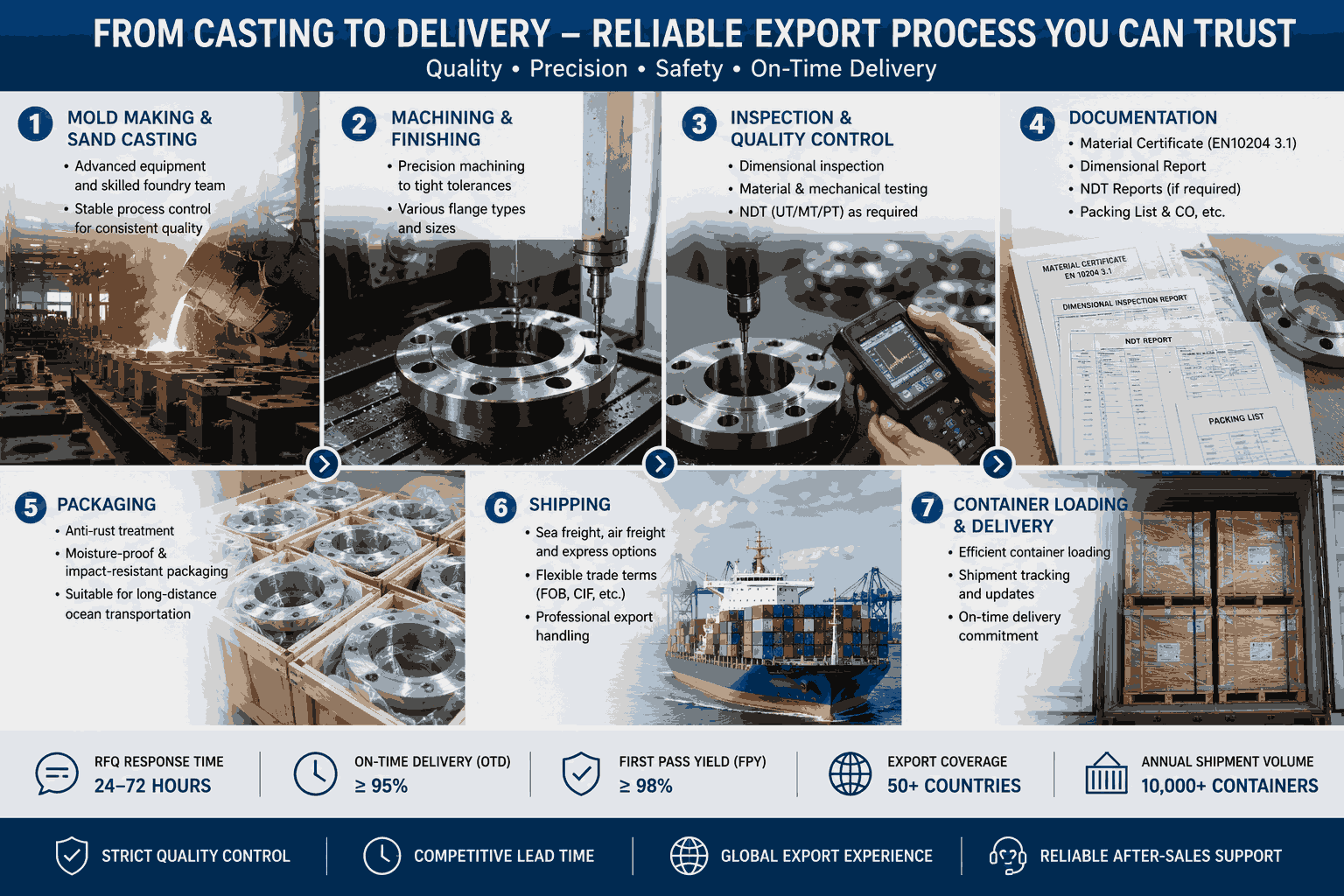
A reliable flange exporter is defined not only by production capability, but by how well the entire export process is controlled—from technical review to final delivery. A structured workflow reduces uncertainty and improves consistency for global buyers.
Technical Review & Quotation (DFM Evaluation)
Every project starts with a technical review of drawings, standards, or samples to confirm manufacturability.
Key activities:
- Check material, dimensions, tolerances, and machining requirements
- Identify potential production risks early
- Provide quotation with lead time and technical suggestions
Key indicators:
- RFQ response time: typically 24–72 hours
- Clear engineering feedback during quotation
- Early confirmation of feasibility to avoid redesign
Production, Quality Control & Inspection
After order confirmation, production follows strict process control from start to finish.
Core process:
- Mold making and sand casting
- Machining and finishing
- Batch production based on confirmed specifications
Quality system:
- Full material traceability
- In-process and final inspections
- Strict dimensional control
Documentation:
- Dimensional inspection reports
- Material certificates (e.g., EN10204 3.1)
- NDT reports when required
Key performance metrics:
- First Pass Yield (FPY)
- Production cycle time (sample vs. bulk)
- On-Time Delivery (OTD) rate
Packaging, Shipping & After-Sales Support
Once inspection is approved, focus shifts to safe delivery and ongoing support.
Service scope:
- Anti-rust and impact-resistant export packaging
- Sea freight, air freight, and trade term coordination (FOB, CIF, etc.)
- Container loading optimization
After-sales support:
- Shipment tracking updates
- Installation and technical assistance
- Export documentation support
Key performance indicators:
- Export coverage across major global regions
- Annual shipment volume (containers or tonnage)
- Stable On-Time Delivery (OTD) performance
Final Insight
A well-structured export service system is what separates basic suppliers from reliable global flange exporters. It ensures that every stage—technical review, production, inspection, and shipping—works as a controlled chain rather than isolated steps.
For buyers, this means fewer surprises, better planning accuracy, and a more stable supply chain for critical industrial projects.
In practice, this level of control is what companies like JC Casting focus on—providing precision sand casting flange solutions with consistent quality, clear engineering communication, and dependable export execution for global customers.
If you are evaluating new suppliers for your next project, sharing your drawings or specifications is the fastest way to get a practical assessment on feasibility, cost, and lead time.