
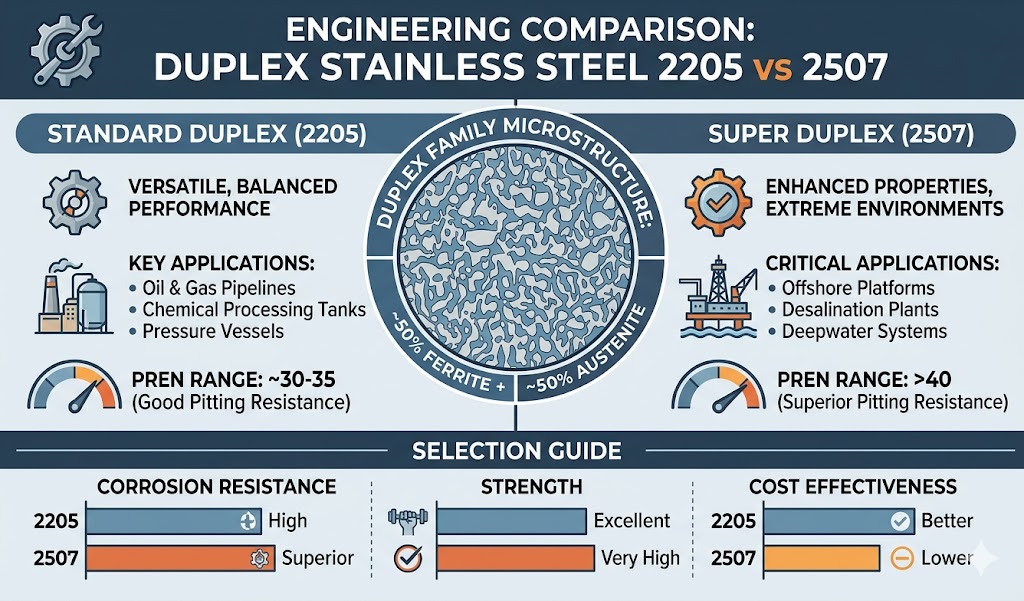
Duplex stainless steels have become a core material choice in industries where corrosion resistance, mechanical strength, and cost efficiency must be balanced. Among them, Duplex 2205 and Super Duplex 2507 are the two most widely specified grades in oil & gas, marine engineering, chemical processing, and high-performance mechanical systems.
Although they belong to the same duplex family, their performance levels differ significantly due to composition and microstructure design. Selecting the wrong grade can lead to over-engineering or premature failure.
This article provides a structured engineering comparison of Duplex Stainless Steel 2205 vs 2507, covering chemistry, corrosion resistance, mechanical properties, fabrication behavior, cost, and application scenarios, followed by practical selection guidance.
1. What Are Duplex Stainless Steels?
Duplex stainless steels are a class of alloys characterized by a mixed microstructure of approximately:
- 50% Austenite
- 50% Ferrite
This dual-phase structure provides a combination of:
- Higher strength than austenitic grades (e.g., 316L)
- Better corrosion resistance than standard ferritic steels
- Improved resistance to stress corrosion cracking (SCC)
The two most commonly used grades are:
- Duplex 2205 (UNS S32205 / S31803) – Standard duplex stainless steel
- Super Duplex 2507 (UNS S32750) – High-alloy super duplex grade
2. Chemical Composition Comparison
The key difference between 2205 and 2507 lies in alloying content, especially chromium, molybdenum, and nitrogen, which directly influence corrosion resistance and strength.
Chemical Composition Overview
| Element | Duplex 2205 (%) | Super Duplex 2507 (%) | Function |
| Chromium (Cr) | 21–23 | 24–26 | Corrosion resistance, passive film stability |
| Nickel (Ni) | 4.5–6.5 | 6–8 | Austenite stability, toughness |
| Molybdenum (Mo) | 2.5–3.5 | 3.5–5 | Pitting resistance |
| Nitrogen (N) | 0.08–0.20 | 0.24–0.32 | Strength + corrosion resistance |
| Iron (Fe) | Balance | Balance | Matrix |
Key Insight
2507 is essentially a higher-alloy evolution of 2205, optimized for extreme chloride environments and aggressive chemical exposure.
3. Corrosion Resistance Performance
Corrosion resistance is the primary selection factor between these two grades.
3.1 General Corrosion
Both grades perform significantly better than 304/316 stainless steels. However:
- 2205: Suitable for moderate chloride exposure
- 2507: Designed for highly aggressive environments
3.2 Pitting & Crevice Corrosion Resistance
A commonly used indicator is PREN (Pitting Resistance Equivalent Number):
- Duplex 2205: PREN ~ 30–35
- Super Duplex 2507: PREN ~ 40–50
Higher PREN indicates stronger resistance to localized corrosion.
3.3 Stress Corrosion Cracking (SCC)
- 2205: Very good SCC resistance in chloride environments up to moderate temperatures
- 2507: Excellent SCC resistance even in high chloride + elevated temperature conditions
Engineering Interpretation
If the environment contains high salinity, offshore splash zones, or acidic chloride media, 2507 offers a significantly higher safety margin.
4. Mechanical Properties Comparison
Duplex steels are known for high strength, which directly affects wall thickness, weight, and cost optimization.
| Property | Duplex 2205 | Super Duplex 2507 |
| Yield Strength | ~450 MPa | ~550 MPa |
| Tensile Strength | ~620–800 MPa | ~800–1000 MPa |
| Hardness | ~290 HB | ~310 HB |
| Elongation | ~25% | ~15–20% |
Key Takeaways
- 2507 is ~20–30% stronger than 2205
- Higher strength allows thinner sections and weight reduction
- 2205 provides better ductility and slightly easier forming
5. 2205 vs 2507 Welding & Fabrication Performance
Fabrication behavior is critical in casting, machining, and welding-heavy industries.
5.1 Weldability
- 2205
- Good weldability with standard duplex procedures
- Lower risk of phase imbalance if properly controlled
- 2507
- Requires stricter heat input control
- More sensitive to intermetallic phase formation
5.2 Machinability
- 2205: Moderate difficulty (work hardening tendency)
- 2507: More challenging due to higher hardness and alloy content
5.3 Casting Considerations (Important for Foundries)
For investment casting and precision casting:
- 2205 has broader process window
- 2507 requires:
- tighter temperature control
- optimized solution treatment
- stricter quality control to avoid sigma phase
Engineering Risk Note
2507 is less forgiving. Poor process control can significantly degrade corrosion resistance.
6. 2205 vs 2507 Cost Comparison
Cost is a decisive factor in material selection.
Cost Drivers
- Nickel and molybdenum content
- Processing difficulty
- Yield loss in manufacturing
- Heat treatment requirements
Relative Cost Level
- Duplex 2205: Baseline (1.0x)
- Super Duplex 2507: 1.5x – 2.5x higher
Economic Interpretation
- 2205 is often the cost-performance optimized choice
- 2507 is a risk-reduction and lifecycle-cost optimization material
In many cases, 2507 reduces maintenance cost but increases upfront investment.
7. Application Areas
Duplex 2205 Typical Applications
- Chemical processing equipment
- Pressure vessels
- Water treatment systems
- Pulp and paper industry
- Medium chloride marine environments
- Pumps and valves
Super Duplex 2507 Typical Applications
- Offshore oil & gas platforms
- Subsea pipelines and components
- High-chloride seawater systems
- Desalination plants
- Heat exchangers in aggressive media
- Critical marine structural components
- Key Differentiation Logic
- 2205 → industrial corrosion resistance baseline
- 2507 → extreme environment engineering material
8. Selection Guide: 2205 vs 2507
Choosing between the two grades requires evaluating environment severity and lifecycle expectations.
Choose Duplex 2205 when:
- Chloride exposure is moderate
- Operating temperature is controlled
- Cost optimization is important
- Structural loads are medium-range
- General industrial corrosion resistance is sufficient
Choose Super Duplex 2507 when:
- High chloride seawater or offshore exposure exists
- Pitting/crevice corrosion risk is critical
- Long service life without maintenance is required
- High mechanical stress is present
- Failure risk cost is extremely high
Engineering Rule of Thumb
If corrosion failure consequences are severe → choose 2507
If cost-performance balance is priority → choose 2205
9. FAQ: Duplex 2205 vs 2507
Q1: Is 2507 always better than 2205?
No. 2507 has higher performance but also higher cost and stricter processing requirements. Over-specifying it can be economically inefficient.
Q2: Can 2205 replace 316 stainless steel?
Yes, in most chloride environments. 2205 offers significantly better strength and corrosion resistance than 316.
Q3: Is 2507 difficult to weld?
It is weldable but requires tighter control of heat input and filler material selection compared to 2205.
Q4: Which is better for seawater applications?
2507 is generally preferred for continuous or severe seawater exposure.
Q5: Does higher strength mean lower corrosion resistance?
Not directly. In duplex steels, strength and corrosion resistance increase together due to nitrogen and alloy optimization.
Duplex 2205 and Super Duplex 2507 are not competing substitutes but different levels of engineering solutions within the same material family.
- 2205 provides a balanced, cost-effective solution for moderate corrosion environments.
- 2507 delivers extreme performance for high-risk, chloride-intensive applications.
The correct selection depends less on “which is better” and more on environment severity, lifecycle cost strategy, and fabrication capability.
Engineering & Casting Insight from JC CASTING
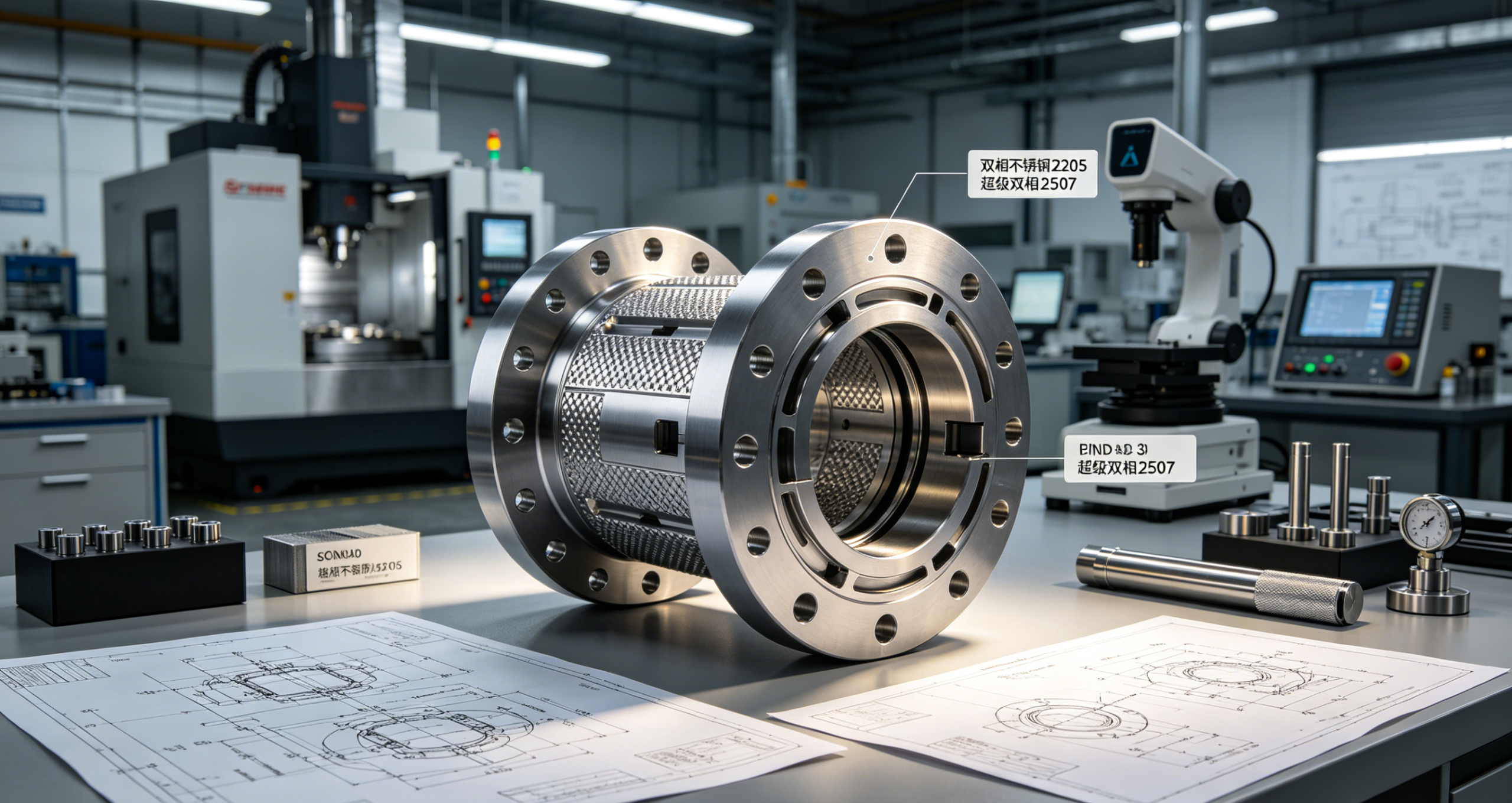
In precision casting and industrial component manufacturing, material selection directly influences yield rate, defect risk, and long-term reliability.
At JC CASTING, we support customers not only with production but also with engineering-driven material selection for duplex stainless steels and other high-performance alloys. Our casting capability includes controlled process design for duplex grades, ensuring stable phase balance, corrosion resistance retention, and dimensional accuracy.
If your project involves Duplex 2205 or Super Duplex 2507 components, our engineering team can assist in:
- Material feasibility evaluation based on working environment
- Casting process optimization for duplex alloys
- Cost-performance analysis for lifecycle efficiency
- Prototype and mass production support for complex geometries
Selecting the right material is not just a purchasing decision—it is a system-level engineering choice.