
Quick answer: CF8 is basically the cast version of 304 stainless steel, while CF8M is the cast equivalent of 316 stainless steel . The main difference between them is that CF8M has added molybdenum, which makes it way better at resisting corrosion.
CF8 and CF8M are two of the most common stainless steel casting materials used in valves, pumps, marine equipment, and chemical processing systems.
They belong to the austenitic stainless steel family and are widely specified under ASTM casting standards. At first glance, they look similar. In practice, the addition of molybdenum in CF8M creates major differences in corrosion resistance, service life, and application range.
For engineers and buyers, understanding CF8 vs CF8M is important because material selection affects:
- corrosion performance,
- maintenance frequency,、
- machining and welding behavior,
- and total lifecycle cost.
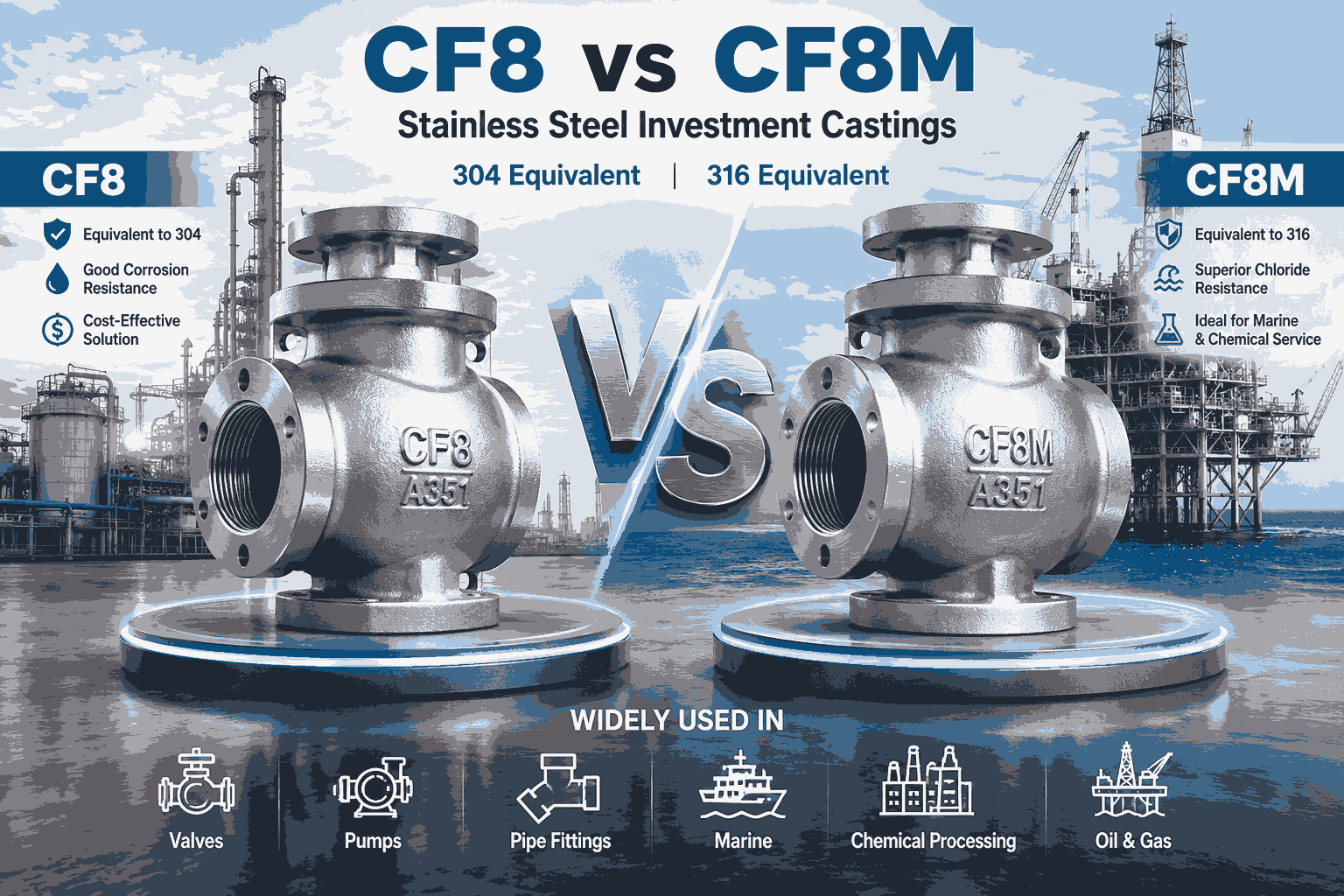
What Are CF8 and CF8M?
CF8
CF8 is the cast equivalent of 304 stainless steel.
It typically contains:
- 18–21% chromium
- 8–11% nickel
- low carbon
CF8 offers good general corrosion resistance, excellent toughness, and relatively low cost. It is widely used in freshwater, food processing, HVAC, and general industrial systems.
CF8M
CF8M is the cast equivalent of 316 stainless steel.
Its key difference is the addition of 2–3% molybdenum, which greatly improves resistance to:
- pitting corrosion,
- crevice corrosion,
- chloride attack,
- and seawater exposure.
CF8M is therefore preferred for marine, offshore, petrochemical, and chemical processing applications.
ASTM Standards and Material Identification
Both CF8 and CF8M are commonly supplied under:
- ASTM A351
- ASTM A743
- ASTM A744
These standards define:
- chemical composition,
- mechanical properties,
- heat treatment,
- inspection methods,
- and certification requirements.
Typical casting markings include:
- CF 8
- CF 8M
- ASTM A351 CF 8
- ASTM A351 CF 8M
- heat number and foundry ID
Chemical Composition Comparison
| Element | CF8 | CF8M |
| Chromium | 18–21% | 18–21% |
| Nickel | 8–11% | 9–12% |
| Molybdenum | None | 2–3% |
| Carbon | ≤0.08% | ≤0.08% |
Key takeaway: the molybdenum addition is the main reason CF8M performs better in aggressive corrosive environments.
Mechanical Properties Comparison
| Property | CF8 | CF8M |
| Tensile Strength | ≥485 MPa | ≥485 MPa |
| Yield Strength | ≥205 MPa | ≥205 MPa |
| Elongation | ≥30% | ≥30% |
| Hardness | 150–200 HB | 150–200 HB |
Mechanically, the two materials are very similar. Corrosion behavior is where the major difference appears.
Corrosion Resistance and Service Limits
General Corrosion Performance
| Property | CF 8 | CF 8M |
| Atmospheric corrosion | Good | Excellent |
| Freshwater resistance | Good | Excellent |
| Chloride resistance | Moderate | High |
| Pitting resistance | Moderate | Excellent |
| Seawater service | Limited | Excellent |
Recommended Service Boundaries
The following limits are practical engineering guidelines, not absolute rules. Actual performance depends on design, flow velocity, oxygen content, and surface condition.
| Condition | CF 8 | CF 8M |
| Chloride concentration | Best below 200 ppm Cl⁻ | Can tolerate 1,000+ ppm Cl⁻ in many systems |
| Continuous service temperature in chloride media | Best below 60°C (140°F) | Often acceptable up to 90°C (194°F) depending on chloride level |
| Organic acids | Good in mild concentrations | Better resistance in stronger concentrations |
| Seawater immersion | Not recommended for long-term immersion | Commonly used for seawater pumps and valves |
Important selection rule: if chloride concentration regularly exceeds 200 ppm or temperatures are elevated, CF8M is usually the safer choice.
Casting Performance & Technical Notes
Casting Fluidity and Filling
- CF8: slightly better fluidity and mold filling behavior. Easier for thin-wall or complex castings.
- CF8M: fluidity is marginally lower because of molybdenum addition, but still very suitable for precision investment casting.
For intricate geometries, gating design and pouring temperature become more important with CF8M.
Solidification Characteristics
Both alloys solidify as austenitic stainless steels and are prone to shrinkage if feeding is inadequate.
- CF8 generally has a slightly wider freezing range.
- CF8M can be more sensitive to hot cracking if restraint is high.
Proper riser design and directional solidification are critical for both grades.
Recommended Heat Treatment
The standard treatment is solution annealing.
- Heat to approximately 1040–1120°C (1900–2050°F).
- Hold long enough for full solutionizing.
- Rapidly quench in water.
This treatment restores corrosion resistance and reduces residual stresses.
Welding Notes
Both materials are weldable, but good practice matters.
- Use low-carbon filler metals when possible.
- Avoid prolonged exposure in the sensitization range of 425–815°C (800–1500°F).
- Post-weld solution annealing may be required for critical corrosion service.
CF8M generally performs better than CF8 in welded chloride-service equipment.
Recommended Service Temperature Range
| Material | Typical Service Range |
| CF8 | -196°C to 425°C |
| CF8M | -196°C to 425°C |
At temperatures above about 425°C (800°F), carbide precipitation and strength changes may become concerns.
Common Casting Defect Risks
- Shrinkage porosity: caused by inadequate feeding.
- Hot cracking: more likely in restrained sections or poor solidification design.
- Gas porosity: related to moisture, shell quality, or melt handling.
- Surface oxidation and inclusions: minimized through proper melting practice and shell preparation.
Experienced investment casting suppliers control these risks through process simulation, shell control, melt chemistry monitoring, and radiographic inspection when required.
Cost Comparison: Initial vs Life cycle Cost
Raw Material Cost
CF8M contains molybdenum and more nickel, so its alloy surcharge is higher.
- CF 8: lower raw material cost.
- CF 8M: typically 15–35% higher material cost depending on global nickel and molybdenum prices.
Casting and Machining Cost
CF8 is usually easier to cast and machine.
CF8M may require:
- slightly tighter process control,
- more careful tooling design,
- and marginally longer machining time due to work hardening tendencies.
The difference is usually moderate, not dramatic.
Small Batch vs Large Batch Production
- Small batches: setup costs dominate, so the material price difference has less impact.
- Large batches: raw material cost becomes a major factor, making CF8 noticeably cheaper overall.
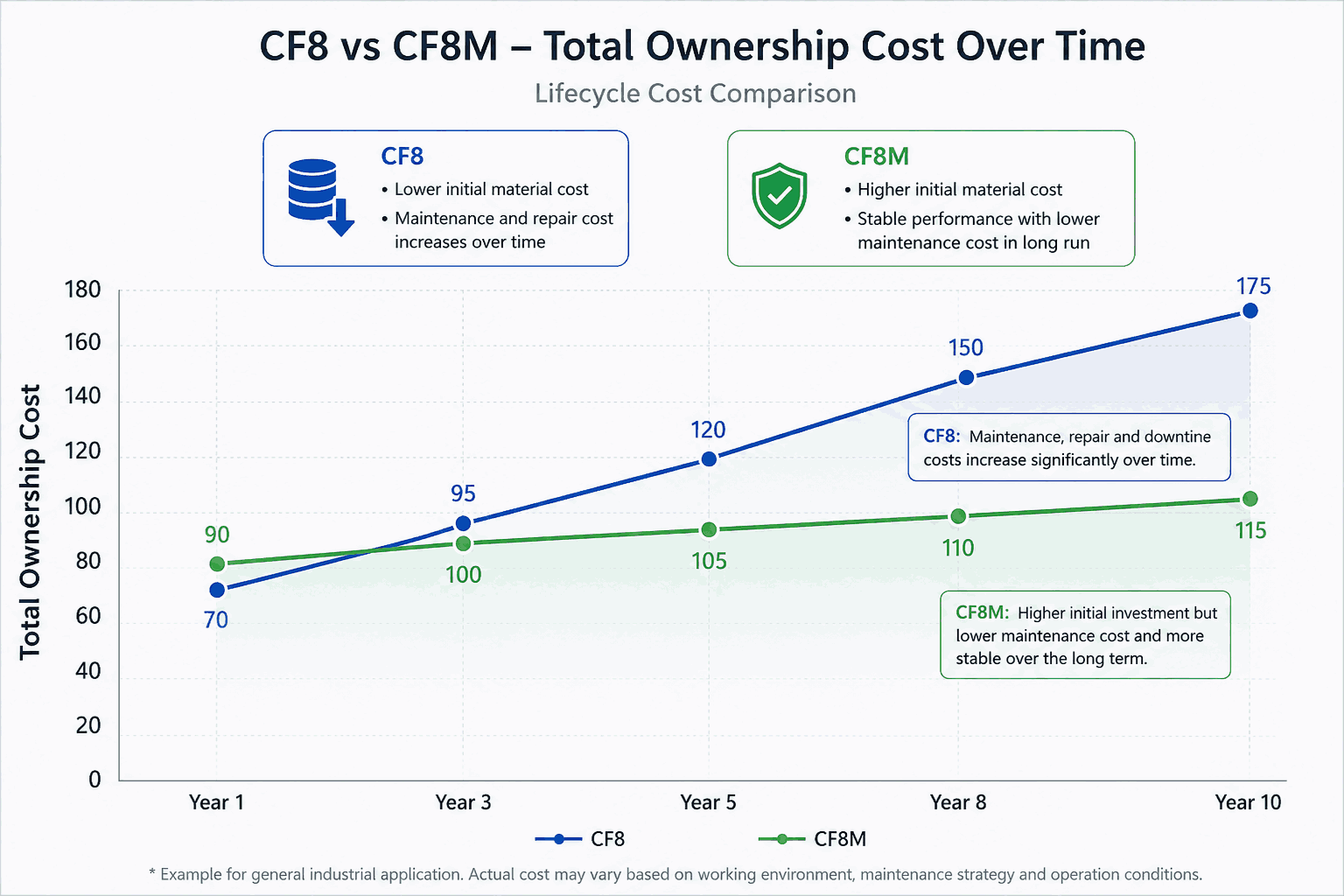
Lifecycle Cost Comparison
The real economic difference often appears after installation.
| Factor | CF 8 | CF 8M |
| Initial purchase cost | Lower | Higher |
| Maintenance frequency in chloride service | Higher | Lower |
| Replacement frequency | Higher | Lower |
| Downtime risk in corrosive media | Higher | Lower |
| Long-term ownership cost | Often higher | Often lower |
Practical rule: CF8 may be cheaper upfront, but CF8M is often more economical over the equipment lifetime in marine or chemical environments.
Typical CF8 and CF8M Castings
Typical CF8 Castings
- Water treatment valve bodies
- HVAC valve components
- Freshwater pump housings
- Food processing machinery parts
- General industrial fittings
Typical CF8M Castings
- Ball valve bodies for oil and gas service
- Seawater pump impellers
- Marine valve bodies
- Offshore platform components
- Chemical processing pump and valve castings
These are among the most recognizable stainless steel investment castings in the industry.
How to Choose Between CF8 and CF8M
Choose CF8 when
- the service medium is freshwater or mildly corrosive,
- chloride levels are low,
- operating temperatures are moderate,
- and minimizing initial cost is important.
Choose CF8M when
- chlorides are present,
- seawater or coastal exposure exists,
- chemical resistance is critical,
- welded equipment will see corrosive service,
- or long-term reliability matters more than lowest upfront cost.
When in doubt, evaluate the full service environment rather than comparing material prices alone.
Practical Case Study
A seawater circulation pump manufacturer experienced recurring corrosion damage on pump housings originally produced in CF8.
After reviewing chloride concentration, temperature, and service life data, the material was upgraded to CF8M investment castings.
The result:
- better resistance to chloride attack,
- longer maintenance intervals,
- and reduced replacement frequency in coastal installations.
This is a common example of how a higher-grade stainless steel can lower total operating cost in aggressive environments.
CF8 and CF8M are both valuable stainless steel casting materials, but they are designed for different service conditions.
- CF 8 is the cast equivalent of 304 stainless steel. It offers good general corrosion resistance and lower cost.
- CF 8M is the cast equivalent of 316 stainless steel. Its molybdenum addition provides much stronger resistance to chlorides, seawater, and chemical attack.
For freshwater and general industrial systems, CF8 is often sufficient. For marine, offshore, petrochemical, and aggressive chemical environments, CF8M is usually the better long-term choice.
At JC Casting, we specialize in manufacturing a full range of castings in different materials, including both CF8 and CF8M grades. If you have any questions or projects related to these materials, feel free to reach out with your drawings and requirements. Our team will get back to you promptly.