
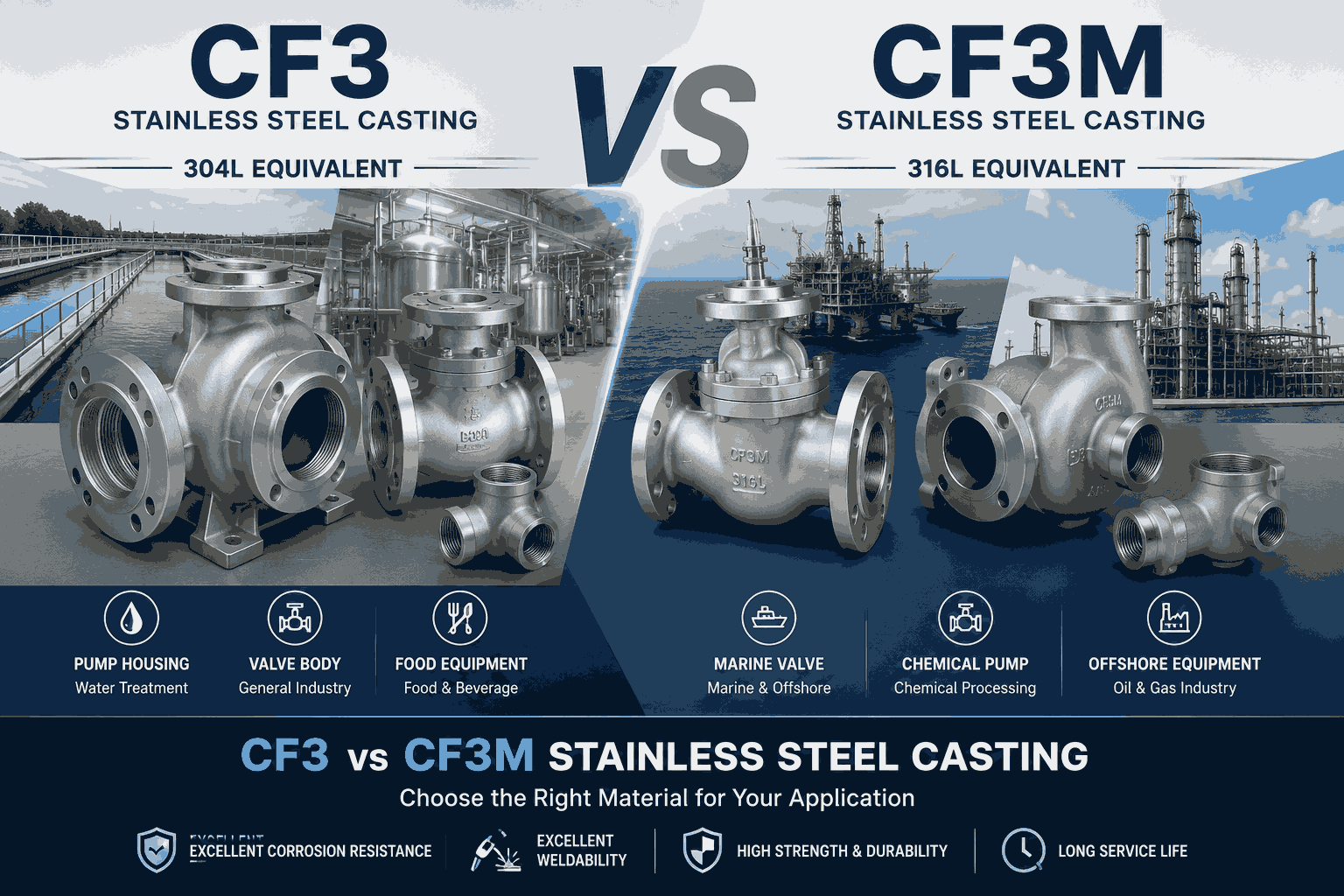
CF3 vs CF3M stainless steel casting is one of the most common material selection decisions for engineers, buyers, and equipment manufacturers.These two alloys mainly vary in corrosion resistance, chloride tolerance and overall service life.
Although both are low-carbon austenitic stainless steel castings specified under ASTM A351, CF3 is generally equivalent to 304L stainless steel, while CF3M corresponds to 316L stainless steel and contains molybdenum for enhanced corrosion protection.
Selecting the right grade can significantly affect equipment reliability, maintenance costs, and lifecycle performance.In this guide, we will explain the key differences between CF3 vs CF3M stainless steel casting, compare their advantages and disadvantages, and help engineers and buyers select the right material for their applications.
What Is CF3 Stainless Steel Casting?
CF3 is a low-carbon austenitic stainless steel casting grade specified under ASTM A351.
It is generally considered the cast equivalent of 304L stainless steel.
The low carbon content helps reduce carbide precipitation during welding, which improves resistance to intergranular corrosion.
Typical Chemical Composition of CF3
| Element | Content (%) |
| Carbon (C) | ≤ 0.03 |
| Chromium (Cr) | 17.0 – 21.0 |
| Nickel (Ni) | 8.0 – 12.0 |
| Manganese (Mn) | ≤ 1.5 |
| Silicon (Si) | ≤ 2.0 |
CF3 provides:
- Good corrosion resistance
- Excellent weldability
- Good toughness
- High ductility
- Strong resistance to oxidation
Because it does not contain molybdenum, its resistance to chloride attack is limited compared with CF3M.
What Is CF 3M Stainless Steel Casting?
CF3M is another low-carbon austenitic stainless steel casting grade under ASTM A351.
It is commonly regarded as the cast equivalent of 316L stainless steel.
The key difference is the addition of molybdenum, which significantly improves corrosion resistance in chloride-containing environments.
Typical Chemical Composition of CF 3M
| Element | Content (%) |
| Carbon (C) | ≤ 0.03 |
| Chromium (Cr) | 17.0 – 21.0 |
| Nickel (Ni) | 9.0 – 13.0 |
| Molybdenum (Mo) | 2.0 – 3.0 |
| Manganese (Mn) | ≤ 1.5 |
| Silicon (Si) | ≤ 2.0 |
The addition of molybdenum allows CF3M to provide:
- Superior pitting resistance
- Better crevice corrosion resistance
- Improved seawater performance
- Enhanced chemical resistance
- Longer service life in aggressive environments
For this reason, CF3M is one of the most widely used stainless steel casting materials in marine and petrochemical industries.
Understanding ASTM A351 CF3 and CF3M
Many buyers see the designations CF3 and CF3M but do not fully understand their meaning.
Let’s break them down:
ASTM A351
ASTM A351 is the standard specification covering austenitic stainless steel castings intended for pressure-containing parts.
Common applications include:
- Pump bodies
- Valve bodies
- Pipe fittings
- Pressure vessels
- Chemical equipment
Meaning of “CF”
The letters “CF” indicate:
- C = Corrosion-resistant
- F = Austenitic stainless steel family
Meaning of the Number “3”
The number “3” indicates low-carbon chemistry.
Maximum carbon content:
- CF3 = 0.03%
- CF3M = 0.03%
Low carbon content helps improve weldability and reduces the risk of sensitization.
Meaning of “M”
The “M” indicates molybdenum addition.
Therefore:
- CF3 = 304L casting equivalent
- CF3M = 316L casting equivalent
CF 3 vs CF 3M: Chemical Composition Comparison
The most important difference between CF3 and CF3M is the presence of molybdenum.
| Element | CF3 | CF3M |
| Carbon | ≤0.03% | ≤0.03% |
| Chromium | 17–21% | 17–21% |
| Nickel | 8–12% | 9–13% |
| Molybdenum | None | 2–3% |
| Corrosion Resistance | Good | Excellent |
| Chloride Resistance | Moderate | High |
Molybdenum strengthens the passive oxide layer on the steel surface, helping protect against localized corrosion.
CF3 vs CF3M: Mechanical Properties
Both materials belong to the austenitic stainless steel family and have similar mechanical properties.
| Property | CF3 | CF3M |
| Tensile Strength | ≥485 MPa | ≥485 MPa |
| Yield Strength | ≥205 MPa | ≥205 MPa |
| Elongation | ≥30% | ≥30% |
| Impact Toughness | Excellent | Excellent |
| Weldability | Excellent | Excellent |
From a strength perspective, there is little difference between the two materials.
The major distinction lies in corrosion performance.
CF3 vs CF3M Corrosion Resistance
Corrosion resistance is usually the deciding factor when selecting between CF3 and CF3M.
CF3 Corrosion Resistance
CF3 performs well in:
- Fresh water
- Atmospheric environments
- Food processing
- Mild chemicals
- General industrial service
However, it is more vulnerable to:
- Chloride attack
- Seawater exposure
- Salt spray environments
Long-term exposure to chlorides can cause pitting corrosion.
CF3M Corrosion Resistance
CF3M provides superior resistance to:
- Seawater
- Brine
- Chloride solutions
- Offshore environments
- Chemical processing media
The molybdenum addition significantly improves resistance to:
- Pitting corrosion
- Crevice corrosion
- Stress corrosion cracking
For aggressive service conditions, CF3M is generally the safer choice.

CF3 vs CF3M Heat Resistance
Both materials offer good oxidation resistance at elevated temperatures.
Typical service temperatures include:
| Material | Recommended Service Temperature |
| CF3 | Up to 870°C (1600°F) |
| CF3M | Up to 870°C (1600°F) |
Although both grades can withstand high temperatures, they are primarily selected based on corrosion requirements rather than heat resistance.
CF 3 vs CF 3M Casting Performance
From a foundry perspective, both materials have excellent castability.
CF3 Casting Characteristics
Advantages:
- Good fluidity
- Stable filling behavior
- Lower alloy cost
- Easier process control
Challenges:
- Less corrosion resistance in harsh environments
CF3M Casting Characteristics
Advantages:
- Better corrosion performance
- Longer service life
Challenges:
- Higher material cost
- Slightly increased alloy control requirements
Modern investment casting foundries can produce both grades with excellent dimensional accuracy and surface finish.
Pros and Cons of CF3 Stainless Steel Casting
Advantages
✓ Lower material cost
✓ Excellent weldability
✓ Good corrosion resistance
✓ Easy fabrication
✓ Good toughness
Disadvantages
✗ Poorer chloride resistance
✗ Limited marine service life
✗ Lower pitting resistance
Pros and Cons of CF3M Stainless Steel Casting
Advantages
✓ Superior corrosion resistance
✓ Excellent seawater performance
✓ Better pitting resistance
✓ Longer service life
✓ Suitable for aggressive chemicals
Disadvantages
✗ Higher raw material cost
✗ More expensive machining and casting
Typical Applications of CF3 Castings
CF3 is commonly used in industries where corrosion conditions are moderate.
Typical applications include:
Pump Components
- Pump casings
- Impellers
- Pump covers
Food Processing Equipment
- Mixing equipment
- Conveyor components
- Sanitary fittings
Water Treatment Equipment
- Valve bodies
- Filter housings
- Pipe connectors
General Industrial Machinery
- Structural components
- Instrument housings
- Equipment frames
Typical Applications of CF3M Castings
CF3M is widely used in harsh environments where superior corrosion resistance is required.
Valve Castings
Common products include:
- Gate valves
- Ball valves
- Globe valves
- Check valves
Pump Castings
- Chemical pumps
- Marine pumps
- Offshore pumps
Marine Equipment
- Seawater system components
- Deck equipment
- Offshore platform hardware
Petrochemical Equipment
- Pressure-containing parts
- Chemical handling systems
- Process equipment
Pharmaceutical Equipment
- Sterile processing equipment
- High-purity fluid systems
Representative Castings Made from CF 3 and CF 3M
Some of the most recognizable cast products manufactured from these materials include:
| Casting Type | CF3 | CF3M |
| Pump Body | ✓ | ✓ |
| Pump Impeller | ✓ | ✓ |
| Valve Body | ✓ | ✓ |
| Pipe Fittings | ✓ | ✓ |
| Marine Hardware | Limited | Excellent |
| Chemical Pump Components | Moderate | Excellent |
| Offshore Equipment | Rare | Common |
CF3 is generally selected for cost-sensitive applications.
CF3M is preferred when corrosion resistance is mission-critical.
How to Choose Between CF3 and CF3M
Choose CF3 when:
- Operating in fresh water
- Working in non-chloride environments
- Budget is a priority
- General corrosion resistance is sufficient
Choose CF3M when:
- Exposure to seawater exists
- Chlorides are present
- Equipment downtime is expensive
- Long service life is critical
- Chemical resistance is required
A higher initial investment in CF3M often results in lower maintenance and replacement costs over the equipment lifecycle.
JC Casting Success Story: CF3M Pump Casting for Offshore Service
A European pump manufacturer approached JC Casting with recurring corrosion failures in a seawater transfer system.
The original castings were produced using a standard 304-type stainless steel grade. After several years of service, pitting corrosion caused leakage and increased maintenance costs.
JC Casting’s engineering team evaluated the operating conditions and recommended upgrading to CF3M investment castings.
The solution included:
- Precision investment casting process
- Strict chemical composition control
- Solution heat treatment
- Dimensional inspection
- Corrosion-resistant finishing
After installation, the customer reported significantly improved corrosion resistance and a longer service life in the offshore environment.
The project reduced maintenance frequency and improved overall system reliability.
Why Choose JC Casting for CF 3 and CF 3M Stainless Steel Castings?
JC Casting manufactures high-quality investment castings for global customers in the pump, valve, marine, chemical, and industrial equipment sectors.
Our capabilities include:
- CF3 precision castings
- CF3M precision castings
- ASTM A351 stainless steel castings
- Complex geometries
- Tight dimensional tolerances
- Machining and surface finishing services
- Material testing and quality certification
We supply cost-effective CF3 castings as well as high corrosion-resistant CF3M components. At JC Casting, we deliver reliable custom solutions based on your actual working conditions.