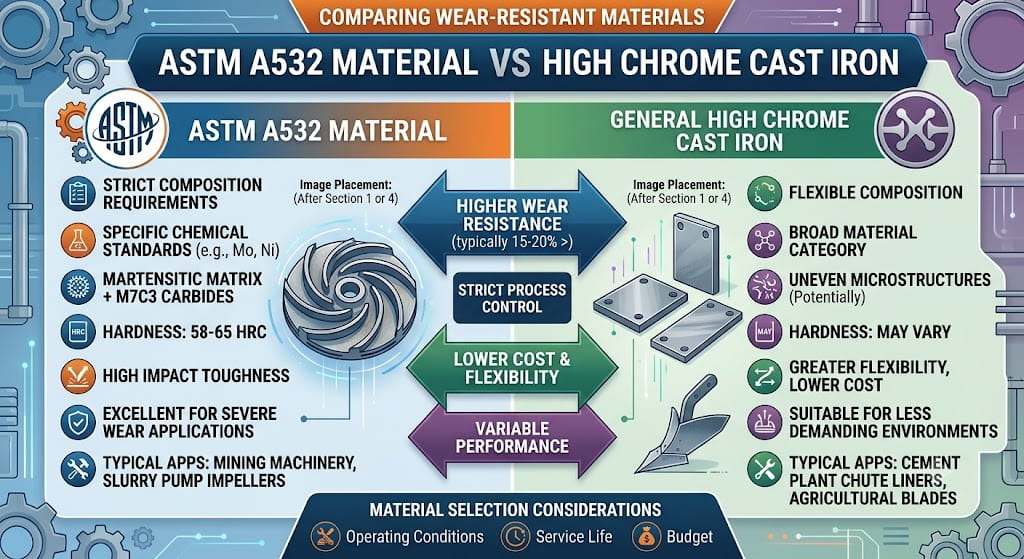
Both options are widely recognized as excellent wear-resistant materials, but a closer look at ASTM A532 Material vs High Chrome Cast Iron reveals distinct differences. ASTM A532 features stricter composition requirements, ensuring more stable mechanical performance and a wear resistance that is typically 15%–20% higher than ordinary high chrome cast iron. This makes it ideal for high-stress applications, such as mining equipment. On the other hand, general high chrome cast iron offers greater manufacturing flexibility and lower production costs, commonly finding its place in less demanding environments like cement plants. When choosing between them, engineers must consider operating conditions, service life, and budget—though for severe wear environments, ASTM A532 is usually the preferred choice.
In industrial applications, selecting the right wear-resistant material is critical.It directly affects equipment performance and service life.Among many options, ASTM A532 and high chrome cast iron are widely used because of their excellent wear resistance.
However, there are significant differences in composition, performance, and application areas.The following sections provide a detailed comparison.
1. Differences in Standards and Chemical Composition
ASTM A532
ASTM A532 is a wear-resistant cast iron standard developed by the American Society for Testing and Materials (ASTM).The standard is divided into Class I, Class II, and Class III grades.Class III materials belong to the high chrome cast iron family.However, they must meet specific chemical composition requirements.
For example:
- Chromium content: 15%–30%
- Carbon content: 2.4%–3.6%
- Alloying additions such as molybdenum (0.5%–2.5%) and nickel (0.5%–1.5%) to improve hardenability and impact resistance.
General High Chrome Cast Iron
High chrome cast iron refers to cast irons containing more than 12% chromium.It is a broad material category rather than a specific standard.Not all high chrome cast irons comply with ASTM A532 requirements.
Typical characteristics include:
- Chromium content: 12%–30%
- Carbon content ranging from 1.5% to 3.5%.
- Additional elements such as copper or titanium may be added based on specific service requirements.
Key Difference
ASTM A532 is a standardized material with strict composition control.General high chrome cast iron offers greater flexibility.Its composition can be customized for specific applications.
2. Microstructure and Performance Comparison
Microstructure
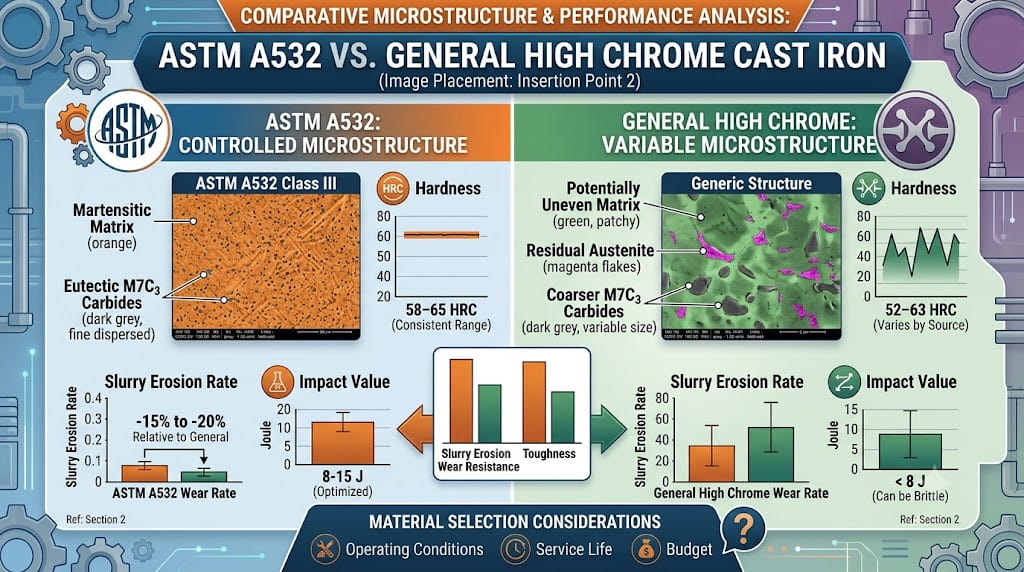
After proper heat treatment, ASTM A532 high chrome cast iron develops a martensitic matrix combined with eutectic carbides such as M7C3. Hardness can reach 58–65 HRC.
Non-standard high chrome cast iron may show greater composition variation.This can result in uneven microstructures.In some cases, retained austenite may remain.This can reduce hardness and wear resistance.
Wear Resistance
Both materials rely on hard carbides such as Cr7C3 for wear resistance.These carbides provide excellent protection against abrasive wear.
However, ASTM A532 offers more consistent performance because of its controlled composition.Test data show that under slurry erosion conditions, ASTM A532 Class III materials can exhibit wear rates 15%–20% lower than ordinary high chrome cast iron.
Toughness
ASTM A532 often contains molybdenum and nickel to improve toughness.Impact values typically range from 8 to 15 J.
Lower-cost high chrome cast iron grades may use fewer alloying elements.As a result, brittleness can increase.
3. Differences in Heat Treatment
ASTM A532
ASTM A532 generally requires a carefully controlled heat treatment process.
Typical procedures include:
- Quenching at 950–1050°C.
- Tempering at 200–450°C.
These steps promote complete martensitic transformation.Some grades may also require deep cryogenic treatment.This helps reduce retained austenite.
General High Chrome Cast Iron
Heat treatment is usually more flexible.
Common methods include:
- Air quenching.
- Oil quenching.
However, performance consistency may be lower.To reduce production costs, some manufacturers may omit tempering.This can leave residual internal stress within the casting.
4. Application Comparison
Typical Applications of ASTM A532
ASTM A532 is commonly used in severe wear environments.
Examples include:
- Slurry pump components such as impellers and liners.
- Mining machinery exposed to heavy abrasive wear.
- Coal mill rollers and grinding rings in power plants.
- High-temperature wear-resistant components.
These applications often involve high stress and demanding operating conditions.
Typical Applications of General High Chrome Cast Iron
General high chrome cast iron is often used in lower-stress wear environments.
Examples include:
- Cement plant chute liners.
- Material handling wear plates.
- Agricultural machinery blades.
- Cost-sensitive industrial equipment.
In many cases, manufacturers reduce alloy content to lower costs.This approach may sacrifice some wear resistance.
5. Cost Comparison and Material Selection
Cost Comparison
ASTM A532 generally contains more alloying elements.It also requires stricter process control and heat treatment.
As a result:
- ASTM A532 products are typically 20%–40% more expensive than ordinary high chrome cast iron.
- General high chrome cast iron provides a lower initial investment.
Selection Guidelines
Choose ASTM A532 when:
- The application involves high impact loads.
- Severe abrasive wear is expected.
- Long service life is a priority.
- Equipment downtime must be minimized.
Choose general high chrome cast iron when:
- Wear conditions are relatively mild.
- The abrasive media are softer, such as coal powder.
- Budget constraints are a major consideration.
- Moderate service life is acceptable.
Summary
ASTM A532 and high chrome cast iron both belong to the family of wear-resistant chromium cast irons.However, they serve different needs.
ASTM A532 emphasizes standardization, reliability, and consistent performance.
General high chrome cast iron offers greater flexibility and lower cost.
The best choice depends on operating conditions, expected service life, and budget requirements.Whenever possible, wear testing should be performed before final material selection.
For harsh industrial environments, ASTM A532-compliant castings remain one of the most reliable solutions for achieving long-term equipment performance and reduced maintenance costs.