
What Are Special-Process Flanges?
Not every industrial project can rely on off-the-shelf flange products.
Take marine equipment manufacturers, for example. When they’re developing seawater cooling systems, their engineering teams usually need flanges with custom bolt hole patterns, a lightweight design, and extra corrosion resistance to survive years of salt spray. Honestly, in most cases, standard flanges just can’t cut it for such harsh conditions.
This is where Special-process Flanges come into play.
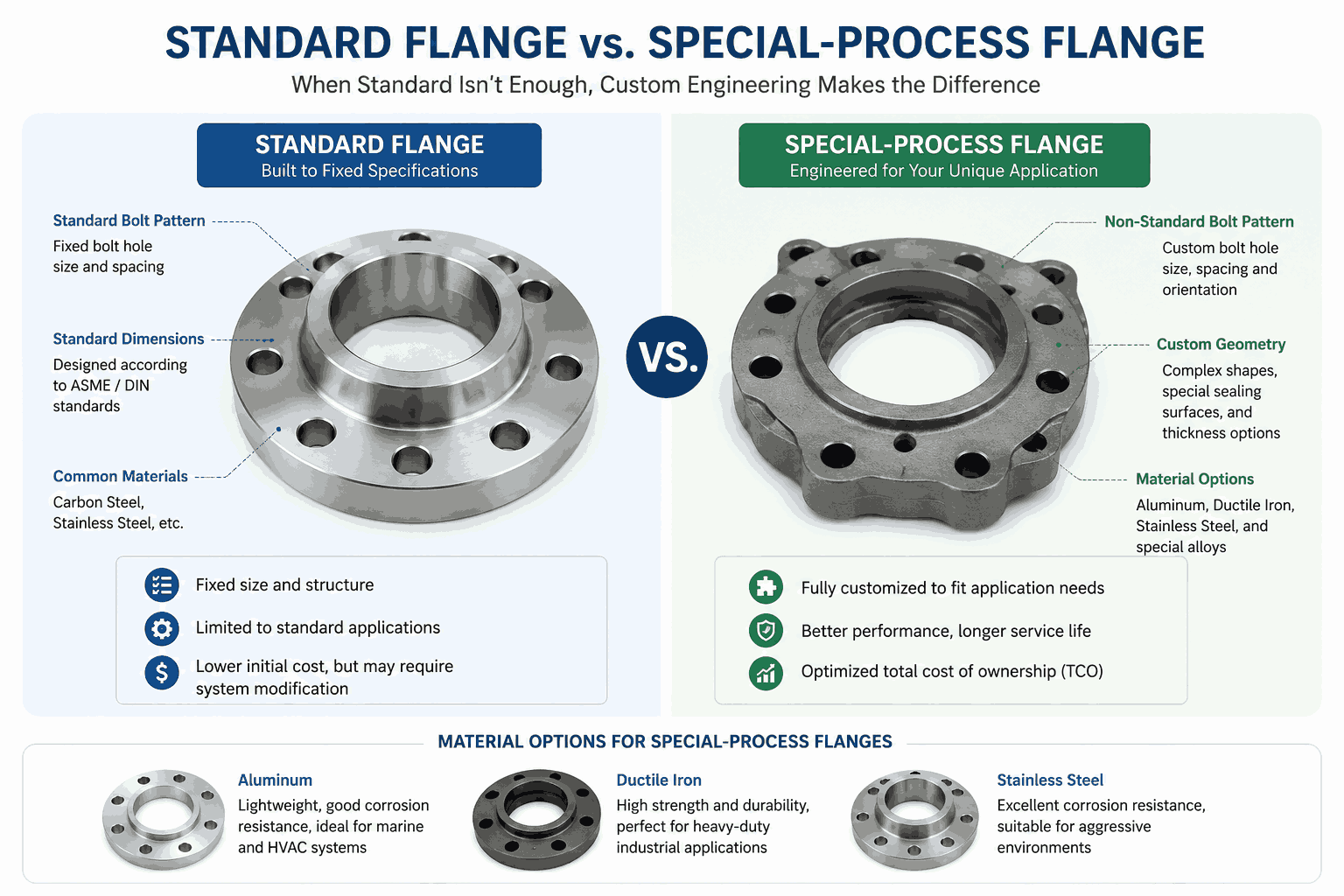
Special-process flanges are custom-engineered flange components manufactured using specialized casting and machining methods to meet unique operating conditions. Unlike standard flanges produced according to fixed specifications, these flanges can be tailored in terms of dimensions, materials, sealing surfaces, pressure ratings, and installation requirements.
Common manufacturing methods include sand casting, investment casting, shell mold casting, and precision machining. These processes allow manufacturers to produce complex flange designs that would be difficult or costly to achieve through conventional production methods.
The demand for customized components continues to grow across industrial sectors. Industry reports indicate that custom-engineered parts account for a significant share of equipment used in marine engineering, industrial processing, water treatment, mining, and energy projects. As systems become more specialized, the need for application-specific flange solutions increases as well.
For mechanical engineers, special-process flanges provide greater design flexibility and improved system compatibility. For procurement specialists, they offer the opportunity to optimize performance, service life, and total ownership cost instead of settling for a standard component that may only partially fit the application.
Simply put, when a standard flange cannot meet the requirements of the job, a special-process flange often becomes the most practical and cost-effective solution.
Aluminum Cast Flanges — A Lightweight Solution for Modern Industrial Systems
In many real-world engineering projects, weight is not just a design detail—it directly affects cost, installation efficiency, and system performance.
Take a simple example: in a seawater circulation system used on offshore platforms, replacing traditional heavy metal flanges with aluminum cast flanges can reduce component weight by up to 50%–65%. That difference matters when hundreds of connection points are involved across a full piping system.
Aluminum cast flanges are designed to solve exactly this type of problem.
They are produced through casting processes that allow aluminum to be shaped into precise flange geometries, including custom bolt patterns and sealing surfaces. Compared with iron or steel flanges, aluminum offers a much lighter structure while still maintaining sufficient strength for low to medium pressure applications.
One of the biggest advantages is handling and installation. Lighter flanges are easier to transport, position, and assemble, which helps reduce labor time on-site. In industries where installation windows are short—such as shipbuilding or modular equipment assembly—this can significantly improve project efficiency.
At the same time, aluminum performs well in environments where corrosion is a concern, especially in moisture-rich or mildly saline conditions. This makes it a practical choice for HVAC systems, marine auxiliary equipment, water treatment units, and lightweight machinery.
Of course, aluminum cast flanges are not a universal solution. They are not ideal for high-pressure or high-temperature pipelines, and engineers must carefully evaluate load conditions before selection. In practice, they are most effective when the design priority is a balance between weight reduction, corrosion resistance, and moderate mechanical strength.
In short, aluminum cast flanges are not just a material choice—they are a system optimization tool that helps engineers reduce weight without compromising operational reliability in the right applications.
Iron Cast Flanges — A Reliable Choice for Heavy-Duty Industrial Applications
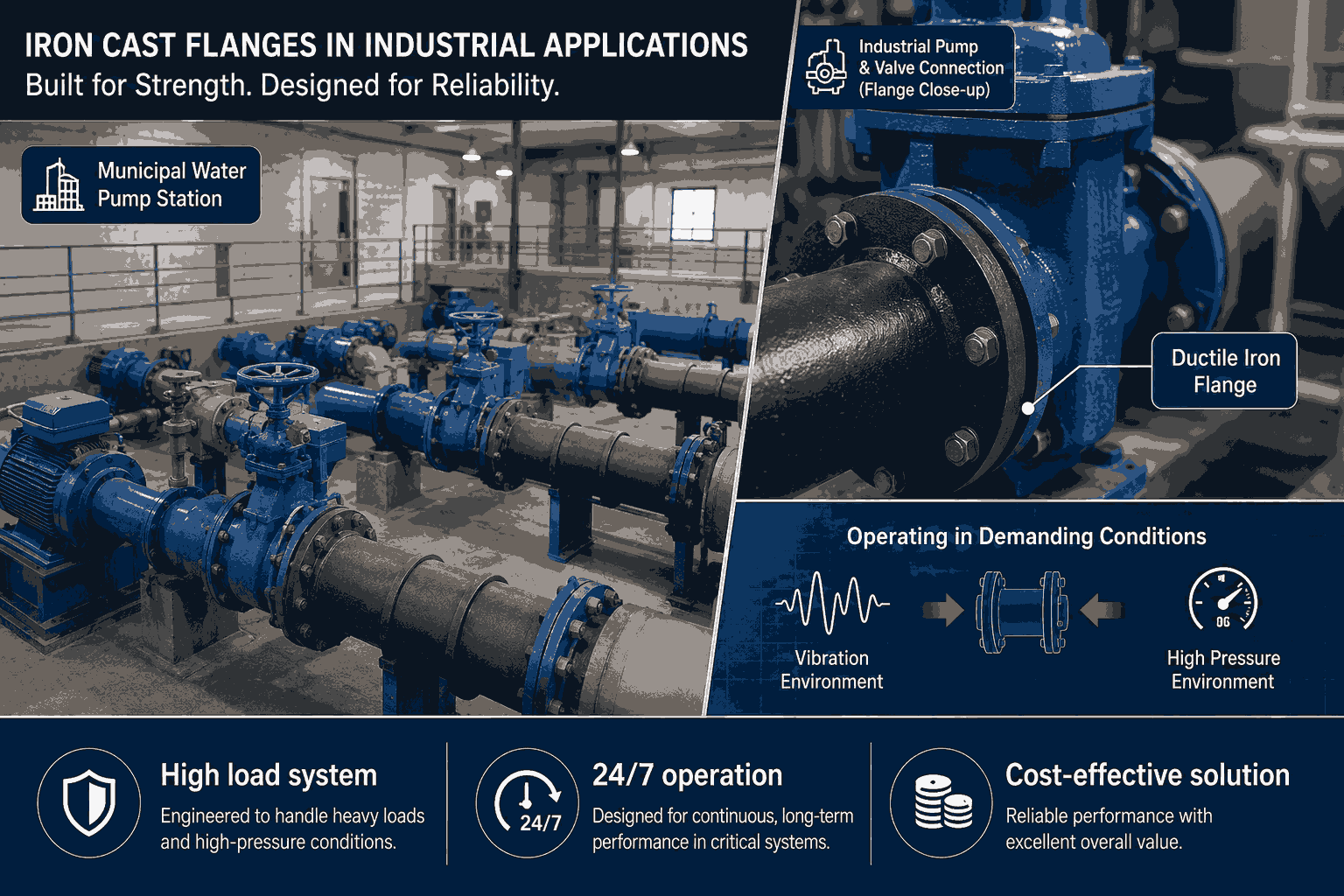
In industrial environments where systems run 24/7 under high load, engineers usually care less about weight and more about one thing: reliability under stress.
That is exactly where iron cast flanges come in.
In a typical municipal water pumping station, for example, hundreds of pipeline connections operate under continuous pressure and vibration. In these setups, ductile iron flanges are often chosen because they can handle tensile strengths in the range of roughly 400–600 MPa, while still keeping material and production costs significantly lower than many stainless steel alternatives.
Iron cast flanges are produced by pouring molten iron into molds, which allows manufacturers to create strong, rigid components with stable geometry. This rigidity is important. It helps reduce deformation at the sealing surface, especially in systems where pressure fluctuations or mechanical vibration are common.
Another practical advantage is cost efficiency. In large-scale infrastructure projects, switching from higher-grade alloys to cast iron can reduce material cost by 20%–40%, depending on specification and volume. For procurement teams managing tight budgets, this difference becomes very meaningful over long project lifecycles.
These flanges are widely used in pumps, mining equipment, industrial piping systems, and water treatment plants—basically anywhere the system is expected to run hard, long, and without frequent shutdowns.
Of course, iron cast flanges are not designed for highly corrosive or extreme offshore environments without proper surface treatment. But in controlled industrial settings, they remain one of the most practical and cost-balanced solutions available today.
How Different Industries Choose the Right Cast Flange
In practice, there is no “one best flange.” The right choice depends entirely on where it is used. The same design that works perfectly in a clean water system may fail quickly in a marine or mining environment.
That is why engineers and buyers usually start from the application first, not the product.
1. Mechanical Engineering Applications — Focus on Fit and Function
In general mechanical equipment, such as pumps, compressors, and valve assemblies, the main concern is system stability.
- Engineers care about pressure rating, sealing performance, and dimensional accuracy.
- Small deviations in flange flatness or bolt alignment can lead to leakage or vibration issues.
- Standardized cast flanges are often preferred here because they balance cost and performance.
In many cases, the selection is straightforward: if operating conditions are stable, standard iron or stainless cast flanges are enough. If the equipment is compact or has special geometry, custom casting becomes necessary.
2. Marine and Offshore Applications — Focus on Corrosion and Lifecycle
Marine environments are much more aggressive.
Saltwater exposure can degrade poorly selected materials quickly, even if initial performance looks acceptable.
- Corrosion resistance becomes the top priority.
- Weight reduction is also important for onboard systems.
- Maintenance access is limited, so long service life is critical.
In offshore systems, a small design mistake can increase maintenance frequency by 2–3 times over the equipment lifecycle, mainly due to corrosion-related failures.
That is why marine engineers often consider aluminum cast flanges or specially treated iron cast flanges, depending on pressure and load requirements.
3. Procurement Perspective — Focus on Total Cost, Not Unit Price
Procurement teams usually look beyond the material itself.
A lower-priced flange does not always mean lower total cost.
Key considerations include:
- Total cost of ownership (TCO), not just purchase price
- Delivery reliability from the supplier
- Quality consistency across batches
- Inspection reports and certifications
In real projects, switching from a “cheaper but unstable” supplier to a qualified casting manufacturer can reduce hidden costs such as rework, downtime, and replacement by 15%–30% over time, even if unit price is slightly higher.
4. Industry Selection Logic — Putting It Together
Across industries, the decision usually follows a simple logic chain:
- Mechanical systems → performance + fit
- Marine systems → corrosion + lifespan
- Industrial procurement → cost + risk control
Once this logic is clear, selecting between aluminum, iron, or custom special-process flanges becomes much easier and more predictable.
Expert Flange Casting for Specialized Applications: Let JC Casting Handle Your Custom Needs
JC Casting is a well-established foundry specializing in custom flanges. With extensive experience in producing non-standard aluminum and cast iron flanges, we are deeply committed to providing supporting components for specialized industrial and architectural applications.
Our facility handles the entire production process in-house, from mold design and precision casting to CNC machining and comprehensive performance testing. We strictly adhere to international industrial standards to manufacture one-piece aluminum flanges, die-cast flanges, custom planetary equipment flanges, heavy-duty cast iron pipe flanges, and vintage decorative flanges. Our technical team optimizes product structures based on clients’ actual operating conditions, ensuring precise assembly and stable operation of the equipment.
Got a custom flange project on hand? Contact us today! We’ll provide a tailored solution for your specific working conditions and a precise factory-direct quote.