
Casting Flange are indispensable connecting parts for industrial piping, machinery, and fluid transmission systems. Mechanical engineers, procurement teams, and industrial contractors widely rely on cast flange solutions to create stable, leak-proof connections.Different casting methods and materials deliver unique performance to fit diverse working conditions. This article explores the basic knowledge, mainstream types, and practical application advantages of industrial casting flanges.
What Are Casting Flange and Flange Casting?
A casting flange is a flange component manufactured through metal casting processes. Workers pour molten metal into customized molds, cool the material, and form finished flange structures. Flange casting refers to the entire manufacturing process of producing flange parts via casting technology.
Compared with forged flanges, cast flanges feature flexible shaping, low production cost, and strong adaptability for complex structures. They perfectly match the demands of general industrial equipment, marine pipelines, and petrochemical fluid systems.
Mainstream Types of Casting Flanges
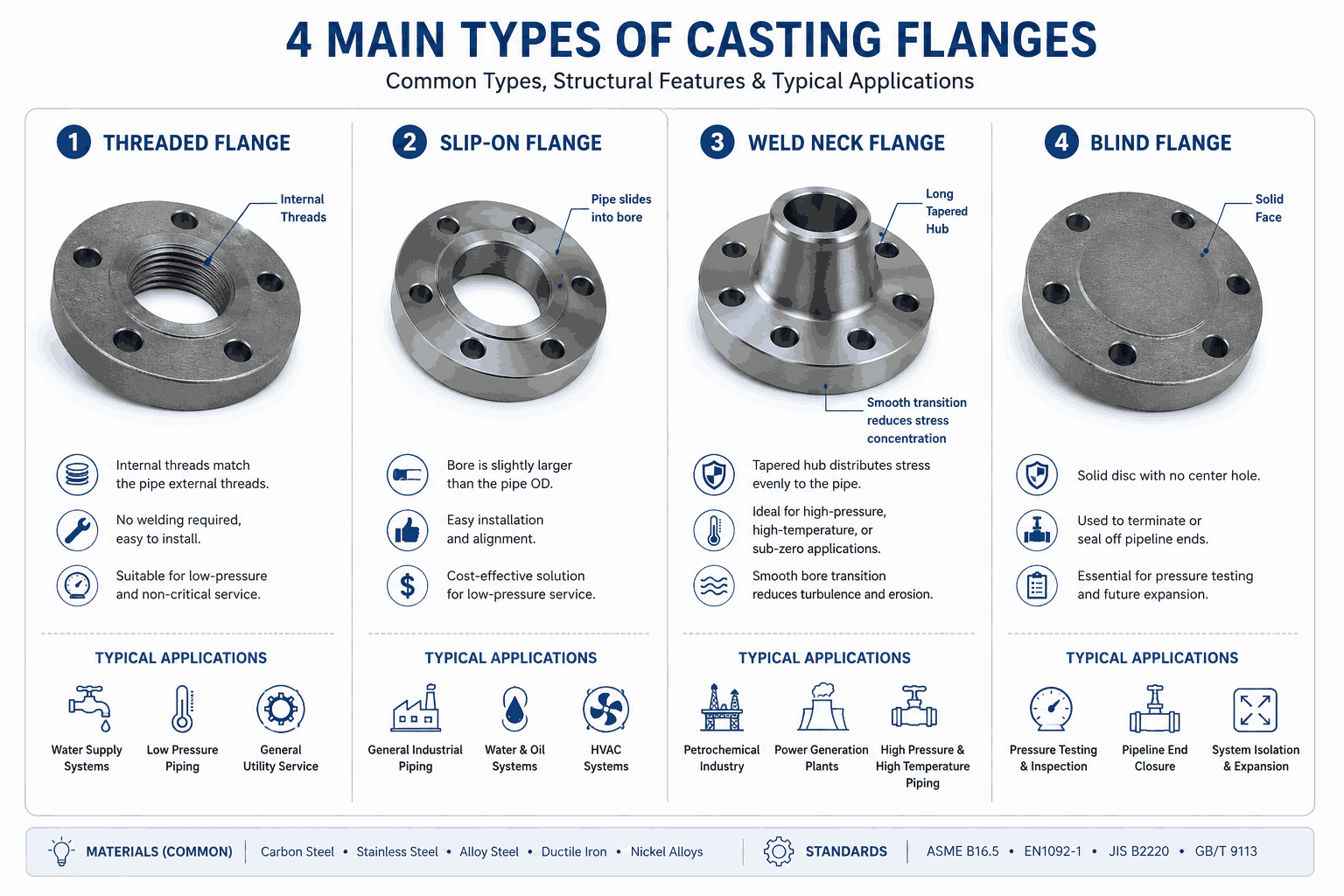
Industrial casting flanges are generally categorized by their face type and structural design, each serving a specific sealing purpose:
Threaded Flanges: Cast with internal threads that match the external threads on the pipe. They are primarily used in low-pressure, non-critical applications where welding is not feasible.
Slip-On Flanges: These are cast with a slightly larger bore than the pipe, allowing the pipe to slide in. They are highly favored for low-pressure applications due to their ease of installation and lower cost.
Weld Neck Flanges: Featuring a long tapered hub, these flanges distribute stress evenly and are ideal for high-pressure, high-temperature, or sub-zero environments. The smooth transition from the flange thickness to the pipe wall reduces turbulence.
Blind Flanges: Solid cast discs with no center hole, used to terminate or seal off the end of a piping system. They are essential for pressure testing and future expansion planning.
Key Industrial Applications for Cast Flanges
Casting flanges cover a wide range of industrial fields due to their flexible performance and cost advantages:
- Mechanical Equipment: Connect gearboxes, pumps, valves, and transmission components
- Marine Industry: Support ship piping systems and offshore platform auxiliary structures
- Petrochemical Field: Transport conventional chemical media and industrial oil pipelines
- General Manufacturing: Build factory water supply and gas transmission pipeline connections
How to Choose the Right Cast Flange for Your Project
You can select suitable casting flanges based on three core factors. First, confirm the working environment: choose aluminum cast flanges for corrosion-prone and lightweight scenarios, and pick sand casting flanges for heavy-pressure and large-size demands. Second, check equipment load and pressure standards to match material grades. Third, confirm installation size and structural requirements to select standard or customized flange casting parts.
Reliable Casting Flange Solutions From Professional Foundry
Casting flanges and flange casting technologies provide reliable, cost-effective connection solutions for global industrial projects. Aluminum cast flanges focus on lightweight and anti-rust performance, while sand cast flanges excel in heavy-duty and customized scenarios. If you need standard casting flanges or custom flange casting services for your mechanical, marine, or petrochemical projects, contact our team for professional technical support and accurate quotations.
JC Casting is a mature and professional flange casting factory with years of in-depth experience in industrial flange design, casting, and precision processing. We integrate independent mold development, metal casting, CNC finishing, and strict quality testing in one-stop production, which lets us fully control product quality, delivery cycles, and production costs. Unlike small foundries that only provide rough castings, we deliver finished, ready-to-install casting flanges that meet international industry standards including ASTM, ASME, and DIN.
Our core advantages lie in a wide range of material options, flexible customization capabilities, and stable batch consistency. Before shipment, every flange undergoes strict inspection to ensure its dimensional accuracy, surface finish, pressure resistance, and structural stability all meet our standards. Serving mechanical engineering, marine, petrochemical, and general manufacturing industries worldwide, we support both small-batch prototype orders and large-scale mass production. Whether you require standard aluminum or sand casting flanges or non-standard custom flange casting parts, our professional team can provide optimized solutions tailored to your specific working conditions.