Lost wax bronze casting is a precision manufacturing process used to produce complex bronze components with excellent surface finish, dimensional accuracy, and reliable mechanical performance. It is widely applied in industries such as marine equipment, valves, pumps, oil and gas, and industrial machinery.
This guide explains the complete lost wax bronze casting process, including how the lost wax method of bronze casting works, commonly used bronze alloys, key advantages, typical applications, and how to select a reliable lost wax bronze casting service provider.
Whether you are an engineer evaluating casting methods or a procurement specialist looking for a bronze casting supplier, this article will help you understand the process, material options, and important factors that affect casting quality and production cost.
What Is Lost Wax Bronze Casting?
Lost wax bronze casting is a precision casting process that uses a disposable wax pattern to create a detailed mold for bronze components.
The basic principle of the lost wax method of bronze casting is simple:
- A wax model is created based on the final component design.
- The wax pattern is coated with multiple layers of ceramic material.
- The wax is melted and removed from the ceramic shell.
- Molten bronze is poured into the empty cavity.
- The ceramic shell is removed, and the bronze casting is finished and inspected.
The term “lost wax” comes from the fact that the wax pattern is sacrificed during the manufacturing process. Unlike reusable molds, each wax pattern creates one finished casting.
Today, the lost wax casting bronze process is widely used for both decorative and industrial applications. For engineering industries, it provides a reliable way to manufacture bronze parts with complex shapes, internal passages, thin walls, and precise details.
Basic Process Overview
| Process Stage | Description |
| Wax Pattern Production | Creates an accurate model of the final bronze component |
| Ceramic Shell Building | Forms a strong heat-resistant mold around the wax |
| Wax Removal | Melts out the wax and creates the casting cavity |
| Bronze Pouring | Fills the cavity with molten bronze alloy |
| Finishing & Inspection | Removes excess material and verifies quality |
Why Choose Lost Wax Bronze Casting for Industrial Parts?
For engineers and procurement teams, choosing the right casting method depends on part complexity, performance requirements, production volume, and cost.
Compared with traditional casting methods, bronze lost wax casting provides several important advantages.
1. Excellent Capability for Complex Geometries
One of the biggest advantages of the lost wax bronze casting technique is its ability to produce complicated designs.
The process can manufacture components with:
- Thin walls
- Intricate shapes
- Internal channels
- Detailed surfaces
- Complex curves
This makes it suitable for components where machining from solid bronze would create excessive material waste or high production costs.
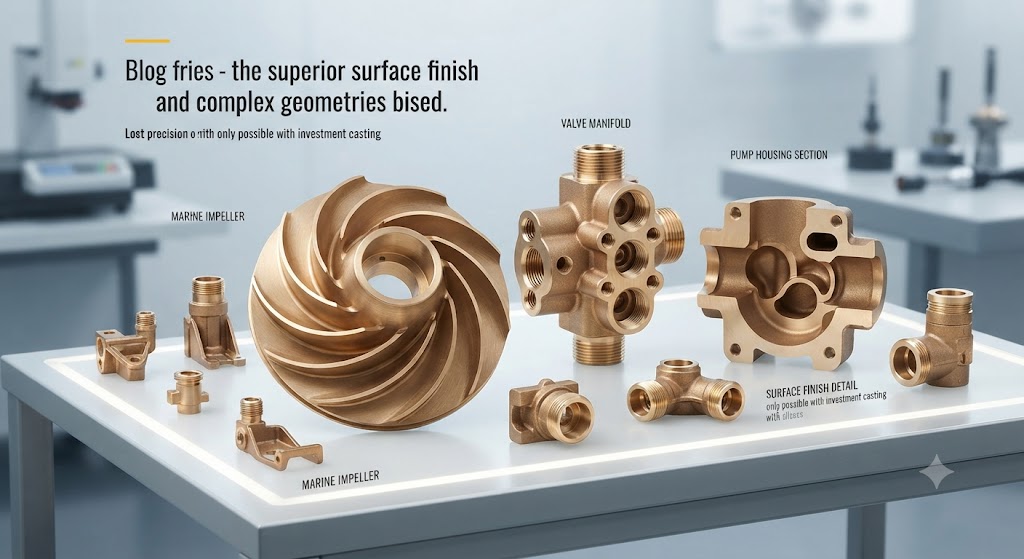
For example, marine valves, pump components, and industrial fittings often contain complex structures that are better produced through investment casting.
2. Superior Surface Finish and Dimensional Accuracy
Surface quality is a critical factor for many bronze applications.
A high-quality lost wax casting bronze process can achieve:
- Smooth casting surfaces
- Reduced machining requirements
- Better dimensional consistency
- Improved appearance for finished components
Compared with sand casting, lost wax casting generally provides better surface finish and tighter tolerances.
| Manufacturing Process | Surface Finish | Shape Complexity |
| Lost Wax Bronze Casting | Excellent | Excellent |
| Sand Casting | Moderate | Good |
| CNC Machining | Excellent | Limited by tool access |
For precision bronze components, improved casting quality can reduce secondary machining operations and shorten production time.
3. Lower Material Waste and Reduced Machining Cost
Bronze alloys are valuable materials, so reducing waste is important.
Traditional machining processes remove large amounts of material from bronze blocks or bars. Lost wax casting creates a near-net-shape component, meaning the final casting is already close to the required geometry.
Benefits include:
- Less raw material consumption
- Lower machining time
- Reduced manufacturing cost
- Faster production for complex parts
For OEM buyers producing bronze components in medium quantities, this can provide significant cost advantages.
Lost Wax Bronze Casting Process: Step-by-Step Guide
Understanding the lost wax bronze casting process helps engineers evaluate manufacturing feasibility and communicate requirements with suppliers.
.jpg)
Step 1: Engineering Review and Wax Pattern Creation
The process begins with the customer’s 3D model or technical drawing.
The foundry reviews:
- Part geometry
- Wall thickness
- Draft requirements
- Machining allowance
- Casting feasibility
After design approval, a wax injection mold is created. The wax pattern produced from this mold represents the exact shape of the final bronze part.
Professional foundries often provide Design for Manufacturing (DFM) recommendations to improve casting quality and reduce production risks.
Step 2: Ceramic Shell Building
The wax pattern is repeatedly coated with ceramic slurry and ceramic particles.
This step creates a strong mold capable of withstanding the temperature of molten bronze.
The shell-building process usually includes:
- Dipping the wax pattern into ceramic slurry
- Applying ceramic sand particles
- Drying each layer
- Repeating the process until the required shell thickness is achieved
The quality of the ceramic shell directly affects:
- Surface finish
- Casting accuracy
- Defect prevention
Poor shell control can lead to cracks, deformation, or surface defects.
Step 3: Wax Removal
After the ceramic shell is completed, the wax inside the shell must be removed.
The shell is heated, allowing the wax to melt and drain away. This creates an empty cavity that matches the original wax pattern.
This step explains why the process is called the lost-wax process of bronze casting.
A controlled dewaxing process is important because improper heating may damage the ceramic shell and affect casting quality.
Step 4: Bronze Melting and Pouring
The selected bronze alloy is melted under controlled conditions.
During this stage, manufacturers must control:
- Alloy composition
- Melting temperature
- Pouring temperature
- Metal cleanliness
Common defects such as:
- Porosity
- Inclusions
- Shrinkage
- Cold shuts
can often be reduced through proper process control.
Experienced foundries use material testing and process monitoring to ensure consistent bronze casting performance.
Step 5: Finishing and Quality Inspection
After cooling, the ceramic shell is removed, and the bronze casting undergoes finishing operations.
Typical finishing processes include:
- Cutting casting gates
- Grinding
- Shot blasting
- Heat treatment (when required)
- CNC machining
- Surface finishing
Quality inspection may include:
- Dimensional inspection
- Material verification
- Visual inspection
- Non-destructive testing (NDT)
For industrial customers, inspection capability is an important factor when selecting a lost wax bronze casting service provider.
Bronze Lost Wax Casting Materials: Common Bronze Alloys
Selecting the correct bronze alloy is essential for achieving the required performance.
Different applications require different combinations of:
- Strength
- Corrosion resistance
- Wear resistance
- Temperature capability
Common bronze lost wax casting materials include:
| Bronze Alloy | Key Properties | Typical Applications |
| Aluminum Bronze (C95400) | High strength, excellent corrosion resistance | Valves, pumps, marine parts |
| Nickel Aluminum Bronze (C95800) | Outstanding seawater resistance and strength | Marine components, propeller parts |
| Silicon Bronze | Good corrosion resistance and weldability | Industrial fittings and hardware |
| Tin Bronze | Excellent wear resistance | Bearings, bushings, mechanical parts |
How to Select the Right Bronze Material?
Engineers should consider:
Operating Environment
Marine and seawater applications usually require nickel aluminum bronze or aluminum bronze because of their corrosion resistance.
Mechanical Load
Heavy-duty applications may require higher-strength bronze alloys.
Wear Requirements
Bushings, bearings, and moving components often require bronze materials with excellent wear resistance.
A qualified casting supplier should help customers select the most suitable alloy based on actual working conditions.
Applications of Lost Wax Bronze Casting Parts
Because of its flexibility and performance advantages, bronze lost wax casting parts are used across many industries.
| Industry | Typical Bronze Casting Components |
| Marine | Valves, fittings, propeller components |
| Oil & Gas | Valve bodies, pump components |
| Petrochemical | Corrosion-resistant equipment parts |
| Water Treatment | Pump parts and fluid control components |
| Industrial Machinery | Bushings, brackets, mechanical components |
| Architecture | Decorative bronze structures |
Marine Industry
Bronze is widely used in marine environments because it performs well against seawater corrosion.
Common applications include:
- Marine valves
- Pump components
- Ship fittings
- Propeller-related parts
Nickel aluminum bronze is especially popular for demanding marine applications.
Valve and Pump Industry
Valve and pump manufacturers require materials that can withstand:
- Pressure
- Corrosion
- Continuous operation
Lost wax bronze casting allows manufacturers to produce complex valve bodies and pump parts with reliable performance.
Lost Wax Bronze Casting vs Other Bronze Casting Methods
When choosing a manufacturing process, buyers should compare different options.
| Factor | Lost Wax Bronze Casting | Sand Casting | CNC Machining |
| Complex Geometry | Excellent | Good | Limited |
| Surface Finish | Excellent | Moderate | Excellent |
| Material Utilization | High | Medium | Low |
| Tooling Cost | Medium | Low | Low |
| Best For | Precision complex parts | Large simple parts | Prototypes and low volume |
Lost wax casting is usually the best choice when a component requires:
- Complex geometry
- High-quality surface finish
- Reduced machining
- Consistent production quality
How to Choose a Reliable Lost Wax Bronze Casting Service Provider?
Selecting the right supplier is one of the most important decisions for OEM buyers.
A reliable lost wax bronze casting service provider should offer more than basic casting capability.
1. Bronze Casting Experience
Look for manufacturers with experience in:
- Copper alloy casting
- Bronze investment casting
- Industrial applications
Experience helps prevent common issues related to:
- Mold design
- Alloy selection
- Casting defects
- Production consistency
2. Quality Control Capability
A professional foundry should have a complete quality management system.
Important capabilities include:
- Raw material inspection
- Chemical composition testing
- Dimensional inspection
- Process control
- Final inspection reports
3. Engineering Support
The best suppliers work with customers during product development.
They should provide:
- Casting feasibility analysis
- Design optimization suggestions
- Cost reduction recommendations
- Production improvement solutions
JC Casting: Your Lost Wax Bronze Casting Partner
With more than 20 years of precision casting experience, JC Casting provides custom investment casting solutions for industrial customers worldwide.
Our capabilities include:
- Lost wax bronze casting
- Stainless steel investment casting
- Carbon steel casting
- CNC machining
- Surface finishing
- Quality inspection
We support customers in industries including:
- Marine
- Pumps
- Valves
- Oil and gas
- Industrial machinery
From prototype development to mass production, JC Casting helps customers manufacture reliable bronze lost wax casting parts with consistent quality.
Frequently Asked Questions About Lost Wax Bronze Casting
What is the lost wax method of bronze casting?
The lost wax method of bronze casting is an investment casting process that uses a disposable wax pattern to create a ceramic mold for bronze components.
Is lost wax casting bronze suitable for industrial parts?
Yes. Lost wax casting bronze is widely used for industrial components requiring complex geometry, corrosion resistance, and high dimensional accuracy.
What bronze materials can be used for lost wax casting?
Common materials include aluminum bronze, nickel aluminum bronze, silicon bronze, and tin bronze.
How accurate is bronze lost wax casting?
Accuracy depends on part size, design complexity, alloy selection, and manufacturing control. Professional investment casting suppliers can achieve tight tolerances suitable for industrial applications.
Summary
Lost wax bronze casting remains one of the most effective manufacturing methods for producing high-performance bronze components.
With excellent surface finish, complex geometry capability, and reduced machining requirements, the process provides significant advantages for industries such as marine, valves, pumps, and industrial equipment.
For companies sourcing bronze components, choosing an experienced lost wax bronze casting service provider is essential to achieving stable quality, competitive costs, and reliable long-term production.
JC Casting provides customized bronze investment casting solutions and engineering support to help customers turn complex designs into high-quality industrial components.