Choosing the right manufacturing process is critical when producing complex bronze components. Bronze investment casting provides excellent dimensional accuracy, surface finish, and design flexibility for applications such as valves, pumps, marine equipment, and industrial machinery.
However, selecting the right process is only part of the decision. Engineers and buyers also need to understand available bronze casting services, factors affecting bronze casting cost, and how to choose a reliable supplier for custom bronze casting projects.
In this guide, we explain the bronze investment casting process, key service capabilities, cost factors, and supplier selection tips to help you make better decisions for your next bronze casting project.
What Is Bronze Investment Casting?
Bronze investment casting is a precision casting process that uses a wax pattern and ceramic shell to create complex bronze components. It is also known as lost wax bronze casting because the wax pattern is removed before molten bronze is poured into the ceramic mold.
Unlike traditional casting methods, investment casting can produce parts with complex geometries, thin walls, and fine details while maintaining high dimensional accuracy.
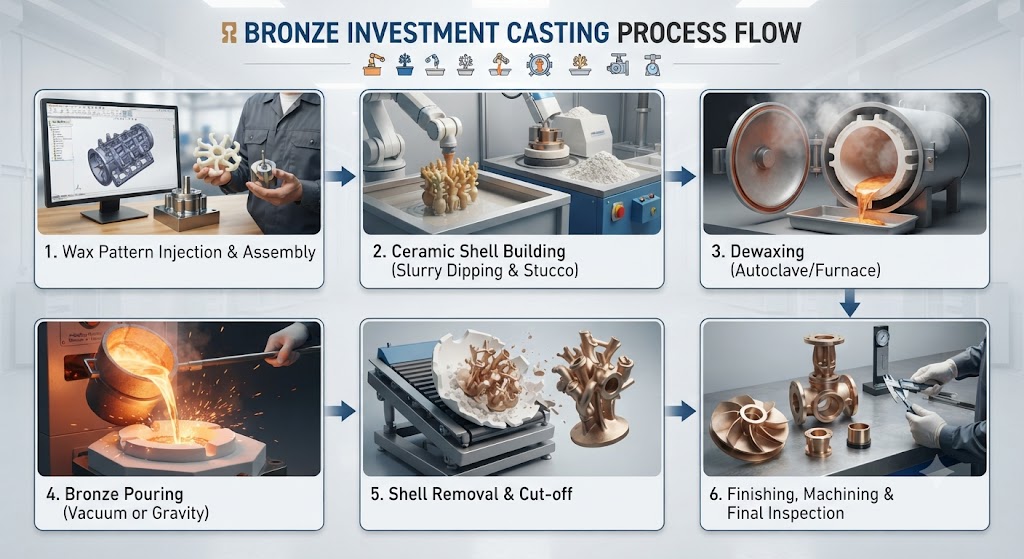
The typical bronze investment casting process includes the following steps:
1. Pattern Creation
Engineers first create a wax pattern based on a customer’s CAD drawing or 3D model. The wax pattern has the same shape and dimensions as the final bronze component.
2. Ceramic Shell Building
The wax pattern is coated with multiple layers of ceramic material. After drying, the ceramic shell becomes a strong mold capable of handling molten bronze.
3. Wax Removal
The wax inside the ceramic shell is melted and removed. This creates an empty cavity for bronze pouring.
4. Bronze Pouring
The selected bronze alloy is melted at controlled temperatures and poured into the ceramic mold.
5. Finishing and Inspection
After cooling, the ceramic shell is removed. The casting is then cleaned, machined, finished, and inspected according to customer requirements.
Compared with other casting methods, bronze investment casting provides several advantages:
| Feature | Bronze Investment Casting | Sand Casting |
| Surface Finish | Excellent | Average |
| Dimensional Accuracy | High | Medium |
| Complex Geometry | Excellent | Limited |
| Thin Wall Capability | Better | Lower |
| Machining Requirement | Reduced | Higher |
For precision bronze parts requiring complex designs and consistent quality, investment casting is often the preferred manufacturing solution.
Why Choose Bronze Investment Casting for Industrial Parts?
Different industries choose bronze investment casting because it combines design flexibility, material performance, and manufacturing efficiency.
1. Produce Complex Bronze Components
One of the biggest advantages of investment casting is its ability to manufacture complex shapes.
The process is suitable for parts with:
- Thin walls
- Internal passages
- Curved structures
- Detailed surfaces
- Difficult machining areas
For example, marine and pump industries often require bronze components with complex internal structures. Investment casting can produce these designs without excessive machining.
2. Improve Surface Quality and Dimensional Accuracy
Bronze investment casting provides smoother surfaces compared with many conventional casting methods.
Benefits include:
- Less machining allowance
- Better dimensional consistency
- Reduced material waste
- Improved assembly performance
For OEM customers, better casting accuracy can reduce secondary processing costs and shorten production cycles.
3. Take Advantage of Bronze Material Properties
Bronze remains popular in industrial applications because of its excellent engineering properties.
Common advantages include:
- Strong corrosion resistance
- Good wear resistance
- Low friction characteristics
- Long service life
- Good machinability
These properties make bronze suitable for:
| Industry | Typical Bronze Components |
| Marine | Bushings, valves, propeller parts |
| Pump Industry | Impellers, wear rings, pump components |
| Valve Industry | Valve bodies, seats, pressure components |
| Industrial Equipment | Bearings, gears, mechanical parts |
When combined with investment casting technology, bronze can provide reliable performance in harsh operating environments.
Bronze Casting Services We Provide
Selecting the right supplier is important because bronze casting quality depends not only on the material but also on manufacturing experience, process control, and engineering support.
Professional bronze casting services should cover the complete production process from design review to final inspection.
At JC Casting, we provide complete bronze casting solutions for OEM customers worldwide.
Custom Bronze Investment Casting
Every industrial application has different requirements. Our custom bronze casting service supports customers from prototype development to mass production.
We manufacture bronze components based on:
- 2D drawings
- 3D CAD models
- Existing samples
- Technical specifications
Our engineering team helps customers optimize designs for:
- Casting feasibility
- Material efficiency
- Machining requirements
- Production stability
This approach helps reduce manufacturing risks before production begins.
Bronze Alloy Selection Support
Choosing the correct bronze alloy directly affects component performance.
Common bronze materials include:
| Bronze Grade | Main Features | Typical Applications |
| C932 Bronze | Good wear resistance and machinability | Bushings, bearings |
| C954 Aluminum Bronze | High strength and hardness | Industrial parts, valves |
| C958 Aluminum Bronze | Excellent corrosion resistance | Marine components |
Different working conditions require different material solutions.
For example:
- Marine components need strong corrosion resistance.
- Pump parts require wear resistance.
- Valve components need strength and pressure capability.
A professional bronze casting manufacturer should help customers select the right alloy instead of simply producing parts.
CNC Machining and Finishing Services
Many bronze components require additional processing after casting.
JC Casting provides:
- CNC machining
- Surface finishing
- Heat treatment
- Dimensional inspection
- Assembly support
By combining casting and machining capabilities, customers can reduce supplier coordination and improve production efficiency.
How Much Does Bronze Casting Cost?
The question of bronze casting cost is one of the most common concerns for industrial buyers.
However, bronze casting prices are not determined by material cost alone. The final cost depends on multiple factors, including part design, alloy selection, quantity, and finishing requirements.
1. Part Size and Weight
The size and weight of a bronze component directly affect production costs.
Larger parts usually require:
- More bronze material
- Larger molds
- Longer melting time
- More handling work
Therefore, a small precision component and a large industrial casting may have very different prices.
2. Design Complexity
Complex designs increase manufacturing difficulty.
Factors that influence cost include:
| Design Factor | Cost Impact |
| Simple geometry | Lower cost |
| Thin walls | Higher cost |
| Deep cavities | Higher cost |
| Complex machining areas | Higher cost |
A design with unnecessary complexity may increase tooling difficulty and production risks.
Experienced suppliers can often suggest design improvements to reduce cost without affecting performance.
3. Bronze Alloy Selection
Different bronze alloys have different raw material costs and processing requirements.
For example:
- Standard bronze alloys are usually more economical.
- Aluminum bronze alloys may cost more because they provide higher strength and corrosion resistance.
The correct material choice should balance:
- Performance requirements
- Service environment
- Total lifecycle cost
4. Production Volume
Production quantity has a major impact on unit price.
| Production Volume | Unit Cost Trend |
| Prototype | Highest |
| Small Batch | Medium |
| Large Production | Lower |
Investment casting tooling costs can be distributed across more parts during larger production runs, reducing average unit cost.
How to Reduce Bronze Casting Cost Without Reducing Quality?
Reducing bronze casting cost does not mean choosing the cheapest supplier. Poor-quality castings often create higher expenses through defects, delays, and rework.
The best cost reduction strategy is improving the manufacturing process.
1. Optimize Product Design
Design optimization can reduce unnecessary costs.
Recommended improvements include:
- Avoid excessive wall thickness
- Reduce unnecessary machining areas
- Simplify difficult structures
- Consider casting limitations during design
This approach is known as Design for Manufacturing (DFM).
2. Choose the Right Casting Process
Not every bronze component requires the same manufacturing method.
Investment casting is ideal for:
- Complex shapes
- High accuracy requirements
- Small to medium-sized precision parts
For simpler and larger components, other casting methods may provide better cost efficiency.
The right process depends on:
- Part geometry
- Quantity
- Tolerance requirements
- Surface requirements
3. Work With an Experienced Foundry
A professional bronze casting supplier can reduce hidden costs by controlling:
- Casting defects
- Material waste
- Production delays
- Quality problems
The lowest quotation is not always the lowest total cost.
A reliable supplier focuses on overall manufacturing value.
Custom Bronze Casting Solutions for Different Industries
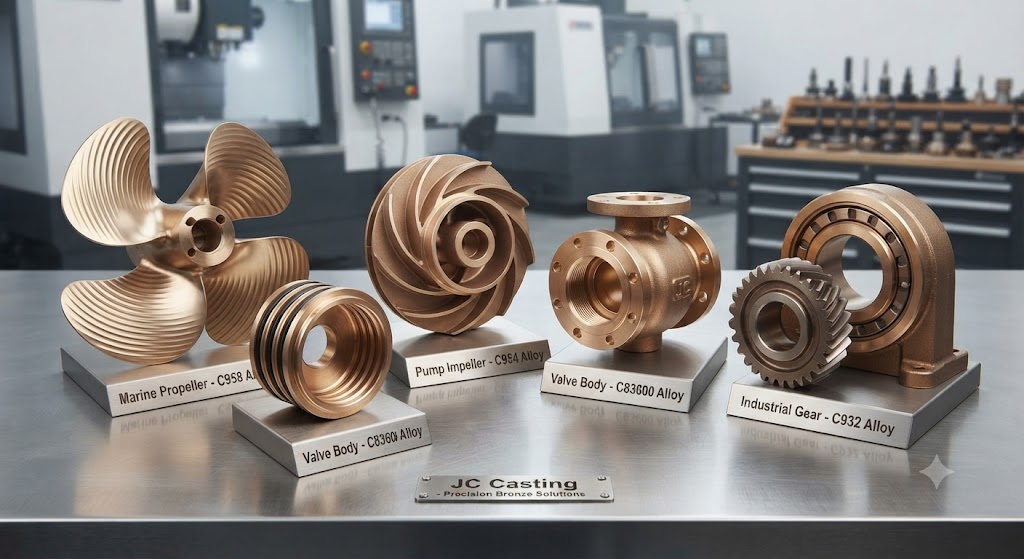
Custom bronze casting is widely used across industries where reliability and durability are critical.
Marine Industry
Marine equipment operates in highly corrosive environments.
Bronze components are commonly used for:
- Bushings
- Valves
- Propeller components
- Marine hardware
Bronze provides excellent seawater corrosion resistance and long service life.
Valve Industry
Valve manufacturers require components with:
- Strength
- Pressure resistance
- Corrosion resistance
Bronze investment casting allows production of complex valve bodies and internal components with consistent quality.
Pump Industry
Pump components often experience:
- Continuous friction
- Mechanical loads
- Fluid exposure
Bronze is widely used for:
- Impellers
- Wear rings
- Pump housings
Its low friction characteristics help improve equipment reliability.
Industrial Machinery
Many industrial machines require durable components that can operate for long periods.
Custom bronze casting provides solutions for:
- Bearings
- Mechanical parts
- Wear-resistant components
How to Choose a Reliable Bronze Casting Manufacturer?
Finding the right bronze casting manufacturer is critical for long-term supply stability.
Before selecting a supplier, buyers should evaluate the following factors:
| Evaluation Factor | Why It Matters |
| Casting Experience | Reduces manufacturing risks |
| Material Knowledge | Ensures correct alloy selection |
| Quality Control System | Provides stable production |
| Machining Capability | Enables one-stop service |
| Engineering Support | Improves product design |
A capable supplier should provide more than casting production. They should support customers with engineering solutions, process optimization, and quality assurance.
Why Choose JC Casting for Bronze Investment Casting?
JC Casting has more than 20 years of experience in precision metal casting and provides complete manufacturing solutions for global industrial customers.
Our capabilities include:
- Bronze investment casting
- Stainless steel casting
- Carbon steel casting
- CNC machining
- Surface finishing
- Quality inspection
We support customers with:
- Prototype development
- Small batch production
- Large-scale OEM manufacturing
Our engineering team works closely with customers to improve casting designs, select suitable bronze materials, and achieve reliable production results.
Whether you need marine bronze components, valve parts, pump components, or customized industrial castings, JC Casting provides professional bronze casting services from design to final delivery.
Send your drawings, 3D models, or technical requirements today. Our team can provide a casting solution and quotation based on your project needs.
Final Observations
Bronze investment casting provides an effective solution for manufacturers that need complex, accurate, and durable bronze components.
By understanding the casting process, available bronze casting services, and factors affecting bronze casting cost, buyers can make better manufacturing decisions.
For companies requiring customized bronze components, working with an experienced supplier is essential.
With professional engineering support, advanced casting technology, and complete manufacturing capabilities, JC Casting helps customers worldwide produce reliable custom bronze casting solutions.