
This article explains the major differences between 18-8, 304, and 316 stainless steel.It helps engineers, buyers and sourcing specialists pick the correct grade for all kinds of industrial projects. Although these materials all belong to the same stainless steel family and offer similar strength and corrosion resistance characteristics, their real-world performance differs a lot due to different chemical makeup and working conditions.
In practice, selecting the wrong grade can result in premature corrosion, higher maintenance costs, and reduced equipment service life—especially in demanding sectors such as marine engineering, chemical processing, oil and gas, and industrial casting. Understanding these differences is essential for making reliable and cost-effective material decisions in real-world manufacturing conditions.
What Do 18-8, 304, and 316 Stainless Steel Mean?
Before comparing performance, it is important to understand what these designations actually represent.
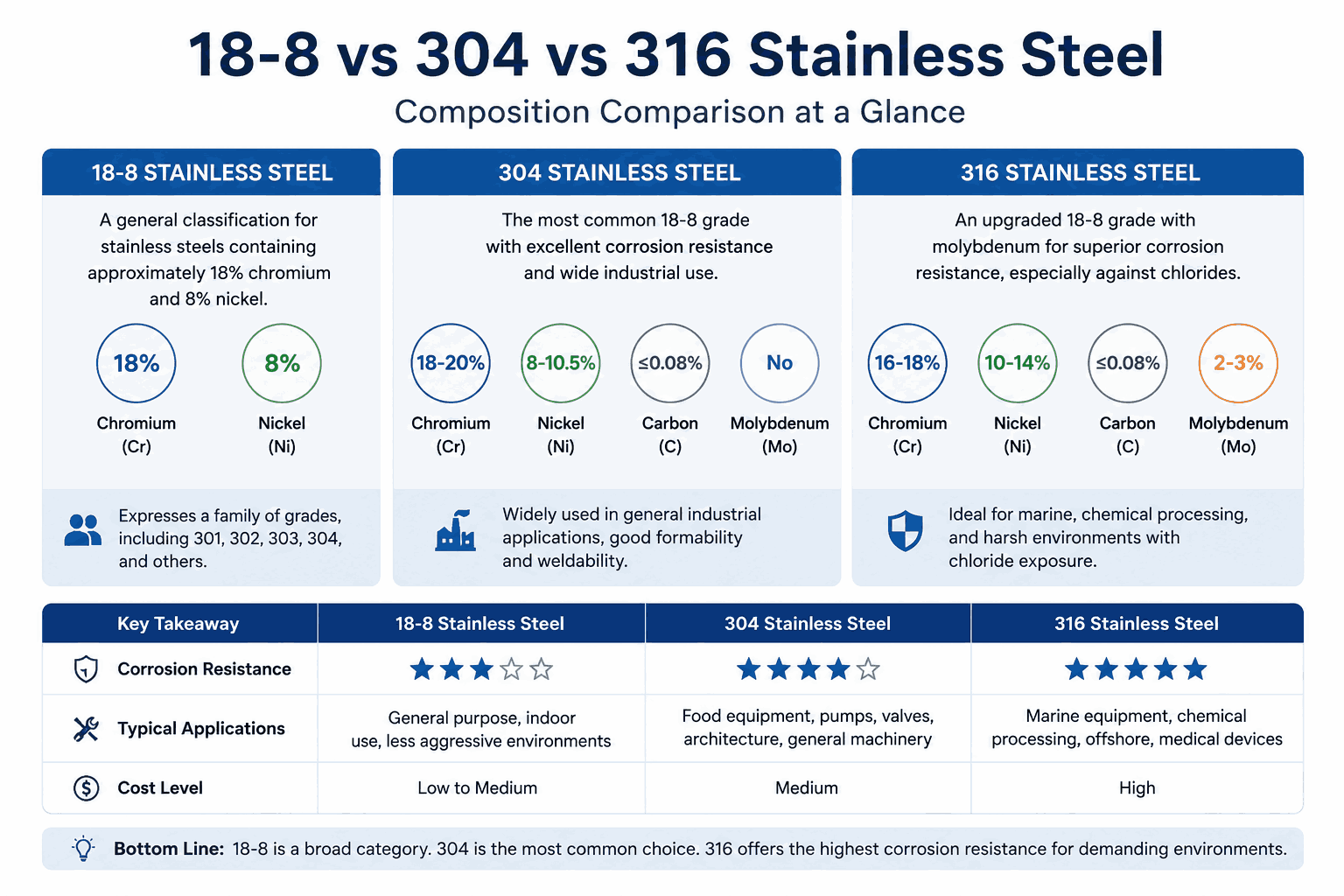
18-8 stainless steel is not a specific grade. Instead, it is a general industry term describing stainless steels that contain approximately:
- 18% Chromium
- 8% Nickel
Many stainless steel grades fall into the 18-8 family, including 301, 302, 303, and 304.
Among them, 304 stainless steel is the most common.
316 stainless steel belongs to the same austenitic stainless steel family but contains additional molybdenum, which significantly improves corrosion resistance.
In simple terms:
- 18-8 = broad category
- 304 = specific stainless steel grade within the 18-8 family
- 316 = upgraded version with improved corrosion resistance
Chemical Composition Comparison
The biggest difference between these materials lies in their alloy content.
| Element | 18-8 Stainless Steel | 304 Stainless Steel | 316 Stainless Steel |
| Chromium | ~18% | 18–20% | 16–18% |
| Nickel | ~8% | 8–10.5% | 10–14% |
| Molybdenum | None | None | 2–3% |
| Carbon | Low | ≤0.08% | ≤0.08% |
| Corrosion Resistance | Good | Excellent | Superior |
The addition of molybdenum in 316 stainless steel provides stronger resistance against chlorides, seawater, and many industrial chemicals.
This single alloying element is the main reason 316 is preferred in harsh environments.
Mechanical Property Comparison
Many buyers assume that 316 stainless steel is significantly stronger than 304. In reality, their mechanical properties are very similar.
| Property | 304 Stainless Steel | 316 Stainless Steel |
| Tensile Strength | 515 MPa | 515 MPa |
| Yield Strength | 205 MPa | 205 MPa |
| Hardness | 70–90 HRB | 79–95 HRB |
| Elongation | 40% | 40% |
| Density | 8.0 g/cm³ | 8.0 g/cm³ |
For most structural applications, strength differences are minimal.
The material selection decision usually comes down to corrosion resistance rather than mechanical performance.
Corrosion Resistance: The Most Important Difference
Corrosion resistance is where 316 stainless steel separates itself from 18-8 and 304.
18-8 and 304 Stainless Steel
18-8 and 304 perform well in:
- Indoor environments
- Food processing equipment
- Architectural applications
- Freshwater systems
- General industrial equipment
They resist rust better than carbon steel and many other metals.
However, chloride exposure can create problems.
Common chloride sources include:
- Seawater
- Coastal air
- Road salt
- Chemical cleaning agents
- Industrial process fluids
When exposed to chlorides for extended periods, 304 may develop pitting corrosion and crevice corrosion.
316 Stainless Steel
316 stainless steel contains molybdenum, which improves resistance to:
- Saltwater
- Marine atmospheres
- Chloride-rich chemicals
- Acids
- Chemical processing environments
As a result, 316 is often called “marine grade stainless steel.”
For offshore platforms, ship components, seawater pumps, and chemical plants, 316 is usually the safer choice.
Heat Resistance Comparison
Both 304 and 316 offer excellent performance at elevated temperatures.
| Property | 304 | 316 |
| Continuous Service Temperature | Up to 870°C | Up to 870°C |
| Intermittent Service Temperature | Up to 925°C | Up to 925°C |
For most industrial heating applications, neither material offers a major advantage.
Environmental corrosion typically influences material selection more than temperature capability.
窗体顶端
Common Misconceptions About 18-8, 304, and 316 Stainless Steel
Many purchasing decisions are influenced by misconceptions.
Myth 1: 18-8 and 304 Are Different Materials
Not exactly.
304 is the most common member of the 18-8 family.
In many applications, people use the terms interchangeably.
Myth 2: 316 Never Rusts
False.
316 is highly corrosion resistant but not corrosion proof.
Under extreme conditions, even 316 can experience pitting or crevice corrosion.
Myth 3: 316 Is Always Better
Not necessarily.
If an application does not involve chlorides or aggressive chemicals, 304 often provides the best balance between performance and cost.
Myth 4: Stronger Stainless Steel Means Better Corrosion Resistance
Mechanical strength and corrosion resistance are different properties.
316’s advantage comes primarily from molybdenum-enhanced corrosion protection, not significantly higher strength.
18-8 vs 304 vs 316: How to Make the Right Choice
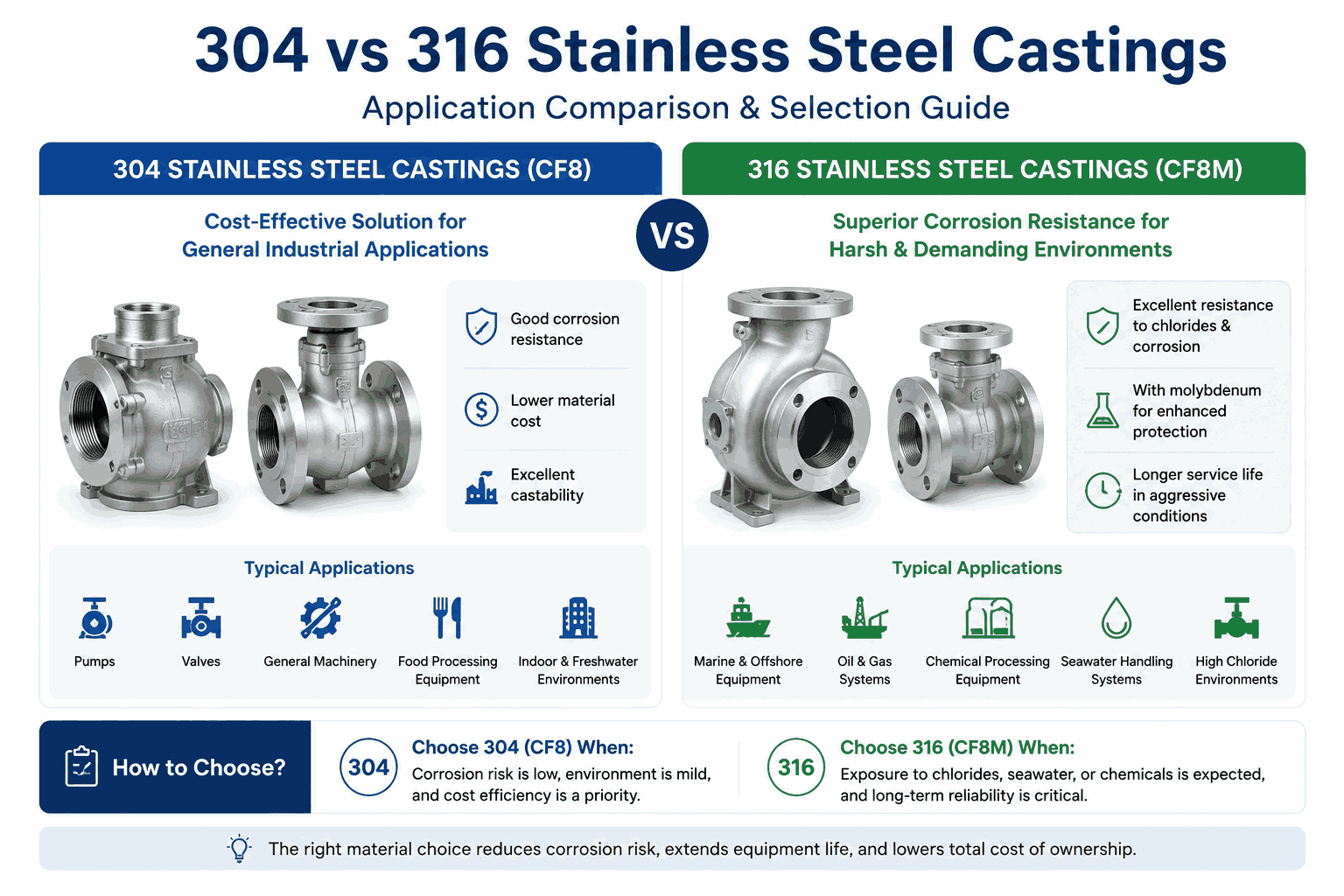
For stainless steel castings, material selection mainly comes down to corrosion severity, service environment, and total lifecycle cost. 304 stainless steel (commonly used as CF8 in casting applications) is widely applied in pumps, valves, food equipment, and general machinery due to its solid corrosion resistance, good castability, and lower cost. It performs well in freshwater and non-aggressive industrial environments, making it the default choice for many standard engineering applications.
When conditions become more demanding, 316 stainless steel (CF8M in casting terms) becomes the preferred option. The addition of molybdenum significantly improves resistance to chlorides, seawater, and aggressive chemicals, reducing the risk of pitting and crevice corrosion. This makes 316 castings more suitable for marine systems, offshore equipment, petrochemical plants, and chemical processing environments where corrosion failure can lead to high downtime and maintenance costs.
The term 18-8 stainless steel is a general classification that often overlaps with 304-grade material in practical use. In most real-world sourcing scenarios, 18-8 and 304 are effectively treated as equivalent, while 316 represents an upgraded material designed for harsher operating conditions. In practice, 304 is typically selected for cost-efficient standard applications, while 316 is chosen when corrosion resistance and long-term reliability are critical.
Why Material Selection Matters in Stainless Steel Casting Procurement?
For industrial buyers, choosing the correct stainless steel grade is only one part of the sourcing decision. Casting quality, dimensional control, and supplier capability are equally important.
In stainless steel casting, especially for CF8 and CF8M components, process stability directly affects corrosion resistance and mechanical performance. Poor casting quality can reduce the expected service life even when the correct alloy is selected.
This is why many OEMs prefer working with specialized stainless steel casting manufacturers who can control:
- Material composition consistency
- Investment casting precision
- Heat treatment process
- Machining and finishing quality
Final Thoughts
Understanding the differences between 18-8, 304, and 316 stainless steel helps engineers and buyers avoid costly material selection mistakes.
In summary:
- 18-8 is a broad stainless steel category.
- 304 is the most common 18-8 stainless steel grade.
- 316 offers superior corrosion resistance due to added molybdenum.
- For marine, chemical, and chloride-rich environments, 316 is usually the preferred option.
- For general industrial applications, 304 often delivers the best value.
When sourcing stainless steel castings, selecting the right grade is only part of the equation. Casting quality, dimensional accuracy, and foundry expertise also play critical roles in long-term performance.
JC Casting specializes in stainless steel investment casting and sand casting. We work with a full range of stainless steel materials including CF8 (304 equivalent), CF8M (316 equivalent), CF3, CF3M, duplex stainless steel, and other custom alloys.
Our cast components are widely used across oil & gas, marine, pumps & valves, food processing, mining, and industrial machinery.
Whether you need corrosion-resistant valve bodies, pump housings, or custom-designed stainless steel castings, our team can recommend the most suitable material grade to match your working conditions.