
A356 is actually one of the most popular casting aluminum alloys out there. It’s super lightweight and strong, plus it has great corrosion resistance and is really easy to cast. That’s exactly why it’s a top choice for automotive, marine, aerospace, and industrial parts.
Compared with many other aluminum casting alloys, A356 offers an excellent balance of mechanical performance and manufacturing efficiency. After T6 heat treatment, its strength increases significantly while maintaining good ductility. This makes it suitable for structural parts that require both durability and lightweight performance.
Whether you are an engineer selecting materials, a purchasing manager sourcing cast components, or a manufacturer comparing casting processes, understanding the characteristics of A356 aluminum can help you make better technical and commercial decisions.
In this guide, you’ll learn:
- What A356 aluminum alloy is
- Its chemical composition
- Mechanical and physical properties
- Why it is one of the most popular casting alloys
- How it compares with other aluminum casting materials
- Which industries commonly use A356 castings
What Is A356 Aluminum Alloy?
A356 aluminum alloy is a heat-treatable aluminum-silicon-magnesium (Al-Si-Mg) casting alloy defined under the ASTM and Aluminum Association standards. It is designed specifically for producing high-quality cast parts that require good strength, corrosion resistance, and dimensional stability.
The alloy contains approximately 7% silicon (Si) and 0.3% magnesium (Mg). Silicon improves casting performance by increasing fluidity and reducing shrinkage, while magnesium allows the alloy to be strengthened through heat treatment.
Because of these characteristics, A356 is widely used in casting processes such as:
- Sand casting
- Gravity casting
- Permanent mold casting
- Low-pressure die casting
- Investment casting
After T6 heat treatment, A356 develops significantly higher mechanical strength, making it suitable for safety-critical and load-bearing components.
A356 Aluminum Alloy at a Glance
| Property | Description |
| Alloy Family | Aluminum-Silicon-Magnesium (Al-Si-Mg) |
| ASTM Designation | ASTM A356 |
| Heat Treatable | Yes |
| Common Heat Treatment | T6 |
| Density | Approximately 2.68 g/cm³ |
| Typical Casting Processes | Sand Casting, Gravity Casting, Permanent Mold Casting, Investment Casting |
| Main Advantages | Lightweight, High Strength, Good Corrosion Resistance, Excellent Castability |
A356 Aluminum Composition
The performance of A356 aluminum begins with its chemical composition. Each alloying element has a specific purpose, affecting casting behavior, strength, corrosion resistance, and heat treatment response.
Typical Chemical Composition of A356 Aluminum
| Element | Typical Content (%) | Primary Function |
| Aluminum (Al) | Balance | Base metal |
| Silicon (Si) | 6.5–7.5 | Improves fluidity and reduces shrinkage |
| Magnesium (Mg) | 0.25–0.45 | Enables heat treatment and increases strength |
| Iron (Fe) | ≤0.20 | Controlled to maintain ductility |
| Copper (Cu) | ≤0.20 | Limited to improve corrosion resistance |
| Manganese (Mn) | ≤0.10 | Improves microstructure stability |
| Zinc (Zn) | ≤0.10 | Residual element |
| Titanium (Ti) | ≤0.20 | Grain refinement |
Why Each Alloying Element Matters
Silicon (Si)
Silicon is the most important alloying element in A356 aluminum.
It helps the molten aluminum flow easily into complex molds. Better fluidity allows manufacturers to produce thin walls, detailed features, and smooth surfaces with fewer casting defects.
Silicon also reduces solidification shrinkage, helping minimize porosity and improving dimensional stability.
Magnesium (Mg)
Magnesium is responsible for the alloy’s heat treatment capability.
During T6 heat treatment, magnesium combines with silicon to form strengthening precipitates inside the aluminum structure. This greatly increases tensile and yield strength while maintaining reasonable ductility.
Without magnesium, A356 would not achieve its well-known mechanical performance.
Iron (Fe)
Iron is generally considered an unwanted impurity in aluminum casting alloys.
Excessive iron forms brittle intermetallic compounds that reduce ductility and increase the risk of cracking.
For this reason, A356 limits iron content to maintain better toughness and machining performance.
Copper (Cu)
Copper can improve strength, but it also reduces corrosion resistance.
Since A356 is commonly used in marine equipment, transportation, and outdoor applications, copper content is kept very low to preserve long-term corrosion performance.
How Composition Affects Performance
The carefully balanced chemistry gives A356 several important advantages:
| Composition Feature | Benefit |
| High Silicon | Better castability and surface finish |
| Magnesium Addition | High strength after T6 treatment |
| Low Iron | Improved ductility and machinability |
| Low Copper | Better corrosion resistance |
| Balanced Alloy Design | Consistent quality in production |
This combination explains why A356 remains one of the preferred materials for structural aluminum castings across many industries.
A356 Aluminum Alloy Properties
One reason A356 aluminum is used in so many industries is its excellent balance of weight, strength, and corrosion resistance. After T6 heat treatment, the alloy delivers mechanical performance that meets the requirements of many demanding engineering applications.
Mechanical Properties
The exact values depend on the casting process, heat treatment, and part geometry, but typical A356-T6 properties are shown below.
| Property | Typical Value |
| Tensile Strength | 280–320 MPa |
| Yield Strength | 200–240 MPa |
| Elongation | 3–8% |
| Brinell Hardness | 75–90 HB |
| Elastic Modulus | 71 GPa |
| Fatigue Strength | Approximately 90 MPa |
What Do These Numbers Mean?
- High tensile strength allows the alloy to withstand heavy loads without breaking.
- Good yield strength helps parts resist permanent deformation under stress.
- Moderate elongation provides enough flexibility to absorb vibration and impact.
- Stable hardness supports wear resistance and machining performance.
These properties make A356 suitable for structural castings such as suspension parts, pump housings, marine hardware, and machine components.
Physical Properties
In addition to mechanical strength, A356 offers several physical advantages that support lightweight engineering designs.
| Property | Typical Value |
| Density | 2.68 g/cm³ |
| Melting Range | 555–615°C |
| Thermal Conductivity | 150–170 W/m·K |
| Electrical Conductivity | Approximately 35% IACS |
| Coefficient of Thermal Expansion | 21–22 ×10⁻⁶/K |
The low density of A356 is especially valuable in automotive and aerospace applications, where reducing weight improves fuel efficiency and overall performance.
A356 T6 Heat Treatment
Many A356 castings are supplied in the T6 condition, which provides the best combination of strength and toughness.
The T6 process generally includes three stages:
- Solution Heat Treatment – The casting is heated to dissolve alloying elements into the aluminum matrix.
- Quenching – The part is rapidly cooled to retain the dissolved elements.
- Artificial Aging – The casting is reheated at a lower temperature to form fine strengthening particles.
This controlled process significantly improves strength without greatly increasing weight.
A356 Properties Compared with Other Popular Aluminum Casting Alloys
| Property | A356-T6 | ADC12 | A380 |
| Heat Treatable | ✔ | ✘ | Limited |
| Strength | High | Medium | Medium |
| Corrosion Resistance | Excellent | Good | Good |
| Weldability | Excellent | Poor | Poor |
| Castability | Excellent | Excellent | Excellent |
| Typical Process | Sand, Gravity, Permanent Mold | High-Pressure Die Casting | High-Pressure Die Casting |
Compared with ADC12 and A380, A356 offers higher structural performance and better corrosion resistance. This is why it is often selected for components that must carry loads or operate in harsh environments.
Why Is A356 One of the Most Popular Aluminum Casting Alloys?
Not all aluminum casting alloys are designed for the same purpose. Some focus on high production speed, while others prioritize strength or low cost. A356 stands out because it delivers a well-balanced combination of casting performance, mechanical properties, and long-term reliability.
For many engineers, it represents the best compromise between manufacturability and performance.
Key Advantages of A356 Aluminum
| Advantage | Why It Matters |
| Excellent Castability | Produces complex shapes with fewer defects |
| High Strength After T6 | Suitable for structural and load-bearing parts |
| Lightweight | Reduces overall equipment weight |
| Good Corrosion Resistance | Performs well in outdoor and marine environments |
| Excellent Machinability | Lowers machining time and tooling costs |
| Good Weldability | Simplifies repair and fabrication |
| Stable Dimensional Accuracy | Supports precision assemblies |
A Good Balance Between Performance and Cost
While stronger aluminum alloys are available, many of them are more difficult to cast or significantly more expensive.
A356 provides an attractive balance by offering:
- Reliable casting quality
- Competitive material cost
- Excellent availability worldwide
- Compatibility with multiple casting processes
- Proven performance across many industries
This balance has made A356 one of the industry’s standard casting materials for decades.
Where A356 Performs Best
A356 is particularly well suited for applications that require:
- High strength with low weight
- Complex casting geometries
- Good corrosion resistance
- Excellent machining quality
- Long service life
A356 Aluminum Casting Processes
One of the biggest advantages of A356 aluminum is its flexibility. Unlike alloys developed specifically for high-pressure die casting, A356 can be used in several casting methods. Each process offers different benefits depending on part size, production volume, dimensional accuracy, and budget.
Choosing the right casting process is just as important as choosing the right alloy.
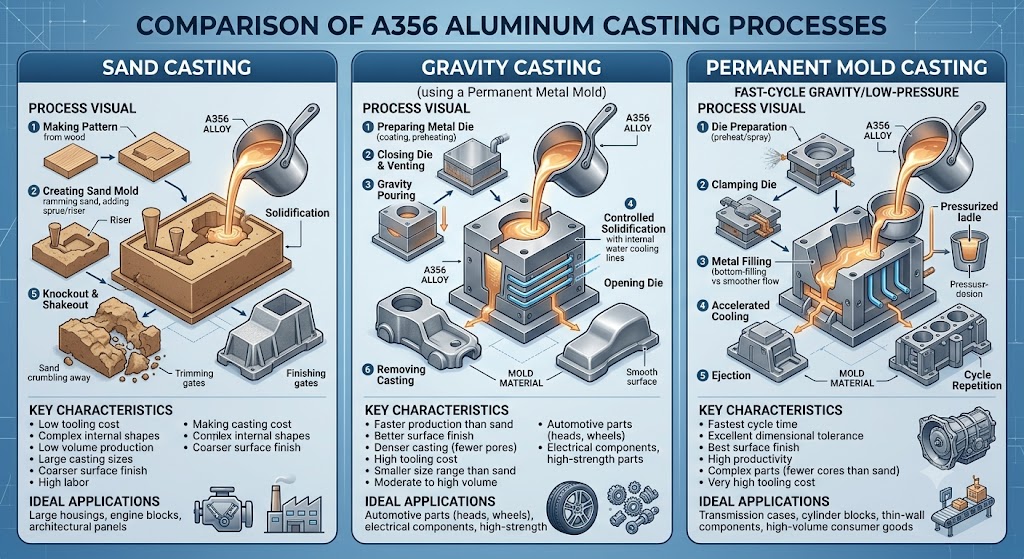
Sand Casting
Sand casting is one of the most common manufacturing methods for A356 aluminum, especially for large or low-volume parts.
Best for:
- Large castings
- Complex internal cavities
- Prototype development
- Small production runs
Advantages
- Low tooling cost
- Suitable for large components
- Flexible design changes
- Short development cycle
Limitations
- Rougher surface finish
- Lower dimensional accuracy than permanent mold casting
- More machining may be required
Typical A356 sand castings include pump housings, valve bodies, marine brackets, and industrial machinery parts.
Gravity Casting (Permanent Mold Casting)
Gravity casting uses reusable steel molds instead of sand molds. Molten aluminum fills the mold under gravity without high injection pressure.
Compared with sand casting, gravity casting provides better consistency and surface quality.
Best for:
- Medium production volumes
- Structural components
- Parts requiring good dimensional accuracy
Advantages
- Better surface finish
- Higher mechanical properties
- Improved repeatability
- Faster production cycle
Limitations
- Higher mold cost
- Less suitable for very complex internal geometries
Typical products include automotive suspension components, marine hardware, and electrical housings.
Low-Pressure Casting
Low-pressure casting fills the mold using controlled air pressure instead of gravity alone.
This process improves metal flow and reduces internal porosity, making it popular for safety-critical aluminum components.
Common applications include:
- Automotive wheels
- Suspension parts
- Aerospace components
- Structural castings
Investment Casting
Although stainless steel is the most common investment casting material, A356 aluminum can also be investment cast when parts require complex geometry and tight tolerances.
Typical applications include:
- Aerospace components
- Medical equipment
- Robotics
- Precision machinery
Can A356 Be Used for High-Pressure Die Casting?
This is one of the most common questions engineers ask.
The short answer is generally no.
High-pressure die casting usually uses alloys such as ADC12 or A380 because they are specifically designed to withstand the rapid filling speed and thermal conditions of the process.
A356 is primarily intended for:
- Sand casting
- Gravity casting
- Permanent mold casting
- Low-pressure casting
- Investment casting
Using A356 in conventional high-pressure die casting may increase the risk of hot cracking and other casting defects.
Comparison of Common Casting Processes
| Process | Production Volume | Surface Finish | Mechanical Properties | Typical Applications |
| Sand Casting | Low | Good | Good | Large industrial parts |
| Gravity Casting | Medium | Very Good | Very Good | Automotive, Marine |
| Low-Pressure Casting | Medium to High | Excellent | Excellent | Wheels, Structural Parts |
| Investment Casting | Low to Medium | Excellent | Excellent | Precision Components |
| High-Pressure Die Casting | High | Excellent | Medium | Consumer Products, Electronics |
Common Applications of A356 Aluminum Alloy
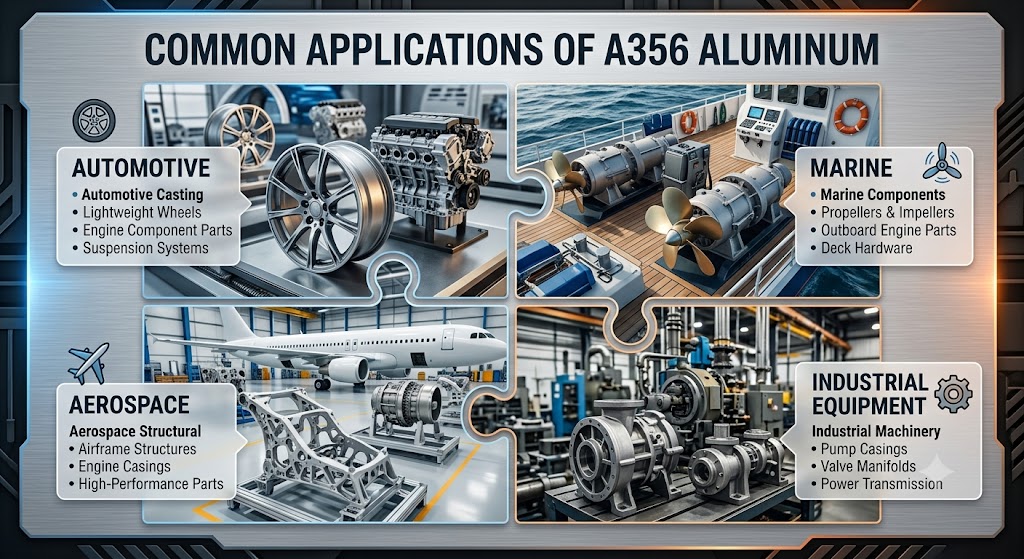
Because A356 combines lightweight performance, strength, and corrosion resistance, it is used across many industries.
Automotive Industry
Automotive manufacturers use A356 to reduce vehicle weight without sacrificing strength.
Common parts include:
- Suspension arms
- Steering knuckles
- Wheel hubs
- Brake components
- Engine covers
Marine Industry
A356 performs well in marine environments due to its excellent corrosion resistance.
Typical marine components include:
- Boat propellers
- Pump housings
- Marine brackets
- Deck hardware
- Steering system components
Aerospace Industry
Aircraft manufacturers value A356 for its high strength-to-weight ratio.
Typical components include:
- Structural brackets
- Landing gear components
- Aircraft housings
- Instrument supports
Industrial Equipment
Industrial machinery often requires durable but lightweight castings.
Applications include:
- Pump casings
- Valve bodies
- Compressor housings
- Gearbox covers
- Hydraulic system components
Renewable Energy
The growing renewable energy industry also uses A356 castings.
Examples include:
- Wind turbine components
- Solar tracking system parts
- Electric motor housings
Typical Applications by Industry
| Industry | Typical A356 Components |
| Automotive | Suspension Parts, Wheel Hubs, Steering Components |
| Marine | Boat Hardware, Pump Housings, Propellers |
| Aerospace | Structural Brackets, Aircraft Housings |
| Industrial Equipment | Pumps, Valves, Gearboxes |
| Renewable Energy | Motor Housings, Wind Power Components |
Common Casting Challenges of A356 Aluminum
Like any casting alloy, A356 can develop defects if the casting process is not properly controlled.
Understanding these issues helps improve product quality and reduce manufacturing costs.
Warping at High Temperature
Warping occurs when uneven cooling creates internal stress.
Common causes
- Uneven wall thickness
- Poor mold design
- Improper heat treatment
- Residual stress after machining
Solutions
- Optimize part design
- Improve cooling control
- Use proper T6 heat treatment
- Apply stress relief when necessary
Gas Porosity
Porosity is caused by trapped hydrogen or gas during solidification.
Solutions
- Degas molten aluminum
- Improve gating design
- Control pouring temperature
- Reduce turbulence
Shrinkage Porosity
Shrinkage defects appear when molten metal cannot fully feed the casting during solidification.
Solutions
- Proper riser design
- Optimized feeding system
- Simulation before production
Oxide Inclusions
Oxide films reduce both appearance and mechanical strength.
Solutions
- Clean melting practices
- Proper metal handling
- Controlled pouring
Common Defects and Solutions
| Casting Challenge | Main Cause | Recommended Solution |
| Warping | Uneven cooling | Better mold design |
| Gas Porosity | Hydrogen | Degassing |
| Shrinkage | Poor feeding | Optimize risers |
| Oxide Inclusion | Turbulent pouring | Improve melt handling |
Why Choose JC Casting for A356 Aluminum Castings?
With more than 20 years of precision casting experience, JC Casting supplies custom A356 aluminum castings for customers worldwide.
We provide complete manufacturing solutions from prototype development to high-volume production.
Our Capabilities
- A356 aluminum sand casting
- Gravity casting
- Precision CNC machining
- T6 heat treatment
- Surface finishing
- Assembly support
Choosing the right casting process and an experienced manufacturing partner is equally important. A supplier with strong engineering expertise, advanced quality control, and complete in-house production capabilities can help reduce defects, improve consistency, and shorten lead times.
At JC Casting, we specialize in custom A356 aluminum castings for customers in the automotive, marine, industrial equipment, energy, and machinery industries. From material selection and DFM support to CNC machining and final inspection, our team is committed to delivering reliable cast components that meet your exact specifications.
Ready to start your next A356 aluminum casting project? Contact JC Casting today to request a fast quotation or upload your CAD drawings for a professional engineering review.
Frequently Asked Questions About A356 Aluminum Alloy
What is the melting point of A356 aluminum alloy?
A356 aluminum has a melting range of approximately 555–615°C (1,031–1,139°F). The exact temperature depends on its chemical composition and processing condition.
What is the yield strength of A356 aluminum?
A356-T6 typically has a yield strength of 200–240 MPa, although actual values vary depending on casting quality and heat treatment.
What percentage of silicon does A356 contain?
A356 aluminum generally contains 6.5% to 7.5% silicon, which improves fluidity, reduces shrinkage, and enhances casting performance.
Can A356 aluminum be heat treated?
Yes. A356 is a heat-treatable alloy and is commonly supplied in the T6 condition, providing significantly higher strength than the as-cast condition.
What is the difference between A356 and 356 aluminum?
Both alloys belong to the Al-Si-Mg family and have similar chemical compositions. A356 generally contains lower impurity levels, especially iron, resulting in improved ductility, toughness, and overall mechanical performance.
Is A356 suitable for die casting?
A356 is not typically used for conventional high-pressure die casting. It is better suited for sand casting, gravity casting, permanent mold casting, low-pressure casting, and investment casting.