
When weighing Brass Lost Wax Casting vs Die Casting vs Sand Casting, choosing an unsuitable brass casting process can inflate manufacturing costs, introduce persistent quality complications, and result in unwanted project delays. A large number of engineering and purchasing teams face decision-making challenges when evaluating these three brass casting solutions, since Brass Lost Wax Casting, Die Casting and Sand Casting all carry separate advantages in dimensional accuracy, unit cost, production batch size and target application fields.
As a precision casting manufacturer with more than 20 years of industry experience, JC Casting helps global customers choose the most suitable solution based on part structure, application requirements, and production goals. This guide compares these three brass casting methods, explains their key differences, and helps you choose the right process based on your part design, performance requirements, and production goals.
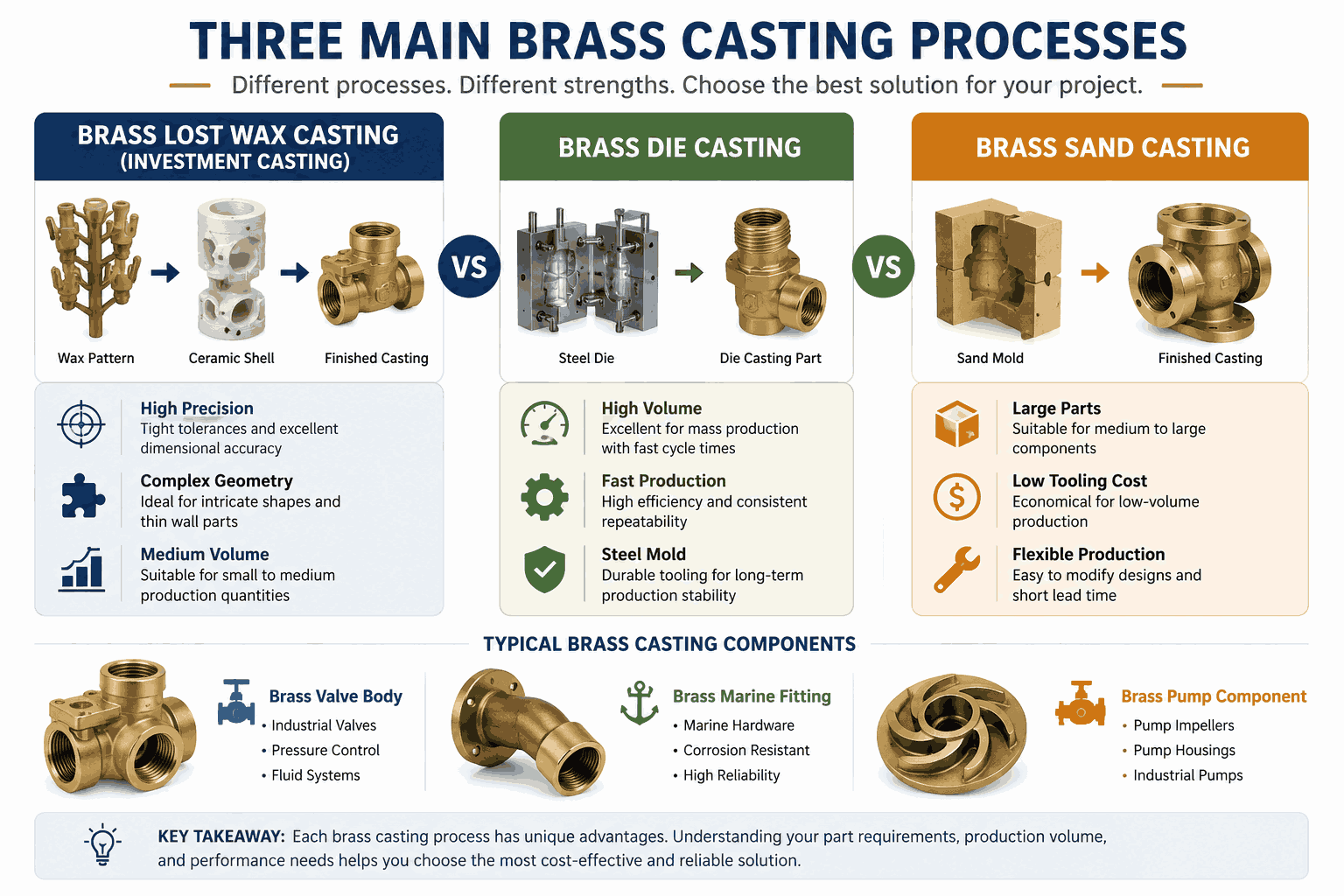
What Are the Three Main Brass Casting Processes?
Brass casting uses molten brass alloys to create metal components with specific shapes and properties. Depending on product requirements, manufacturers mainly use three casting methods: brass lost wax casting, brass die casting, and brass sand casting.
Each process has a different manufacturing principle and serves different industrial needs.
Brass Lost Wax Casting
Brass lost wax casting, also known as brass investment casting, is a precision casting method that uses a wax pattern and ceramic shell mold to produce complex brass components.
The process usually includes:
- Creating a wax model based on the part design
- Building a ceramic shell around the wax pattern
- Removing the wax through heating
- Pouring molten brass into the ceramic mold
- Removing the shell and finishing the casting
This method can produce parts with excellent surface finish, tight tolerances, and complex geometries that are difficult to achieve with other casting processes.
Advantages of Brass Lost Wax Casting:
- High dimensional accuracy
- Excellent surface finish
- Ability to produce complex shapes
- Reduced machining requirements
- Suitable for small and medium production quantities
Because of these advantages, brass lost wax casting is widely used for:
- Industrial valves
- Pump components
- Marine hardware
- Precision mechanical parts
- Petrochemical equipment components
For customers looking for the best custom brass casting solution with high accuracy and complex designs, investment casting is often the preferred choice.
Brass Die Casting
Brass die casting is a high-efficiency casting process that injects molten brass into a reusable steel mold under high pressure.
Unlike lost wax casting, which uses disposable molds, die casting uses permanent tooling. This allows manufacturers to produce large quantities of identical components quickly.
The basic process includes:
- Preparing a steel die mold
- Melting brass alloy
- Injecting molten brass into the mold under pressure
- Cooling and removing the finished part
- Performing secondary operations if required
Advantages of Brass Die Casting:
- Fast production cycles
- Excellent repeatability
- Lower cost per part in high-volume production
- Good dimensional consistency
Brass die casting is commonly used for:
- Plumbing fittings
- Electrical components
- Hardware products
- Automotive components
- Consumer products
However, die casting requires expensive tooling, making it less suitable for small-volume production or frequently changing designs.
Brass Sand Casting
Brass sand casting is one of the oldest and most flexible metal casting methods. It creates molds using bonded sand, allowing manufacturers to produce large and relatively simple brass components.
The process includes:
- Making a pattern
- Creating a sand mold
- Pouring molten brass into the mold
- Removing the casting after cooling
- Cleaning and machining the final part
Advantages of Brass Sand Casting:
- Low tooling investment
- Suitable for large components
- Flexible for low-volume production
- Easy design modification
Brass sand casting is often selected for:
- Large valve bodies
- Pump housings
- Marine components
- Replacement parts
- Heavy industrial equipment
For customers requiring customized brass casting with large dimensions or limited production quantities, sand casting provides a practical and economical option.
Brass Lost Wax Casting vs Die Casting vs Sand Casting: Key Differences
Although all three methods produce brass components, their performance characteristics are significantly different. Engineers and buyers should evaluate several factors before selecting a casting method, including accuracy, production volume, part complexity, and cost requirements.
The following table provides a quick comparison:
| Feature | Brass Lost Wax Casting | Brass Die Casting | Brass Sand Casting |
| Mold Type | Ceramic shell mold | Permanent steel mold | Sand mold |
| Accuracy | Excellent | Good | Moderate |
| Surface Finish | Excellent | Good | Fair |
| Design Complexity | Very high | Medium | Medium to high |
| Production Volume | Low to medium | High | Low to medium |
| Tooling Cost | Medium | High | Low |
| Part Size Capability | Small to medium | Small to medium | Medium to large |
| Machining Requirement | Low | Medium | Higher |
| Best Application | Precision components | Mass production | Large or low-volume parts |
Process Selection Based on Production Needs
The best brass casting method depends largely on production requirements.
For High Precision Components:
Choose brass lost wax casting when the project requires:
- Tight tolerances
- Complex internal structures
- Smooth surface finish
- Minimal machining
Examples include precision valves, marine fittings, and industrial components.
For High Volume Manufacturing:
Choose brass die casting when you need:
- Thousands or millions of identical parts
- Fast production cycles
- Lower unit costs
The higher tooling investment can be justified when production quantities are large.
For Large or Low-Volume Parts:
Choose brass sand casting when you need:
- Large component sizes
- Flexible production
- Lower initial investment
This process is especially useful for custom industrial parts and replacement components.
Accuracy, Surface Finish and Design Flexibility Comparison
When engineers select a brass casting process, dimensional accuracy, surface quality, and design freedom are often the most important technical considerations. Different casting methods create different results because they use different mold materials, forming pressures, and production controls.
Accuracy Comparison of Three Brass Casting Methods
Dimensional accuracy directly affects assembly performance, sealing reliability, and machining costs. A more accurate casting usually requires less secondary machining, which helps reduce total manufacturing costs.
| Casting Process | Typical Accuracy | Main Characteristics |
| Brass Lost Wax Casting | ±0.1–0.3 mm | Excellent precision for complex parts |
| Brass Die Casting | ±0.1–0.5 mm | Good repeatability for mass production |
| Brass Sand Casting | ±1–3 mm | Suitable for larger parts with looser tolerances |
Why Brass Lost Wax Casting Provides Higher Accuracy
Brass lost wax casting uses a ceramic shell mold that captures fine details from the original wax pattern. This allows manufacturers to produce complex shapes, thin walls, and precise features without excessive machining.
For components such as:
- brass valve bodies
- pump impellers
- marine connectors
- industrial fittings
lost wax casting can reduce machining requirements and improve overall product reliability.
Surface Finish Comparison
Surface finish affects not only appearance but also functional performance. Poor surface quality may increase friction, create leakage risks, or require additional finishing operations.
| Casting Process | Typical Surface Finish |
| Brass Lost Wax Casting | 3.2–6.3 μm Ra |
| Brass Die Casting | 3.2–12.5 μm Ra |
| Brass Sand Casting | 12.5–25 μm Ra |
Brass Lost Wax Casting
The ceramic shell mold provides a smooth casting surface. This makes it ideal for parts where appearance, sealing performance, or flow efficiency matters.
For example, brass valve components used in marine or chemical environments often require smooth surfaces to improve corrosion resistance and reduce fluid turbulence.
Brass Die Casting
Die casting provides good surface consistency because the molten brass fills a precision steel mold under pressure.
However, complex internal structures may be difficult to produce because molten metal flow depends on mold design and filling conditions.
Brass Sand Casting
Sand casting provides the greatest flexibility for large components but normally produces a rougher surface. Additional machining or finishing is often required to achieve tighter specifications.
Brass Casting Cost Comparison: Tooling, Production Volume and Part Cost
Cost is one of the most important factors when choosing a brass casting process. However, the lowest initial cost does not always mean the lowest total cost.
Engineers and purchasing managers should evaluate:
- tooling investment
- production quantity
- machining requirements
- material waste
- finishing costs
Brass Lost Wax Casting Cost Factors
Brass lost wax casting usually has a higher manufacturing cost compared with sand casting because the process involves multiple steps, including wax pattern production and ceramic shell preparation.
However, it can reduce total costs when:
- parts have complex geometry
- machining operations are expensive
- accuracy requirements are strict
- production volumes are small or medium
For precision industrial components, lost wax casting often provides better overall value because it minimizes secondary processing.
Brass Die Casting Cost Factors
Brass die casting requires significant upfront tooling investment because manufacturers need customized steel molds.
The advantages appear during mass production:
- faster cycle times
- lower labor cost per piece
- consistent quality
For large production runs, die casting usually provides the lowest unit cost.
However, it may not be economical for:
- prototypes
- small batches
- frequently changing designs
Brass Sand Casting Cost Factors
Brass sand casting has the lowest tooling cost because sand molds are inexpensive and easy to modify.
It is a good choice when:
- production quantity is limited
- parts are large
- design changes are expected
However, sand casting may require more machining, which can increase the final part cost.
Cost Comparison Table
| Cost Factor | Lost Wax Casting | Die Casting | Sand Casting |
| Initial Tooling Cost | Medium | High | Low |
| Unit Cost (Small Batch) | Medium | High | Low |
| Unit Cost (Large Batch) | Medium | Lowest | Medium |
| Machining Cost | Low | Medium | Higher |
| Design Change Cost | Medium | High | Lo |
Applications of Different Brass Casting Methods
Different industries select brass casting processes based on performance requirements, production volume, and operating conditions.
Brass Lost Wax Casting Applications
Brass lost wax casting is widely used in industries that require precision and reliability.
Common applications include:
Marine Industry
Marine components often face:
- saltwater corrosion
- continuous mechanical stress
- strict reliability requirements
Brass investment casting is commonly used for:
- marine valves
- connectors
- hardware components
Oil & Gas and Petrochemical Industry
Equipment used in oil and gas applications requires stable performance under demanding conditions.
Typical brass castings include:
- valve parts
- pressure control components
- flow control fittings
Industrial Machinery
Precision brass castings are used for:
- pump components
- mechanical assemblies
- customized equipment parts
Brass Die Casting Applications
Brass die casting is preferred for high-volume production.
Typical applications include:
- plumbing fittings
- electrical connectors
- automotive hardware
- decorative hardware
When manufacturers need thousands of identical components, die casting provides excellent production efficiency.
Brass Sand Casting Applications
Brass sand casting is suitable for larger and lower-volume components.
Common applications include:
- large valve bodies
- pump housings
- industrial equipment parts
- custom replacement components
It is especially useful when customers require customized brass casting solutions without expensive tooling investment.
How to Choose the Right Brass Casting Process for Your Project?
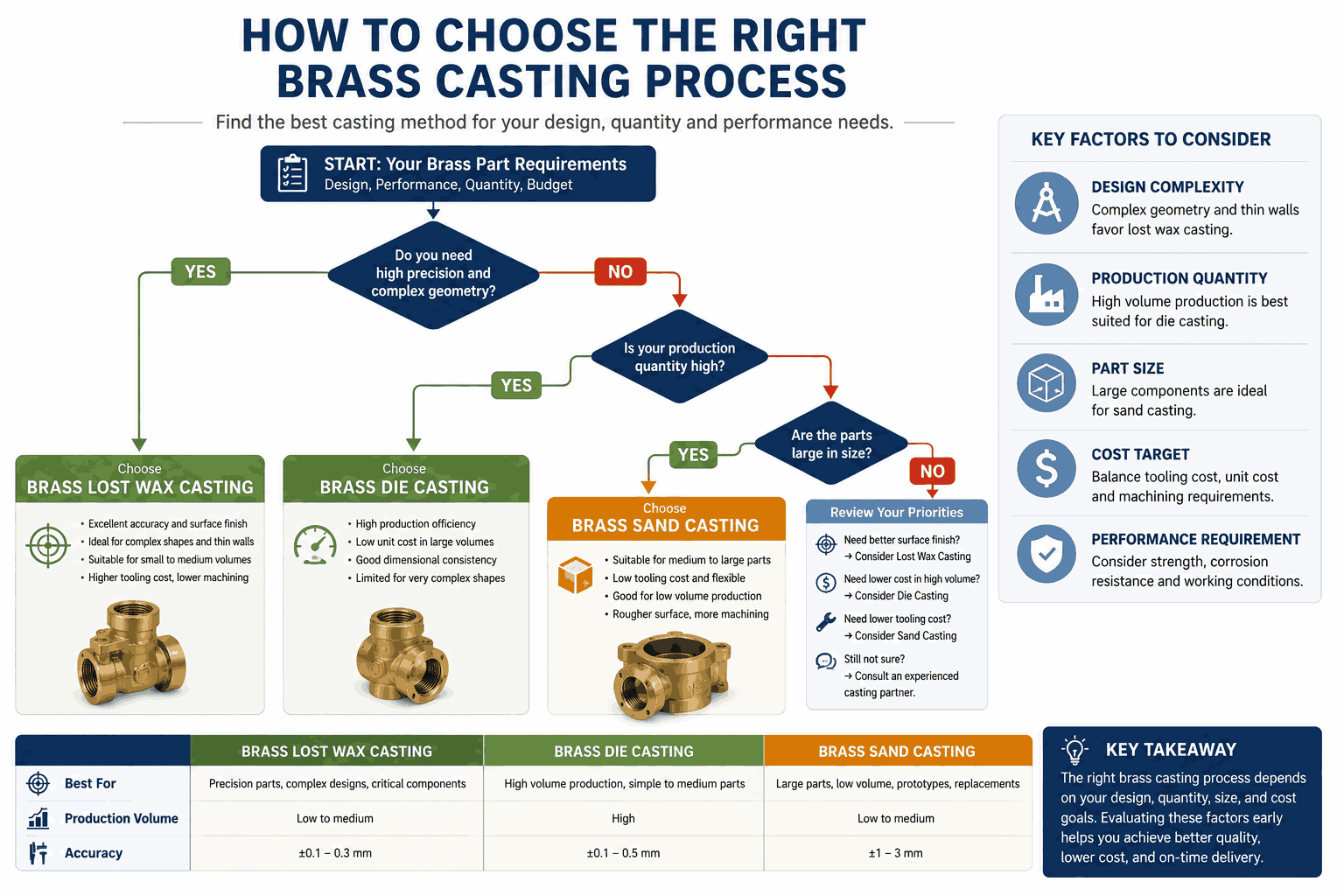
Selecting the right casting method requires balancing technical requirements and business goals.
Before choosing a supplier or process, engineers should evaluate the following factors.
Consider Part Geometry and Design Complexity
Complex parts with:
- thin walls
- internal passages
- detailed surfaces
usually benefit from brass lost wax casting.
Simple shapes with repeated designs may be better suited for die casting or sand casting.
Consider Production Quantity
Production volume strongly affects process selection.
| Production Quantity | Recommended Process |
| Prototype / Small Batch | Lost Wax Casting or Sand Casting |
| Medium Production | Lost Wax Casting |
| Large Production | Die Casting |
Consider Operating Environment
The application environment also affects material and process selection.
For example:
- Marine applications require corrosion resistance.
- Petrochemical components require reliability.
- Industrial machinery requires dimensional stability.
A professional casting supplier should help customers select suitable brass alloys and manufacturing processes.
Consider Supplier Capability
A qualified brass casting supplier should provide:
- casting process expertise
- material recommendations
- dimensional inspection
- CNC machining capability
- surface treatment services
Working with a supplier that provides complete manufacturing support can reduce project risks and shorten development time.
Frequently Asked Questions About Brass Casting Processes
Is Brass Lost Wax Casting Better Than Brass Die Casting?
Neither process is universally better. The right choice depends on application requirements.
Brass lost wax casting is better for:
- complex designs
- high precision
- small and medium production
Brass die casting is better for:
- high-volume manufacturing
- lower unit costs
- repeated production
Which Brass Casting Process Has the Lowest Cost?
The answer depends on production quantity.
For large-volume production, brass die casting usually offers the lowest unit cost.
For small quantities, brass sand casting often provides the lowest initial investment.
For precision components, brass lost wax casting may provide the best total value by reducing machining costs.
Which Brass Casting Method Is Best for Marine Parts?
For many marine applications, brass lost wax casting is preferred because it provides:
- excellent dimensional accuracy
- smooth surface finish
- complex geometry capability
However, large marine components may require brass sand casting depending on size and design.
Can Brass Castings Be Machined After Casting?
Yes. All three brass casting methods can be combined with CNC machining.
Machining is commonly used to achieve:
- tighter tolerances
- threaded holes
- sealing surfaces
- final dimensions
A supplier with both casting and machining capabilities can provide a complete manufacturing solution.
Why Choose JC Casting for Custom Brass Casting Solutions?
With more than 20 years of experience in precision casting, JC Casting provides reliable brass casting solutions for global industrial customers.
We support projects from initial design evaluation to final production.
Customized Brass Casting Solutions for Different Industries
We provide customized brass casting services for:
- valves
- pumps
- marine equipment
- industrial machinery
- petrochemical applications
Our engineers help customers select the most suitable casting process based on:
- part design
- production volume
- performance requirements
- cost targets
From Prototype Development to Mass Production
Whether you need a small batch of precision castings or large-scale production, JC Casting provides flexible manufacturing support.
Our goal is to help customers achieve reliable quality, competitive cost, and stable delivery.If you are looking for the best custom brass casting partner, JC Casting can help you select the right process and deliver reliable brass components from prototype to production.