
Brass die casting is widely used in industries that require strength, corrosion resistance, and stable dimensional accuracy. It is especially common in marine systems, valves, pumps, electrical fittings, and industrial hardware. For engineers and procurement teams, understanding how the process works—and how cost is formed—directly affects product reliability and project budget control.
This guide explains brass die casting from a practical manufacturing perspective, including process flow, cost structure, part types, and supplier selection criteria.
Why Brass Die Casting Is Still a Preferred Manufacturing Process
Manufacturers across marine, petrochemical, and mechanical industries still rank brass die casting as a top metal forming solution in 2026. Unlike sand casting, brass die casting delivers tight dimensional control, smooth surface finishes, and mass-production stability that modern industrial projects demand.
Engineers choose this process for two main reasons: excellent corrosion resistance and consistent brass tolerance die casting performance. Procurement teams prefer it because trusted foundries provide transparent brass die casting pricelist and flexible brass die casting quotes for both small prototypes and bulk orders. Even with new metal manufacturing technologies, OEM brass die casting remains irreplaceable for fluid systems, marine hardware, and electrical components.
What Is Brass Die Casting?
Brass die casting is a metal forming process where molten brass is injected into a steel mold under high pressure or gravity filling conditions. After cooling, the part is ejected and then finished through trimming or CNC machining.
Typical raw material:
- Brass ingots for die casting (Cu-Zn alloys with controlled composition)
Basic advantages:
- High repeatability in mass production
- Good surface finish directly from mold
- Suitable for complex geometries
This process is widely used for OEM brass die casting parts and industrial components requiring consistent tolerances.
Brass Die Casting Process
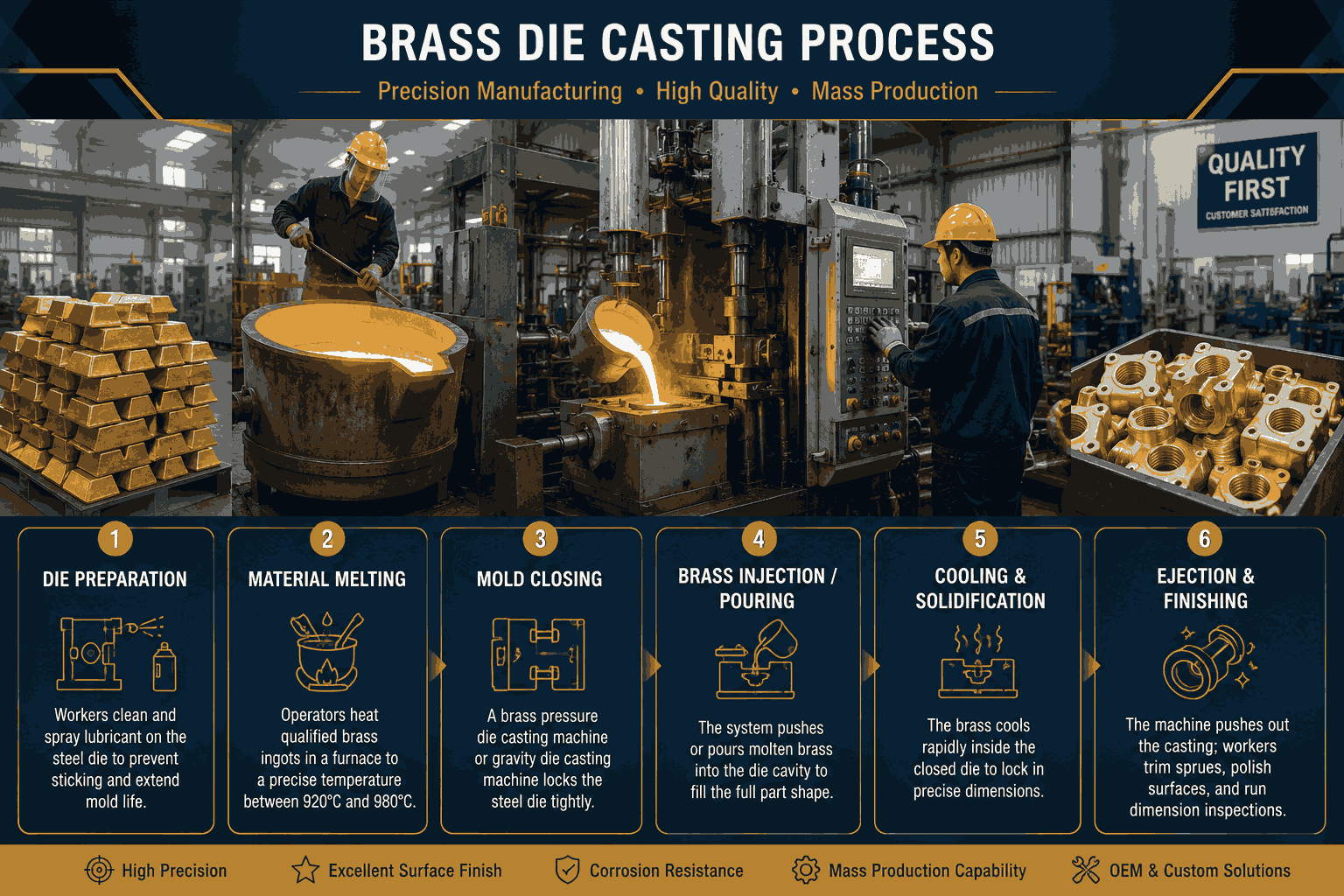
Professional foundries follow six standardized steps for all brass die casting projects, using fully active and repeatable operations:
Step 1:Die Preparation: Workers clean and spray lubricant on the steel die to prevent sticking and extend mold life.
Step 2: Material Melting: Operators heat qualified brass ingots in a furnace to a precise temperature between 920°C and 980°C.
Step 3:Mold Closing: A brass pressure die casting machine or gravity die casting machine locks the steel die tightly.
Step 4: Brass Injection/Pouring: The system pushes or pours molten brass into the die cavity to fill the full part shape.
Step 5:Cooling & Solidification: The brass cools rapidly inside the closed die to lock in precise dimensions.
Step 6: Ejection & Finishing: The machine pushes out the casting; workers trim sprues, polish surfaces, and run dimension inspections.
For long-batch production, factories apply continuous brass die casting to cut downtime and boost daily output by up to 35%.
What Is the Difference Between Gravity and Pressure Die Casting?
Brass gravity die casting and brass pressure die casting are the two mainstream process types. The table below shows key differences for engineers and buyers to select the right solution quickly:
| Feature | Brass Gravity Die Casting | Brass Pressure Die Casting |
| Filling Force | Relies on natural gravity flow | Uses high mechanical pressure |
| Dimensional Tolerance | Standard (CT7-CT9) | Precision (CT4-CT6, tight brass tolerance die casting) |
| Production Speed | Slow, for low-medium volume | Fast, for high-volume mass production |
| Machine Cost | Lower (brass gravity die casting machine) | Higher (brass pressure die casting machine) |
| Best Use Case | Large parts, small batch OEM orders | Small precise parts, wholesale brass die casting runs |
Use gravity die casting for heavy valve bodies; choose pressure die casting for tiny precision components like medieval cast brass signet ring casting and miniature mechanical fittings.
Advantages of Brass Die Casting
1. High dimensional accuracy
Typical tolerance range:
- ±0.05 mm to ±0.20 mm (depends on geometry)
This makes brass tolerance die casting suitable for precision assemblies.
2. Strong mechanical performance
Brass performs well under:
- Pressure systems
- Vibration environments
- Wear contact surfaces
3. Corrosion resistance
Especially important in:
- Marine environments
- Chemical processing systems
4. High production efficiency
Once tooling is ready, unit cost drops significantly in mass production.
5. Good surface finish
Reduces secondary polishing cost.
Common Brass Die Casting Parts
Brass die casting is used across multiple industrial categories.
Valve and fluid systems
- Valve bodies
- Fittings
- Connectors
Pump systems
- Pump housings
- Impellers
Electrical and lighting
- Brass die casting LED street light housing
- Electrical connectors
Industrial hardware
- Brass tube die casting parts
- Brass die casting machine parts
Precision small components
- Tiny brass die casting components for instrumentation
What Affects Brass Die Casting Cost?
Many factors change your final brass die casting quotes and die casting brass pricelist. Buyers must master these points to get the best brass die casting pricelist:
- Raw Material Price: Global copper and zinc prices directly affect brass ingot cost, the largest portion of total expense.
- Part Complexity & Tolerance: Tighter brass tolerance die casting requires precise machines and more inspection steps, raising cost.
- Production Volume: Larger orders reduce die setup amortization, so you get the best brass die casting quotes for bulk OEM projects.
- Process Selection: Pressure die casting has higher mold costs than gravity die casting.
- Post-Processing: Polishing, plating, CNC machining, and NDT testing add extra fees to the base price.
- Equipment Configuration: Custom oem brass die casting machine or special brass die casting machine parts maintenance increases project cost.
How to Choose the Best Brass Die Casting Supplier
Selecting the right supplier has direct impact on product performance and delivery stability.
Key evaluation criteria:
- In-house mold design capability
- CNC machining integration
- Material traceability system
- Dimensional inspection (CMM)
- Pressure testing capability
- Experience in OEM brass die casting
- Stable mass production capability
A reliable supplier should support both prototyping and high-volume wholesale brass die casting production.
Engineering teams often compare multiple suppliers to identify the best brass die casting partner based on quality consistency and cost transparency.
Why Work with JC Casting for Brass Die Casting
JC Casting holds over 10 years of professional experience in brass die casting production, serving global mechanical, marine, and petrochemical clients. We stand out from ordinary suppliers for clear reasons:
- Professional Alloy Control: We use certified brass ingots for die casting and stabilize brass tolerance die casting within CT5-CT7 for precision projects.
- Full Process Capacity: We run gravity, pressure, and continuous brass die casting lines, plus complete oem brass die casting customization services.
- Transparent Pricing: We provide detailed brass die casting quotes and itemized best brass die casting pricelist with zero hidden charges for procurement teams.
- Wide Application Support: We produce standarddie casting brass parts, brass die casting led street light housing, and niche medieval cast brass signet ring casting crafts.
- Stable Delivery & Service: Our in-house brass die casting machine parts inventory reduces downtime, and our engineering team optimizes your design to cut production cost.
If you need reliable oem brass die casting solutions or accurate project quotes, contact JC Casting today to get your customized brass die casting quotes.