
Deciding between brass and aluminum casting is a pretty common headache for engineers, designers, and buyers. If you pick the wrong one, it’s not just about higher costs or a shorter lifespan. You could end up with a product that just doesn’t perform well, or worse, have it fail completely when it’s pushed to the limit.
Although both materials are widely used in industrial casting, they have significant differences in strength, weight, corrosion resistance, thermal performance, machining, and overall cost.
In this guide, we compare brass vs aluminum casting from an engineering and manufacturing perspective, helping you understand the advantages, limitations, applications, and key factors to consider when selecting the right casting material for your project.
What Is Brass Casting?
Brass casting is a metal casting process that uses brass alloys as the casting material. Brass is mainly composed of copper and zinc, with additional elements such as lead, aluminum, iron, or manganese added to improve specific properties.
Common brass alloys used in casting include:
- C83600 Brass
- C84400 Brass
- C85800 Brass
- Silicon Brass
- Aluminum Brass
Depending on part requirements, manufacturers use different casting methods, including:
- Investment casting (lost wax casting)
- Sand casting
- Gravity casting
- Die casting
Brass casting is widely selected for components that require high strength, corrosion resistance, and reliable performance under harsh conditions.
Typical brass casting applications include:
- Valve bodies and valve components
- Pump housings and impellers
- Marine hardware
- Pipe fittings
- Electrical connectors
- Industrial machinery parts
One of the biggest advantages of brass is its excellent balance between mechanical performance and corrosion resistance. This makes brass a preferred choice for applications exposed to water, chemicals, pressure, or continuous mechanical wear.
For example, in marine and petrochemical industries, brass components often provide longer service life compared with many lightweight alternatives because they can withstand demanding operating environments.
What Is Aluminum Casting?
Aluminum casting is a manufacturing process that produces metal parts by pouring molten aluminum alloy into a mold. Aluminum alloys are popular because they combine low density, good strength-to-weight ratio, and excellent thermal performance.
Common aluminum casting alloys include:
- A356 Aluminum
- AlSi10Mg
- ADC12 Aluminum
- LM6 Aluminum
Common aluminum casting processes include:
- Die casting
- Sand casting
- Gravity casting
- Investment casting
Compared with brass, aluminum is much lighter. Its density is approximately one-third of brass, making it an ideal material for industries where weight reduction is important.
Typical aluminum casting applications include:
- Automotive components
- Motor housings
- Gearbox covers
- Heat sinks
- Aerospace parts
- Electronic equipment housings
- Machinery brackets
The main advantage of aluminum casting is efficiency. It allows manufacturers to produce large and complex components while keeping overall product weight and material costs lower.
For industries such as automotive and aerospace, where reducing weight can improve energy efficiency and performance, aluminum casting has become an essential manufacturing solution.
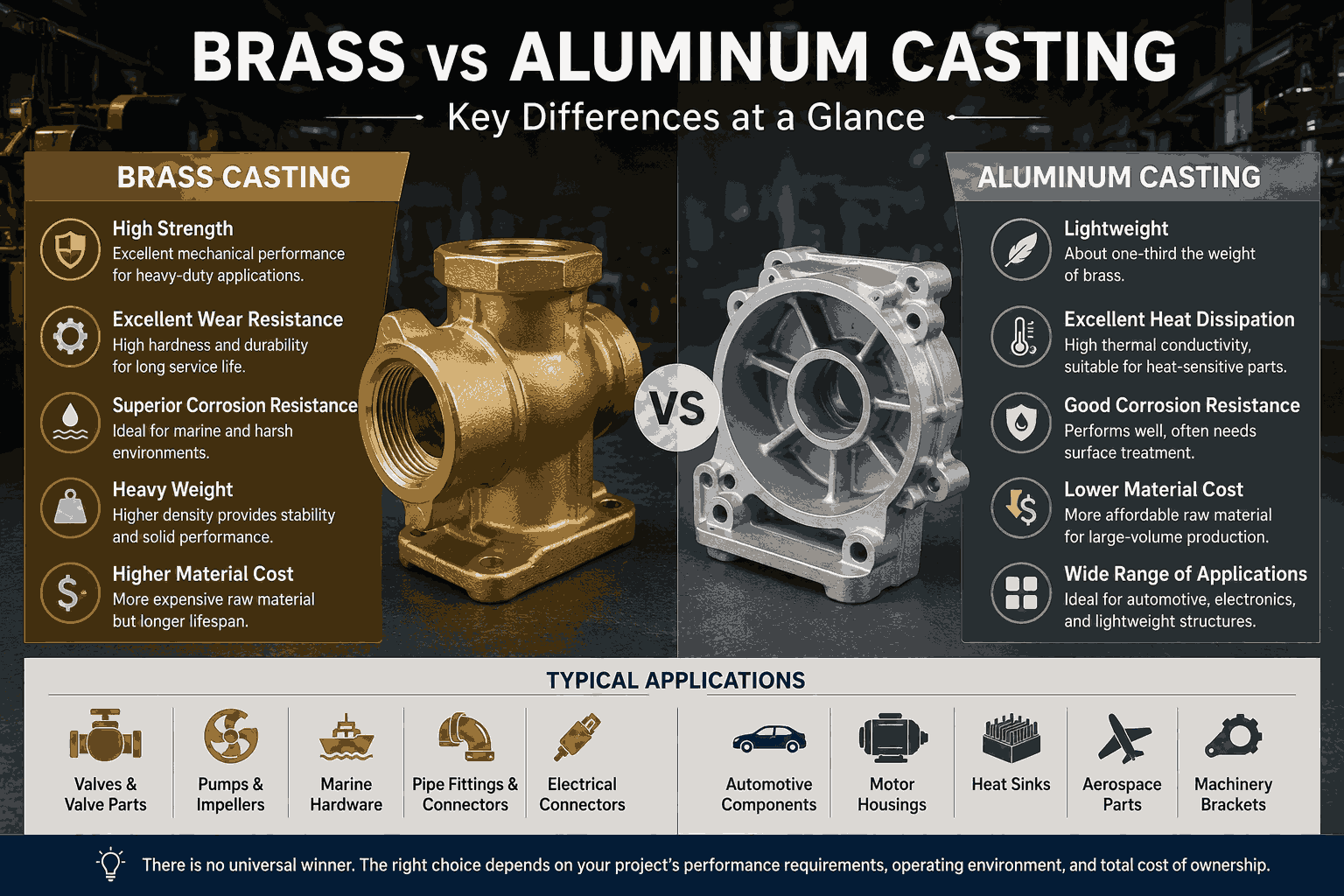
Brass vs Aluminum Casting: Key Differences at a Glance
Brass and aluminum both have strong advantages, but their performance characteristics are different. The following table provides a quick comparison of the two materials.
| Property | Brass Casting | Aluminum Casting |
| Main Elements | Copper + Zinc | Aluminum + Silicon/Magnesium |
| Density | Higher (around 8.4–8.7 g/cm³) | Lower (around 2.6–2.8 g/cm³) |
| Weight | Heavier | Much lighter |
| Strength | Higher mechanical strength | Good strength-to-weight ratio |
| Hardness | Higher hardness and wear resistance | Lower hardness |
| Corrosion Resistance | Excellent, especially in marine environments | Good but often requires surface protection |
| Thermal Conductivity | Moderate | Higher |
| Electrical Conductivity | Higher than many aluminum alloys | Good but alloy dependent |
| Machinability | Excellent machinability | Easy machining with high cutting speed |
| Wear Resistance | Excellent | Moderate |
| Casting Fluidity | Good casting performance | Excellent for many aluminum alloys |
| Surface Finish | Smooth and attractive appearance | Good surface finish |
| Material Cost | Higher | Lower |
| Weight Advantage | Limited | Excellent |
| Typical Applications | Valves, marine parts, fittings, pumps | Automotive, electronics, lightweight structures |
From this comparison, it is clear that there is no universal winner between brass and aluminum casting.
Brass is generally preferred when the priority is:
- Higher strength
- Better wear resistance
- Long-term corrosion protection
- Heavy-duty industrial performance
Aluminum is usually preferred when the priority is:
- Lightweight design
- Lower material cost
- Heat dissipation
- Large-volume production
The final material choice should always consider the complete operating environment rather than only the material price.
Brass vs Aluminum Casting: A Detailed Comparison
After understanding the basic differences between brass casting and aluminum casting, engineers need to evaluate more specific performance factors before selecting a material.
In real manufacturing projects, material selection is rarely based on only one factor. Strength, weight, corrosion resistance, machining requirements, production cost, and service environment all influence the final decision.
The following sections provide a detailed comparison of brass vs aluminum casting from an engineering and manufacturing perspective.
Mechanical Properties Comparison
Mechanical performance is one of the most important factors when selecting a casting material.
Brass generally provides higher strength, hardness, and wear resistance compared with aluminum alloys. This makes brass suitable for components that experience pressure, friction, impact, or continuous operation.
Aluminum, however, offers an excellent strength-to-weight ratio. Although aluminum is softer than brass, its lightweight advantage makes it valuable in applications where reducing overall system weight is important.
| Mechanical Property | Brass Casting | Aluminum Casting |
| Tensile Strength | Higher, typically 300–600 MPa depending on alloy | Moderate, typically 150–350 MPa depending on alloy |
| Hardness | Higher hardness and wear resistance | Lower hardness |
| Impact Resistance | Excellent | Good |
| Fatigue Resistance | Good for heavy-duty applications | Good when properly designed |
| Strength-to-Weight Ratio | Moderate | Excellent |
When to Choose Brass Casting
Brass is often the better choice when parts need to handle:
- High mechanical loads
- Repeated friction
- Pressure-containing applications
- Long service cycles
- Harsh industrial environments
Examples include:
- Valve bodies
- Pump components
- Marine fittings
- Industrial connectors
When to Choose Aluminum Casting
Aluminum is preferred when designers focus on:
- Reducing component weight
- Improving energy efficiency
- Simplifying transportation
- Increasing production efficiency
Examples include:
- Automotive housings
- Motor covers
- Aerospace structures
- Electronic enclosures
Weight and Density Comparison
Weight is one of the biggest differences between brass and aluminum casting.
The density of brass is approximately three times higher than aluminum:
- Brass density: about 8.4–8.7 g/cm³
- Aluminum density: about 2.6–2.8 g/cm³
This means an aluminum component with the same volume can weigh significantly less than a brass component.
| Factor | Brass Casting | Aluminum Casting |
| Density | High | Low |
| Component Weight | Heavier | Lightweight |
| Transportation Cost | Higher | Lower |
| Installation Convenience | Moderate | Excellent |
| Lightweight Design | Limited | Excellent |
For industries such as automotive, aerospace, and robotics, weight reduction can directly improve:
- Fuel efficiency
- Energy consumption
- Product mobility
- Operating performance
This is why aluminum casting has become increasingly popular in lightweight engineering applications.
However, lower weight does not always mean better performance.
For example, valve components used in marine or chemical systems often require higher density and strength to maintain pressure resistance and durability. In these cases, brass casting may provide better long-term value.
Corrosion Resistance Comparison
Corrosion resistance is a critical consideration for components exposed to moisture, chemicals, salt water, or outdoor environments.
Brass has excellent corrosion resistance because copper-based alloys naturally form a protective surface layer that helps prevent further corrosion.
This makes brass especially suitable for:
- Marine equipment
- Plumbing systems
- Water valves
- Chemical processing equipment
Aluminum also has good corrosion resistance because it forms a thin oxide layer on the surface. However, this protection can be affected in certain environments, especially:
- Saltwater exposure
- Acidic environments
- High-contact wear conditions
| Environment | Brass Casting | Aluminum Casting |
| Fresh Water | Excellent | Good |
| Marine Environment | Excellent | Requires protection in many cases |
| Salt Spray | Very Good | Moderate to Good |
| Chemical Exposure | Alloy dependent | Alloy and coating dependent |
| Outdoor Use | Excellent | Good with surface treatment |
For marine and offshore applications, brass is often selected because it provides reliable corrosion resistance without additional coating requirements.
For aluminum components, manufacturers often apply additional surface treatments such as:
- Anodizing
- Powder coating
- Painting
- Conversion coating
to improve corrosion protection.
Thermal and Electrical Conductivity Comparison
Both brass and aluminum have good conductivity, but their performance characteristics differ.
Aluminum has excellent thermal conductivity and is widely used where heat dissipation is important.
Common applications include:
- Heat sinks
- Motor housings
- Electronic equipment
- Cooling components
Brass has better electrical conductivity than many engineering metals and provides excellent durability for electrical components.
| Property | Brass Casting | Aluminum Casting |
| Thermal Conductivity | Moderate | Excellent |
| Heat Dissipation | Good | Excellent |
| Electrical Conductivity | Very Good | Good |
| High Temperature Stability | Good | Moderate to Good |
Aluminum Advantages in Thermal Applications
Because aluminum transfers heat efficiently while remaining lightweight, it is widely used in:
- LED housings
- Battery components
- Automotive cooling systems
- Electronic enclosures
Brass Advantages in Electrical Applications
Brass is commonly used for:
- Electrical terminals
- Connectors
- Switch components
- Conductive fittings
because it combines conductivity with excellent mechanical strength and wear resistance.
Machinability and Casting Performance Comparison
Machinability and casting performance directly affect manufacturing efficiency and production cost.
Both brass and aluminum are considered easy-to-machine materials, but they behave differently during manufacturing.
Brass Machining Performance
Brass is known as one of the most machinable metal alloys.
Advantages include:
- Excellent chip formation
- Lower cutting resistance
- Reduced tool wear
- Smooth surface finish
This makes brass ideal for precision components requiring tight tolerances.
Typical examples:
- Valve parts
- Precision fittings
- Threaded components
Aluminum Machining Performance
Aluminum is also highly machinable and allows:
- Higher cutting speeds
- Faster production cycles
- Lower machining forces
This makes aluminum suitable for high-volume manufacturing.
However, aluminum can have challenges such as:
- Material deformation
- Tool adhesion
- Surface scratching
if machining parameters are not properly controlled.
Casting Performance Comparison
| Factor | Brass Casting | Aluminum Casting |
| Casting Fluidity | Good | Excellent |
| Thin Wall Casting | Moderate | Excellent |
| Complex Geometry | Good | Excellent |
| Porosity Control | Important | Important |
| Surface Finish | Excellent | Good to Excellent |
| Dimensional Accuracy | High | High |
Aluminum generally performs better for lightweight complex shapes and high-volume production.
Brass performs better when the final component requires durability, precision, and long service life.
Brass vs Aluminum Casting Cost Comparison
Cost is often one of the first factors considered by purchasing teams. However, the lowest material price does not always mean the lowest total manufacturing cost.
The final cost depends on:
- Raw material price
- Casting process
- Part complexity
- Machining requirements
- Surface treatment
- Production volume
| Cost Factor | Brass Casting | Aluminum Casting |
| Raw Material Cost | Higher | Lower |
| Casting Cost | Moderate | Lower for high volume |
| Machining Cost | Competitive | Competitive |
| Surface Treatment Cost | Usually lower | May require coating |
| Transportation Cost | Higher | Lower |
| Long-Term Durability | Excellent | Good |
Brass Casting Cost Considerations
Although brass has a higher material cost, it can reduce lifecycle expenses because of:
- Longer service life
- Better wear resistance
- Lower replacement frequency
For critical industrial components, the initial investment may provide better long-term value.
Aluminum Casting Cost Considerations
Aluminum is often selected for cost-sensitive projects because:
- Material price is lower
- Weight reduces logistics costs
- High production efficiency lowers unit cost
For automotive, consumer products, and large-volume applications, aluminum casting is often the more economical choice.
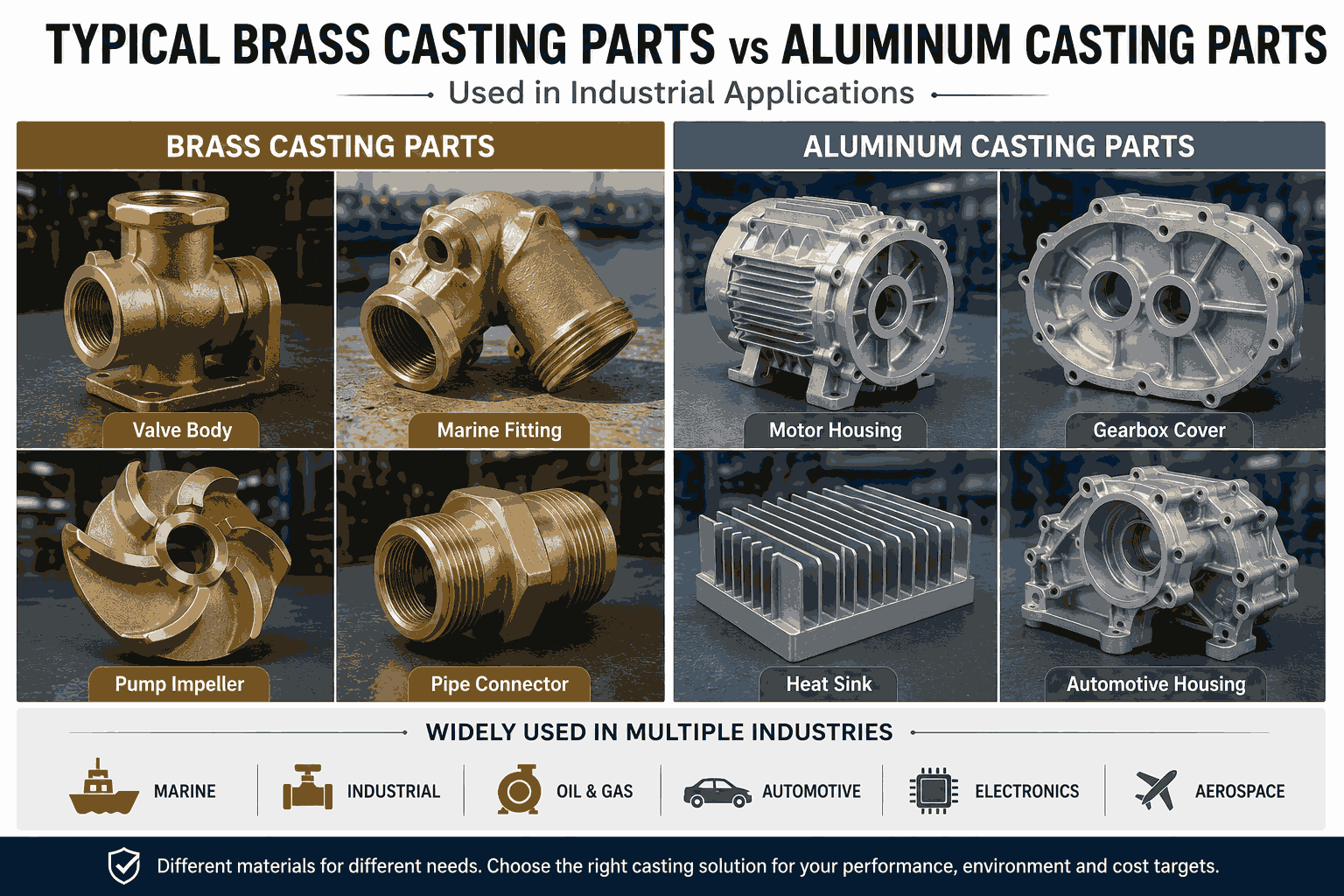
Brass vs Aluminum Casting: Advantages and Disadvantages
Both brass casting and aluminum casting offer unique advantages. The right choice depends on the performance requirements, operating environment, and production goals of the final component.
Understanding the strengths and limitations of each material helps engineers avoid unnecessary costs and select the most suitable casting solution.
Advantages and Disadvantages of Brass Casting
Brass casting has been widely used in industrial applications for decades because of its excellent combination of strength, corrosion resistance, and durability.
Advantages of Brass Casting
| Advantage | Description |
| High Mechanical Strength | Brass provides excellent strength for pressure-bearing and heavy-duty components. |
| Excellent Corrosion Resistance | Brass performs well in water, marine, and industrial environments. |
| Superior Wear Resistance | High hardness makes brass suitable for moving and friction-related parts. |
| Excellent Machinability | Brass is easy to machine and achieves precise dimensions with smooth finishes. |
| Long Service Life | Brass components often maintain reliable performance for many years. |
| Attractive Appearance | The golden surface appearance is suitable for decorative and visible components. |
Disadvantages of Brass Casting
| Disadvantage | Description |
| Higher Material Cost | Copper-based alloys generally cost more than aluminum alloys. |
| Higher Density | Brass parts are heavier, which may limit lightweight applications. |
| Higher Transportation Cost | Increased weight can increase logistics expenses. |
| Lower Heat Dissipation Compared with Aluminum | Brass is not the first choice for applications requiring maximum thermal performance. |
Brass casting is usually the better choice when reliability and durability are more important than weight reduction or initial material cost.
Advantages and Disadvantages of Aluminum Casting
Aluminum casting has become increasingly popular because industries continue to focus on lightweight design and manufacturing efficiency.
Advantages of Aluminum Casting
| Advantage | Description |
| Lightweight Design | Aluminum is approximately one-third the weight of brass. |
| Excellent Strength-to-Weight Ratio | Provides good mechanical performance with reduced weight. |
| Lower Material Cost | Aluminum is generally more economical than brass. |
| Excellent Thermal Conductivity | Ideal for heat dissipation applications. |
| Good Casting Performance | Aluminum alloys are suitable for complex and large-volume castings. |
| Easy Transportation | Lower weight reduces shipping and handling costs. |
Disadvantages of Aluminum Casting
| Disadvantage | Description |
| Lower Wear Resistance | Aluminum is softer and may wear faster under friction. |
| Lower Strength Than Brass | Some applications require stronger materials. |
| Surface Protection May Be Needed | Certain environments require anodizing or coating. |
| Lower Corrosion Resistance in Harsh Conditions | Saltwater and chemical environments may require additional protection. |
Aluminum casting is usually the preferred solution when weight reduction, production efficiency, and cost control are the main priorities.
Common Applications of Brass and Aluminum Castings
The best casting material depends heavily on the industry and operating conditions.
Common Brass Casting Applications
Brass casting is widely used in industries requiring durability, corrosion resistance, and reliable mechanical performance.
Valve and Fluid Control Components
Brass is commonly used for:
- Valve bodies
- Valve covers
- Pipe fittings
- Pressure components
because it provides excellent sealing performance and corrosion resistance in water and fluid systems.
Marine Applications
Marine environments create serious corrosion challenges. Brass casting is commonly selected for:
- Marine fittings
- Pump components
- Ship hardware
- Underwater equipment parts
because copper-based alloys perform well in saltwater conditions.
Pump and Industrial Equipment
Brass components are often found in:
- Pump housings
- Impellers
- Bushings
- Precision mechanical parts
where wear resistance and long operating life are important.
Common Aluminum Casting Applications
Aluminum casting is widely used in industries where reducing weight and improving efficiency are key goals.
Automotive Components
Typical aluminum castings include:
- Engine housings
- Transmission cases
- Motor covers
- Structural brackets
Lightweight aluminum components help improve vehicle efficiency and reduce energy consumption.
Electronics and Heat Management
Aluminum is commonly used for:
- Heat sinks
- Electronic enclosures
- Cooling components
because of its excellent thermal conductivity.
Machinery and Industrial Equipment
Applications include:
- Gearbox housings
- Machine frames
- Protective covers
- Lightweight brackets
How to Choose Between Brass and Aluminum Casting
There is no single “best” material between brass and aluminum casting. The correct choice depends on your product requirements.
The following guide can help engineers and buyers make a faster decision.
| Project Requirement | Recommended Material |
| Lowest component weight | Aluminum Casting |
| Highest mechanical strength | Brass Casting |
| Excellent wear resistance | Brass Casting |
| Marine applications | Brass Casting |
| Better heat dissipation | Aluminum Casting |
| Lower material cost | Aluminum Casting |
| High-volume production | Aluminum Casting |
| Precision mechanical components | Brass Casting |
| Decorative appearance | Brass Casting |
| Lightweight structural parts | Aluminum Casting |
Before selecting a material, consider these questions:
1. What Environment Will the Part Work In?
For seawater, chemicals, and harsh outdoor environments, brass may provide better long-term performance.
For dry environments where weight matters, aluminum may be more suitable.
2. Does Weight Matter?
If reducing weight improves product performance, aluminum is usually the better option.
If weight is less important than durability, brass may be preferred.
3. What Is the Total Lifecycle Cost?
A cheaper material does not always mean lower total cost.
A brass component may have a higher initial price but require fewer replacements over its service life.
An aluminum component may reduce manufacturing and transportation costs in large-volume production.
Why Choose JC Casting for Brass and Aluminum Casting Projects
Selecting the right casting material is only one part of successful manufacturing. The casting supplier also plays an important role in product quality, consistency, and delivery reliability.
With more than 20 years of precision casting experience, JC Casting provides customized metal casting and machining solutions for global industrial customers.
Our manufacturing capabilities include:
- Brass casting
- Aluminum casting
- Stainless steel casting
- Investment casting
- Sand casting
- Die casting
- CNC machining
- Surface finishing
- Heat treatment
Our experience covers industries including:
- Valve and pump manufacturing
- Marine equipment
- Oil and gas
- Petrochemical
- Food machinery
- Industrial automation
- Automotive components
For engineers and purchasing teams looking for a reliable casting partner, working with an experienced manufacturer can reduce development risks and improve product performance.